


TL;DR: Fiverr has 700,000 fewer customers than it did a year ago, and makes more money from the ones who stayed. Its CEO says AI is taking the cheap, simple jobs. Those were the jobs beginners built a reputation on, and companies are cutting their own junior roles in the same year. If you plan to hire experienced freelancers in 2031, somebody has to be paying beginners to practice today, and the list of people willing to do that is getting short.
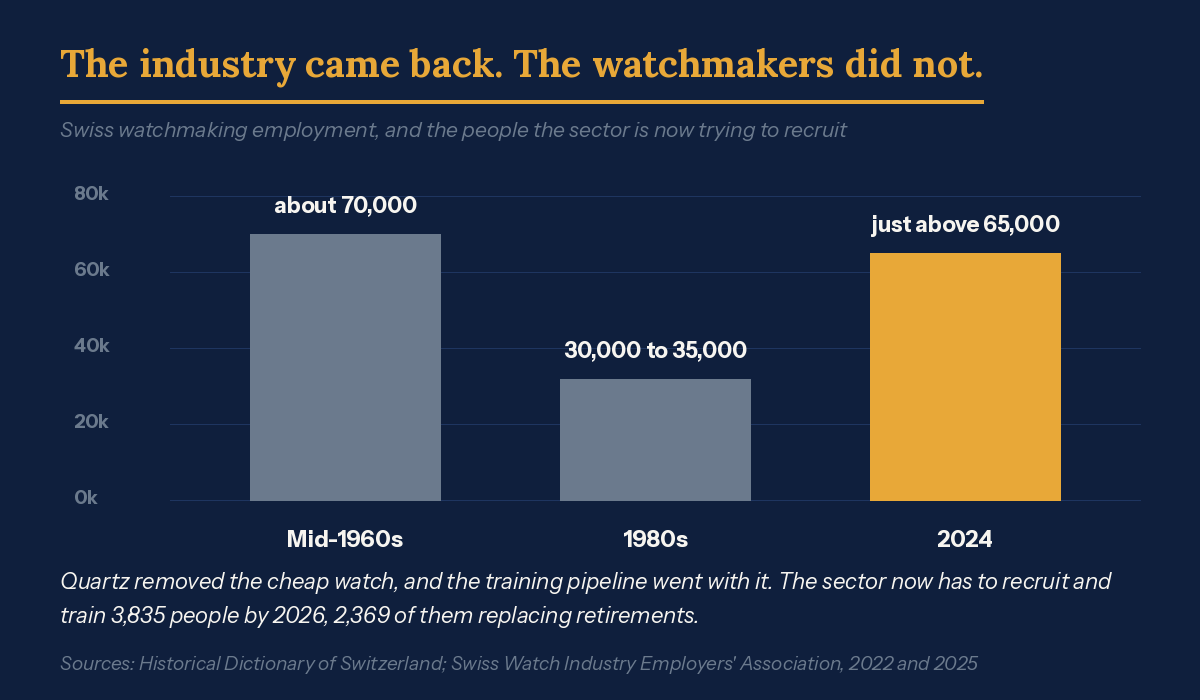
Seiko put the first quartz wristwatch on sale in Tokyo on Christmas Day 1969, and within fifteen years it had taken apart the thing Switzerland did best. A quartz watch runs on a battery and a vibrating crystal. A mechanical watch runs on a wound spring and a few hundred small parts that a trained person fits together by hand. Quartz kept better time, cost a fraction, and needed no craftsman. Swiss watchmaking employment fell from roughly 70,000 in the mid-1960s to between 30,000 and 35,000 in the 1980s, according to the Historical Dictionary of Switzerland.
Then the comeback everybody cites. The mechanical watch returned as a luxury object, the Swiss rebuilt around craft, and employment is just above 65,000 today.
The watchmakers did not come back with it. The Swiss Watch Industry Employers’ Association counted 3,835 people the sector had to train or recruit by 2026, 2,369 of them replacing workers heading into retirement. Rolex runs its own training center. Swatch runs its own schools. The ordinary path into the trade, which produced watchmakers as a byproduct of making ordinary watches, closed the moment Switzerland stopped making them. A trade can lose the way it trains people and not notice for thirty years, because everyone trained before the collapse is still working.
I started collecting watches recently. One of my first was a Seiko Presage Cocktail Time, a mechanical watch with a dial made to catch light the way a drink does. It winds itself from the motion of your wrist, costs a few hundred dollars, and is built by Seiko, the company whose quartz watch nearly ended mechanical watchmaking. Somebody still has to know how to put it together.
AI is now doing to the cheap freelance job roughly what quartz did to the cheap watch. Fiverr’s last quarter is the first clean reading of it.
Fewer buyers, bigger jobs
Fiverr runs an online marketplace for freelance work. A business or individual buys a defined job at a set price, a freelancer somewhere in the world delivers it, and Fiverr keeps a cut. Fiverr calls the customers buyers and the freelancers sellers.
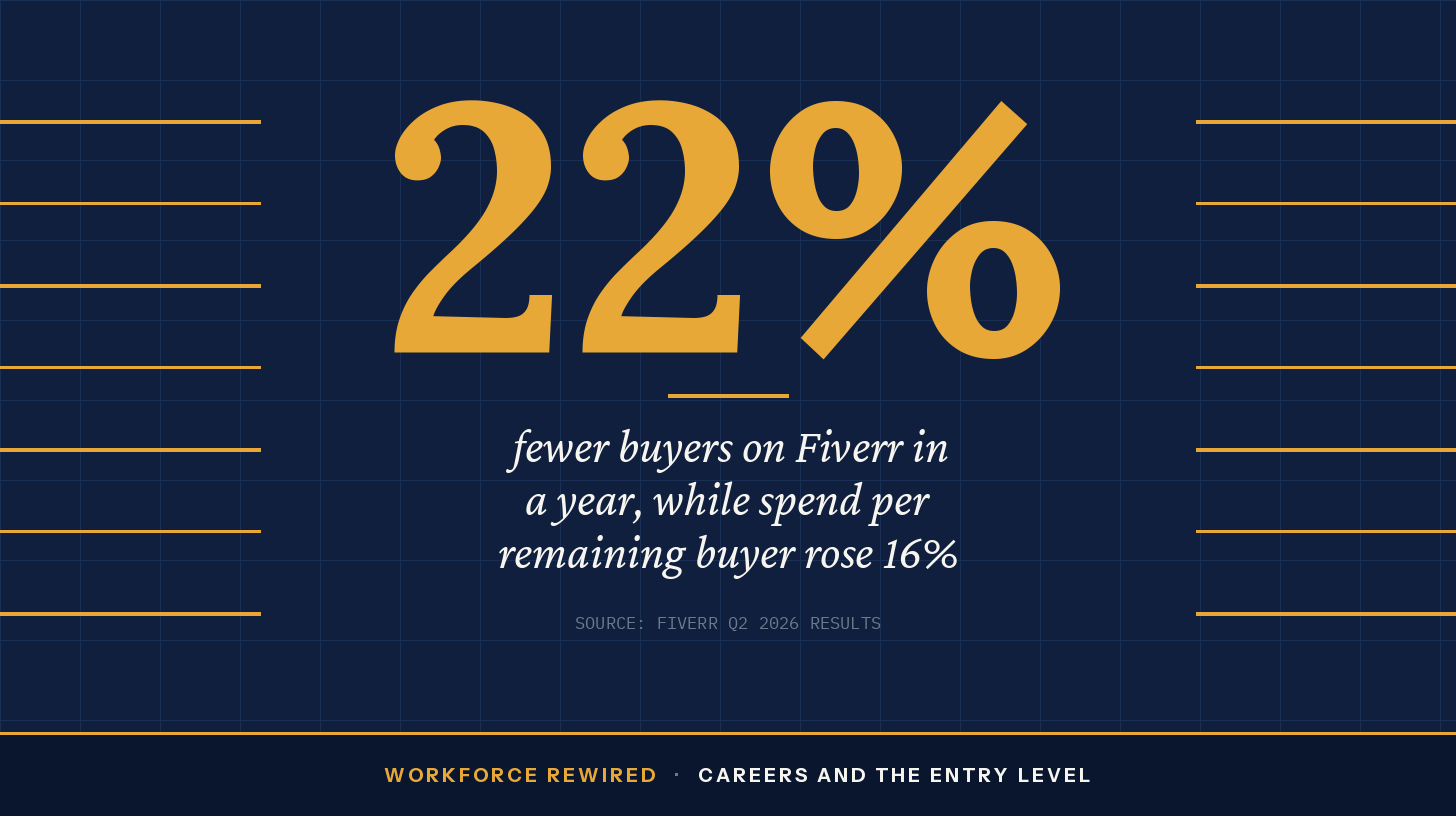
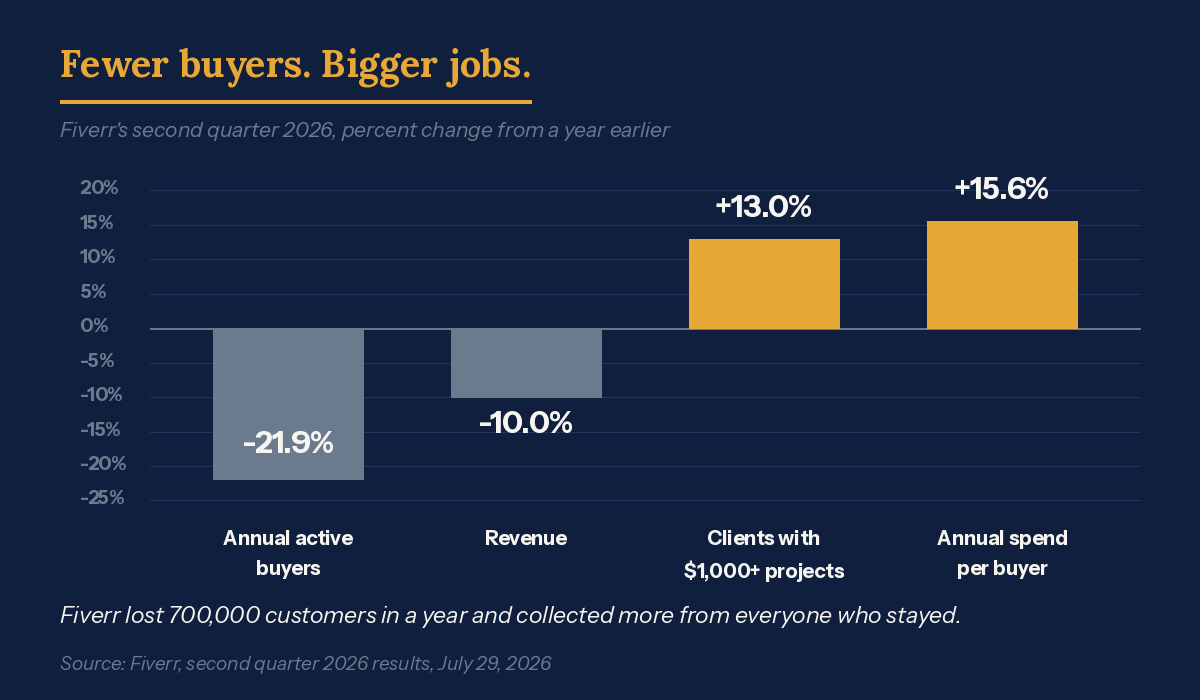
Fiverr’s second quarter reads like a company in trouble until you get to the second line. Revenue fell 10 percent to $97.8 million. The number of customers who bought anything in the past year fell almost 22 percent, from 3.4 million to 2.7 million, or 700,000 people gone. Then the turn. The average customer spent 15.6 percent more, $368 across the year, and customers buying projects worth $1,000 or more grew 13 percent.
Fewer customers, bigger jobs, more money from everyone who stayed.
Fiverr’s CEO, Micha Kaufman, gave the reason in six words: “AI absorbs high-volume, low-value, transactional tasks.” Transactional work means the small, repeatable jobs: the logo, the translation, the cleanup. On the earnings call his CFO, Esti Levy Dadon, said the expensive part out loud. That work, she told analysts, “currently represents the majority of our marketplace.” Fiverr then cut its forecast for the year to a decline of 14 to 17 percent. A marketplace has no HR department to protect and no reason to soften a number.
Two prices in the same market
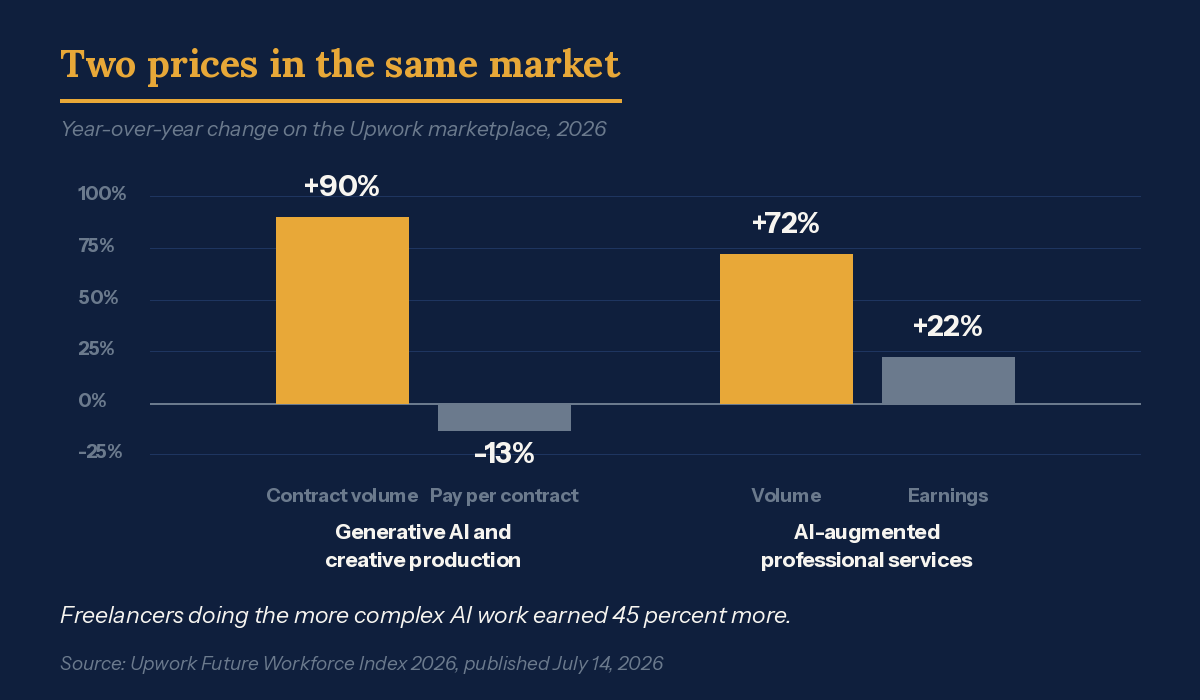
Upwork, the larger marketplace and weighted toward longer contracts, describes the same split from its side in its Future Workforce Index, published in July. New contracts in AI and creative production grew 90 percent compared with a year earlier, while the pay on each one fell 13 percent. Freelancers doing the harder AI work earned 45 percent more. Upwork wants this market to look large, so trust the direction more than the size.
Far more work, worth far less per job. That is what it looks like when a skill stops being scarce.
More Americans work for themselves every year, so a shrinking bottom touches more of them each year. MBO Partners counted 74.9 million in 2026. Hold that loosely. The last federal count found 11.9 million, because it counts only people whose main job is independent. Most numbers in this argument are sold by companies with a stake in the answer.
Both ladders, same rung
Picture someone who wanted to work for themselves. They started at the bottom: a logo for $40, four hours of data cleanup, a slide deck tidied overnight. The money was bad. The point was the reviews, the only proof that market accepted. Do ninety of those jobs and you have a record nobody can fake, plus the beginning of the case that lets you charge $1,000 and get it.
That rung is the one Fiverr says AI is taking.
The other ladder is losing the same rung. Employment for workers aged 22 to 25 in the jobs most open to AI fell 13 percent compared with everyone else, according to Erik Brynjolfsson, Bharat Chandar and Ruyu Chen at Stanford, who used real payroll records rather than a survey.
I have been building that argument here since I started writing. The entry-level crisis said companies were cutting the first job faster than they replaced what it taught. The inverted pyramid followed the same cut through India's service firms, where graduate hiring collapsed while mid-level hiring held up. The accidental apprenticeship argued that the informal ways juniors learn were vanishing without anyone deciding to remove them. Last week, the chimney piece found the smaller team McKinsey describes has no junior seat at all. Four pieces, six months, the same mechanism.
Every one of those put the problem inside a company. Every one also rested on something I never wrote down: that a company was one of two places a beginner could get paid to practice. The freelance market was the other one. It did not deliver people into the same careers by a second route, and plenty who tried never built anything lasting. What it offered was work a beginner could actually win, at a price a client would actually pay, which is the thing employers had stopped offering.
Fiverr’s earnings report is that assumption getting tested in public.
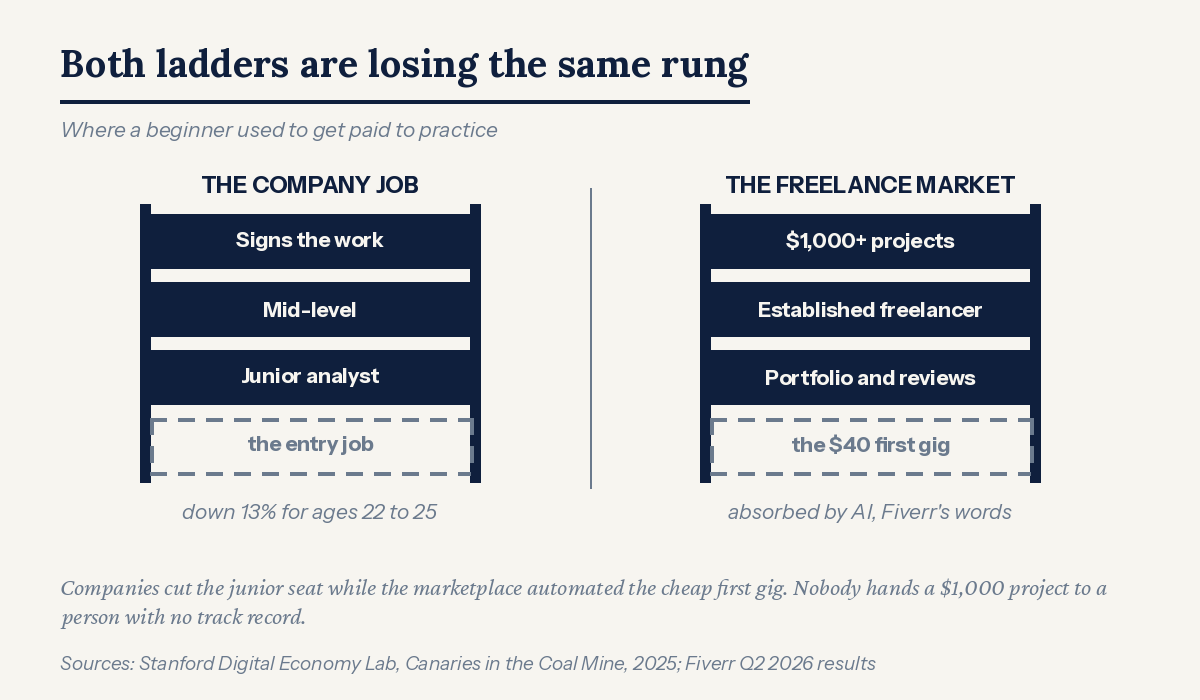
Both ladders now narrow at the same height, in the same year, and the top of each is worth more than ever. Nobody hands a $1,000 project to a person with no track record, and the place people built track records is closing.
The case for the market as teacher
The strongest objection is that working for yourself teaches more than a staff job does. A freelancer sees twenty clients a year instead of one manager, gets corrected in days, and learns pricing and scoping no training program covers. MBO’s numbers support it: 78 percent plan to stay independent, and more than three-quarters say they are happy with the work.
All of that is true for people already established. The objection fails on who pays for the learning. An employer absorbs the cost of a beginner being slow and supervised, and calls it onboarding. A client buys a finished thing at a price, and the only way a beginner wins that work is by charging less than the people who are good at it. Falling pay at the cheap end is the price of admission going away: when a capable model does the $40 job for pennies, nobody buys the beginner’s version at any price. That practice was always paid for by somebody. One of the two payers just disappeared, and the other is being cut on purpose.
What companies are planning to buy
Three-quarters of large companies expect to use freelancers for AI work, according to MBO’s research with Staffing Industry Analysts. Fewer than one-third rate their own approach to using them as strong. That survey reached 84 executives, so treat it as a sketch.
Strip the percentages and the picture is simple. Most large employers plan to buy more skill from the freelance market, and most cannot describe the market they are buying from. Its two biggest platforms both report that the bottom of it, where people learn, is being automated. I decide which work goes to a company office in India, Mexico or the UK and which stays in Virginia, and the version of that decision I was taught priced the rate and the risk. It never priced what buying does to supply five years out.
Every fix I have proposed in this newsletter has been an internal one, offered as a good option among several. With the freelance market pricing beginner work toward zero, the junior seat inside a company becomes the last place that practice happens.
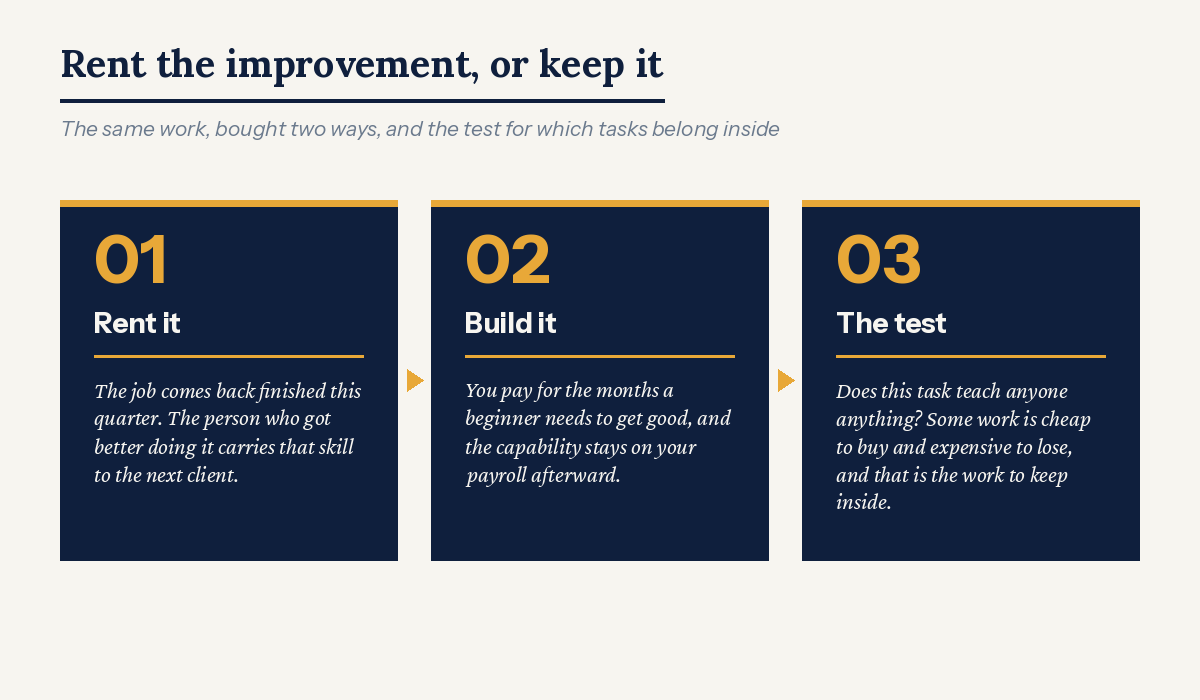
The fix is unglamorous and it costs real money. Hire beginners onto your own payroll and pay for the months it takes them to get good. Paying a freelancer to learn on your job buys an improvement you do not keep, because that person carries the skill to the next client. Switzerland worked this out in the end. Rolex and Swatch answered the shortage by building their own schools and hiring the graduates. The companies hiring comfortably in 2031 are the ones paying for that now, while it still costs a salary instead of a decade.
Here’s how you take action
Hire one beginner you were about to contract out. Take work you were going to send outside and give it to someone on your payroll who is not quite ready for it. Pay for the extra time. Train a freelancer and you have rented the improvement. Train your own hire and you keep it.
Protect the work they learn on. Some tasks are cheap to buy and expensive to lose, because doing them badly a few times is how a person gets good. Name those tasks before the next cost review, and take them off the list of things you send out.
Keep them long enough to earn it back. Training someone and losing them in eighteen months costs what buying it outside costs, only slower. Decide what the next three years look like for that person, and tell them.
Put the five-year number in the business case. A contractor is cheaper this year and costs more in 2031, when the experienced people you are counting on have to come from somewhere. Give that line an owner, or the cheaper answer wins every quarter.
The company that cuts the junior role and buys the finished work has paid for this year’s budget with next decade’s bench. The market will send that invoice later, and it will not say what it is for.
Christina Lexa writes Workforce Rewired, on the intersection of workforce transformation, AI, and global talent.
The views expressed here are my own and do not represent the position of my employer or any organization I am affiliated with.