


TL;DR: For thirty years, India’s IT services industry ran the world’s largest white-collar apprenticeship, and the world hired its output: 71 percent of US H-1B approvals, the top source of international students, 11 Fortune 500 CEOs. AI has collapsed the intake at the same moment Western visa policy is narrowing the export channel. This piece traces the double squeeze on the global talent supply and what to do before your 2030 workforce plan meets a pool nobody restocked.
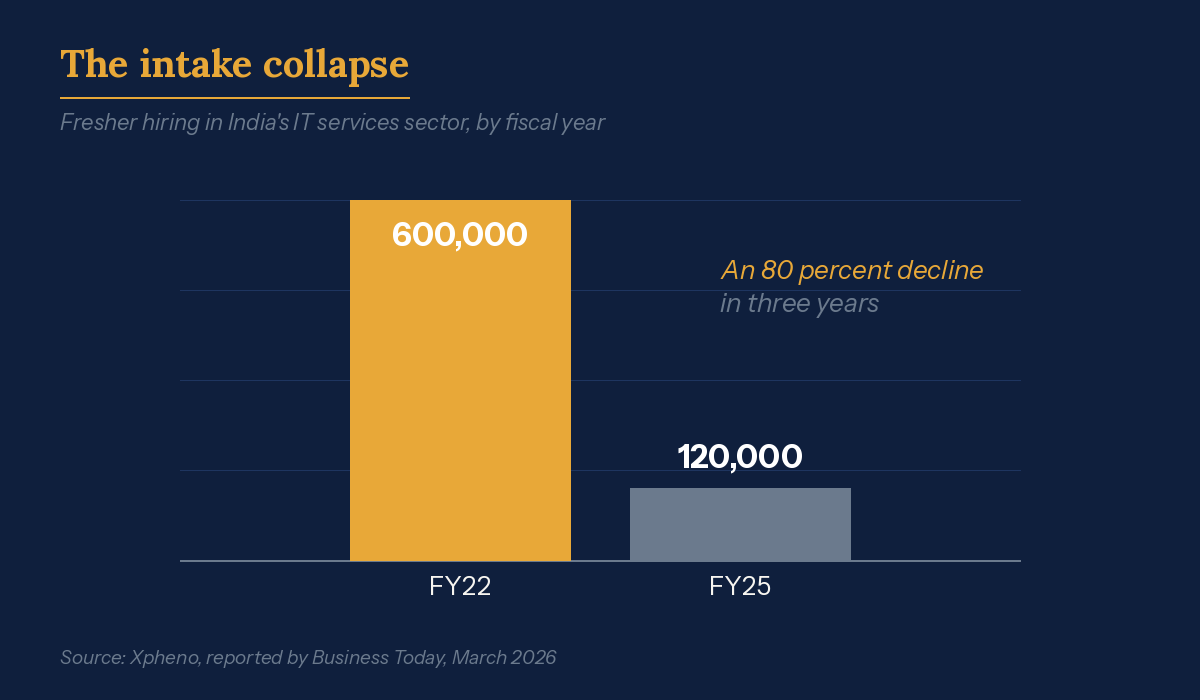
In fiscal year 2022, India’s IT services industry hired roughly 600,000 new college graduates (often called ‘freshers’). By fiscal 2025, that number had fallen to about 120,000, according to talent analytics firm Xpheno. Four out of five entry doors into the world’s largest technology services workforce closed in three years.
The numbers come from India. The consequences land on every workforce plan, in every country, that assumes experienced technology talent will be available to hire in 2030, because India has been the world’s single largest supplier of it.
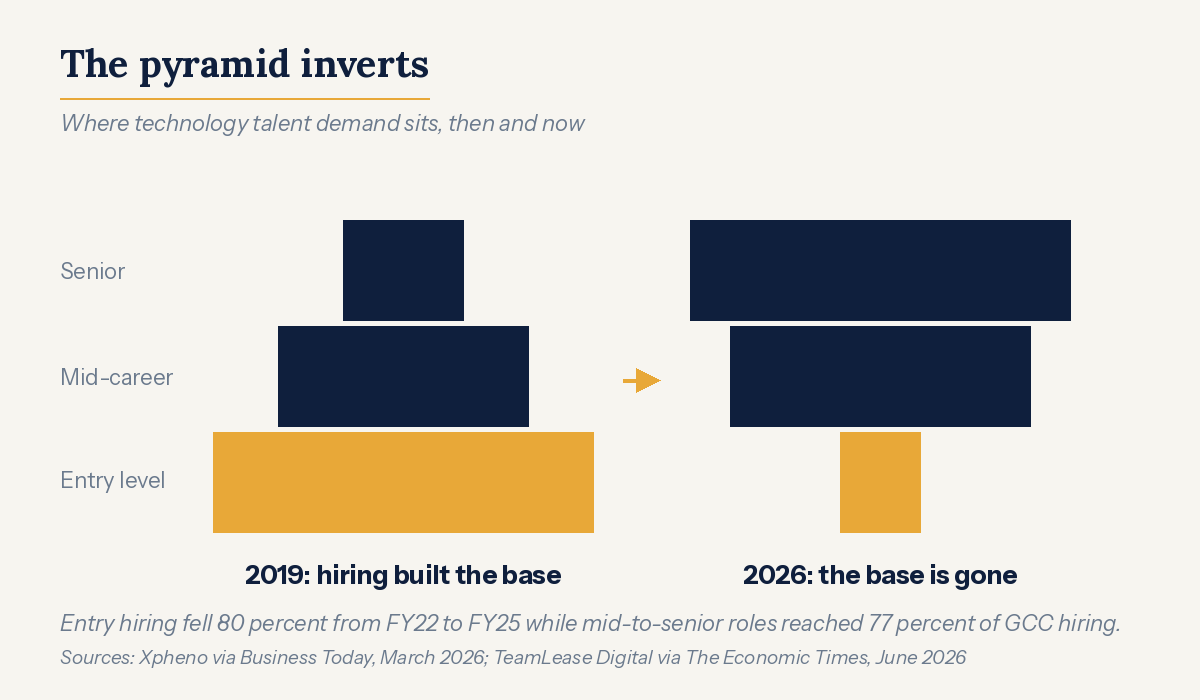
Here is the model that just broke. For three decades, TCS, Infosys, Wipro, and their peers hired graduates in six-figure batches, ran them through three to six months of training, and deployed them on the routine work of the global economy: testing, maintenance, support, basic development. The industry called it the pyramid. A wide base of juniors, narrowing toward a small number of senior architects and delivery leaders. The pyramid’s most valuable export was people, with the code almost a byproduct. Every year it converted hundreds of thousands of graduates into experienced professionals, and the entire global market hired from the output.
I have spent years building workforce strategies that touched include India, and I can tell you the assumption was never written down because it never needed to be. Experienced talent was treated like a renewable resource. The pyramid replenished it. You planned around salary inflation and attrition, never around the possibility that the intake itself would stop.
The intake is stopping. AI tools now perform the testing, maintenance, and basic development work that justified the fresher cohorts. TCS cut around 12,200 jobs in 2025, the largest reduction in its history, a reduction Outlook Business read as the collapse of the talent pyramid as an operating model. The head of digital operations at Kimberly-Clark put the trajectory plainly in May: “(The) zero-to-two-years experience ... will go away is my assumption in the next few years.”
The boom that hides the problem
The other half of the same labor market is thriving, and the contrast is the whole story. India’s global capability centers, the captive technology arms of multinationals, added nearly 200,000 net employees in fiscal 2026, almost twice the 110,000 added by IT services firms. The Nasscom-Zinnov 2026 landscape report counts 2,117 centers employing 2.36 million professionals. When I wrote about the GCC model in post-03, the open question was whether the cost arbitrage that built these centers would survive. The answer turned out to be that it did not need to: the centers moved up-market into AI platforms, product engineering, and cybersecurity.
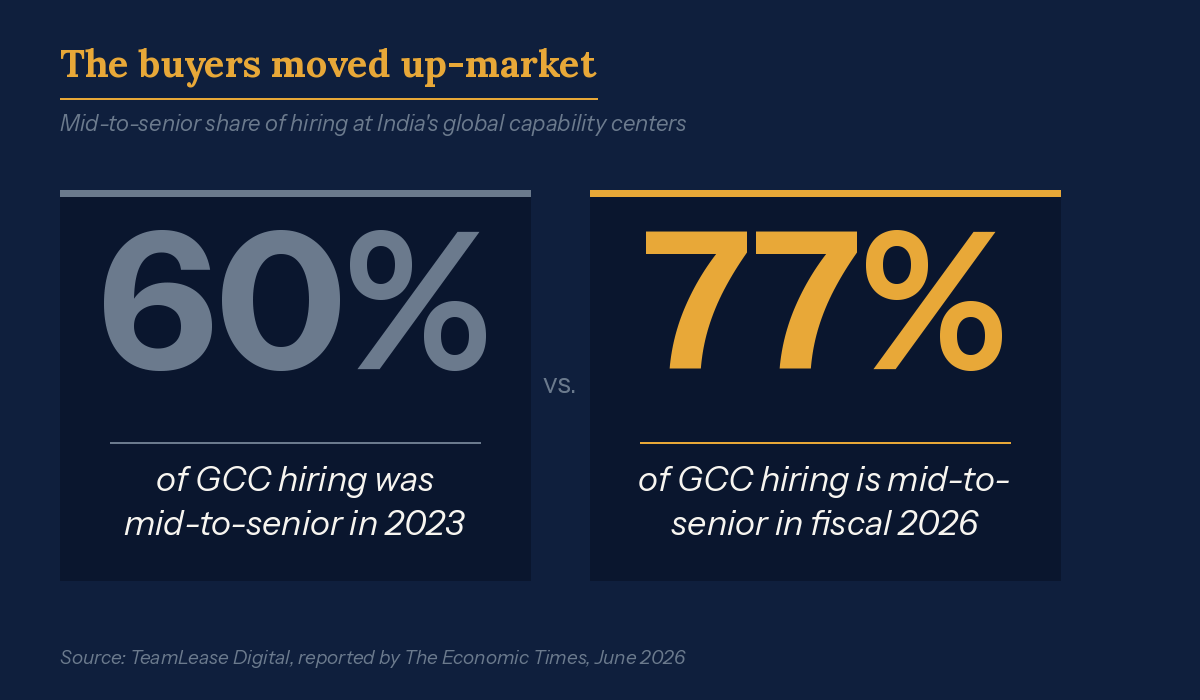
But watch who they are hiring. TeamLease Digital data reported by The Economic Times shows mid-to-senior talent rose from 60 percent of GCC hiring in 2023 to more than 77 percent in fiscal 2026. The fastest-growing employers in the world’s largest technology labor market have, as a group, nearly stopped buying at the entry level.
The strain is already measurable. Quess Corp estimates a 38 to 42 percent gap in AI and data skills across India’s GCC ecosystem, and Deloitte’s Rohan Lobo told The Economic Times that demand for AI specialists has risen more than 300 percent since 2024. Blame for that gap usually lands on universities and training programs. The arithmetic points somewhere else: an industry stopped manufacturing the very people it now cannot find. The senior AI engineer of 2031 is the junior hire of 2026, and if the junior hire of 2026 went unmade, the senior engineer of 2031 goes unmade with her. Recruiting budgets change none of that math, because recruiting only redistributes the talent that already exists
The double squeeze
What makes this everyone’s problem is what India has been to the rest of the world: the largest exporter of high-skilled talent in modern history. India-born workers received 71 percent of all US H-1B approvals in fiscal 2024, roughly 283,000 people. India is the top source of international students in American universities for the second consecutive year. And the channel reaches the very top of Western business: 11 Fortune 500 companies, with a combined market value above $6.5 trillion, are led by CEOs of Indian heritage, Microsoft and Google among them. Trace those careers back far enough and many begin in the same place: an entry-level seat in the Indian talent system.
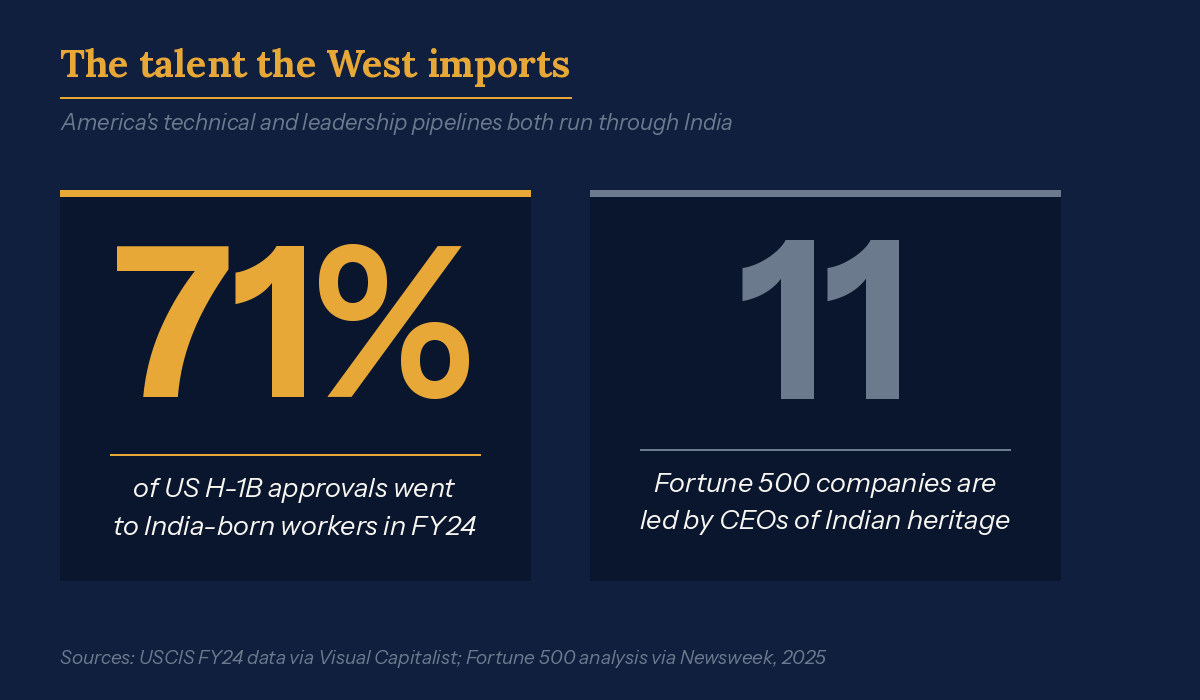
Now the channel is narrowing at the same moment the source is shrinking. A $100,000 supplemental fee on new H-1B petitions took effect in September 2025, replacing a previous cost of $2,000 to $5,000 per petition. New international student enrollment in the US fell 17 percent in fall 2025, on top of a 7 percent drop the year before, with the steepest declines among Indian students. Whatever you think of the policy choices, the workforce arithmetic stays the same: the US, Europe, and Canada built their technology and leadership benches partly on talent India developed, and the development and the export are constricting at once.
In post-02, I argued that AI is severing the apprenticeship layer inside American companies. The standing answer to that problem has always been import: if you stop growing your own seniors, hire someone else’s. India’s numbers close that exit. Both jaws of the vise are tightening on the same future hire.
The uncomfortable truth
Global talent strategy at most large companies rests on an assumption nobody checks: that experienced talent is a renewable resource replenished by someone else. Someone else trains the juniors, absorbs the cost of the unproductive first two years, and converts graduates into professionals. Your job is to show up at year five with a competitive offer or a visa petition and collect. That someone else has left the market.
The organizations that come out ahead will switch from buying to making, and a few are showing what that looks like. Infosys held its fresher target at 20,000 this year, with its CFO describing the intake as an investment in future capacity. Accenture’s Julie Sweet has argued that younger employees adapt to AI tools fastest, which reframes the entry-level hire from a cost center into an advantage. The old pyramid trained people by handing them five years of routine work, and that work is gone. Whatever replaces it has to be deliberate: smaller cohorts, AI-fluent from day one, given real problems with real stakes and enough supervision to build judgment on purpose rather than by osmosis. That is harder to run than a training bootcamp and a bench. It is also the only mechanism left that manufactures the talent everyone’s 2030 workforce plan assumes will be available.
The pyramid worked because someone was willing to pay for the base. For thirty years, that someone was the Indian IT services industry, and the whole world collected the dividend. The question your organization should be asking is the one the industry just stopped answering: who pays for the base now?
Here’s How You Take Action
Audit your dependency on talent you did not develop. Pull your hiring plan for the next three years and mark every role that assumes an experienced external hire, then note how many of those hires have historically come through immigration channels. That share of your plan is a double bet: on a supply pool that is no longer being restocked, and on an import channel that is narrowing. Name the number and put it in front of your leadership team.
Price the make-versus-buy decision honestly. Recruiting premiums for experienced AI talent are rising with a 300 percent demand spike behind them. Run the comparison: five years of escalating buy-side premiums versus the cost of a deliberate early-career development engine. The bootcamp-and-bench model is dead, so run the comparison against a structured modern apprenticeship rather than against nostalgia.
If you operate global capability centers, stress-test your 2030 bench. Take your center’s current fresher intake and project your senior staffing five years out. If the intake is near zero, your growth plan depends entirely on poaching from a market where every competitor is running the same play.
Find the practice loops your AI deployments deleted, and rebuild them on purpose. Every routine task AI absorbed was doing double duty as someone’s training ground. Identify where your early-career people used to build judgment, and design replacement experiences with real stakes and real supervision. Osmosis retired along with the routine work, so judgment development is now a design problem, and it belongs on someone’s roadmap by name.
Workforce Rewired publishes weekly at the intersection of AI, organizational design, and the future of work. If this piece made you think, share it with someone navigating the same questions.
The views expressed here are my own and do not represent the position of my employer or any organization I am affiliated with.