


TL;DR: An eighteenth-century New England house put a masonry chimney in the middle because heat could not travel. Central heating removed that constraint in the late 1800s, and the floor plan barely moved for sixty years. McKinsey’s new argument is that agentic AI is lifting the constraints that shaped the org chart in the same way, and the proof is already visible in how big a team is. Nobody is deciding what happens to the seat where people used to learn the work.
An eighteenth-century New England house had a masonry chimney in the middle of it, and every room was built around it. The Pennsylvania Historical and Museum Commission’s field guide to the center-chimney house describes the pattern plainly: a massive center chimney that created hearths for all the main rooms. Rooms were small and closed off because heat does not travel. Those walls were thermal engineering long before anyone called them a design preference.
Central heating arrived in the late 1800s. Hot-air registers and steam radiators freed rooms from fireplaces, and steel, available from the 1870s, let builders span distances that masonry could not. The constraint was gone.
The houses stayed the same.
Henry Hobson Richardson opened up a plan at Stonehurst in 1883, which Old House Online dates as the start of the open plan. It reached ordinary bungalows, split-levels and ranches somewhere between the 1920s and the 1960s. Philip Johnson’s Glass House, the high-style peak of the idea, went up in 1949, sixty-six years after Stonehurst. Sixty-six years between the moment the constraint lifted and the moment most people lived differently because of it. A version of that lag is running right now inside every company redesigning itself around AI.
McKinsey Quarterly published a piece this month by Alexis Krivkovich, Brooke Weddle, Holly Price and Vik Sohoni called “AI is changing work. Now it has to change the organization.” For more than a century, they write, the building blocks of organizational design, meaning tasks, jobs, teams, management layers and hierarchies, reflected three constraints: human capacity, expertise, and coordination. Agentic AI alters all three. The org chart, like the floor plan, encodes a legacy artifact that may no longer exist.
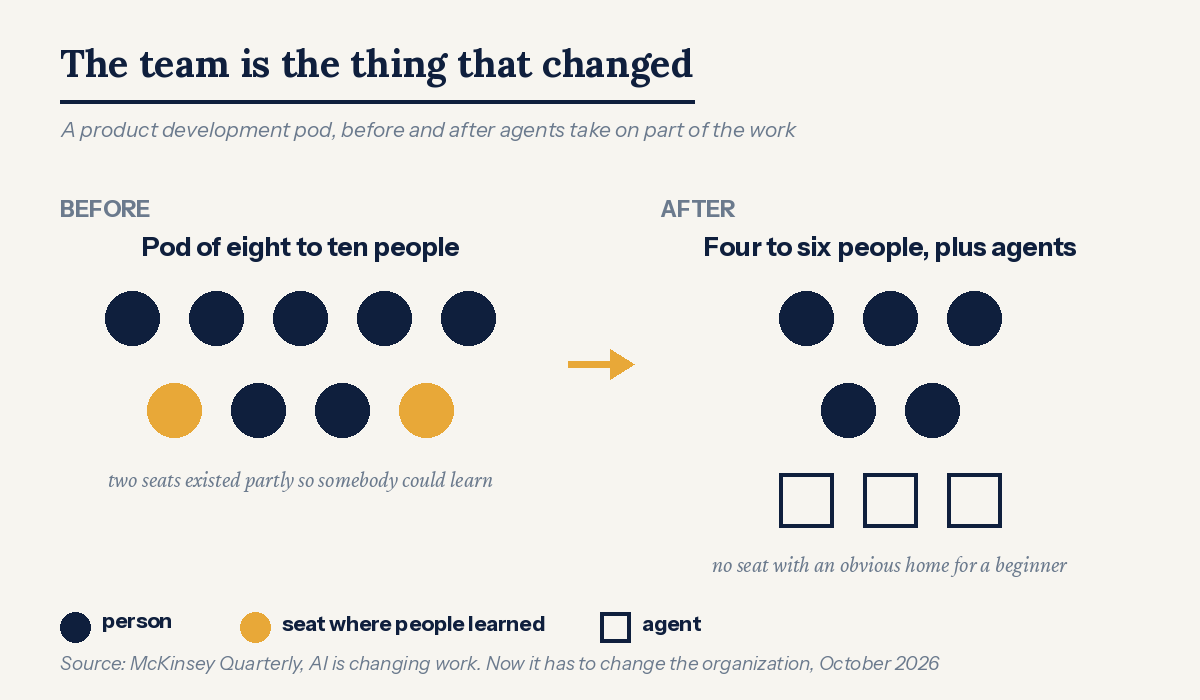
The evidence they offer is specific. In one organization’s product development function, traditional pods of eight to ten people shifted to hybrid teams of four to six people supported by agents. Across their client work, they report that “coordinator roles,” meaning internal jobs whose purpose is moving decisions around the organization, grew at roughly 1.5 to 2.0 times the rate of line roles over the past five years. Meetings, they point out, are mostly a mechanism for transferring information and reaching alignment, and agents can now track what has been decided and what is outstanding.
Capacity, expertise, coordination. Those are the reasons the rooms were small.
I have written about flattening three times, and this argument sits somewhere else. The Math of Flat looked at Amazon and Google widening spans of control faster than they redesigned the manager’s job. Who Wants to Lead People Anymore looked at what is left of a management role once coaching gets squeezed out. Meta’s Flattest Team Just Asked for Its Managers Back looked at a company reversing the same bet twice. All three are about the vertical dimension: how many people report to one manager, and how many layers sit between the bottom and the top.
This is the horizontal one. The team itself is being recomposed. Eight to ten people become four to six people and some agents, and the layer count is a consequence rather than the decision. A company can flatten without changing what a team is made of. A company that changes what a team is made of has already flattened, whether or not anyone drew a new chart. The question of how many managers you need in this new construct should come next if you are redrawing walls.
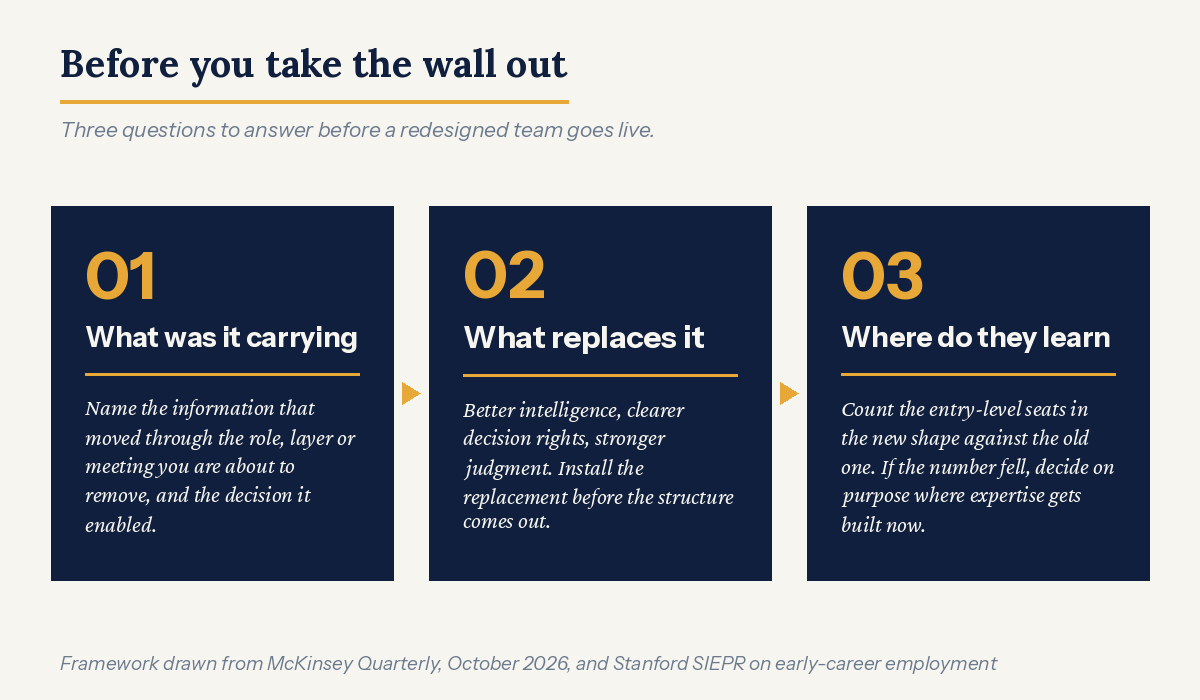
Richard Neutra’s Lovell Health House in 1929 used a steel frame, which let him eliminate load-bearing walls. The frame went in first. Take a wall out of a house and the sequence is fixed: find out what the wall is carrying, and if it carries the roof, install the beam before the sledgehammer comes out.
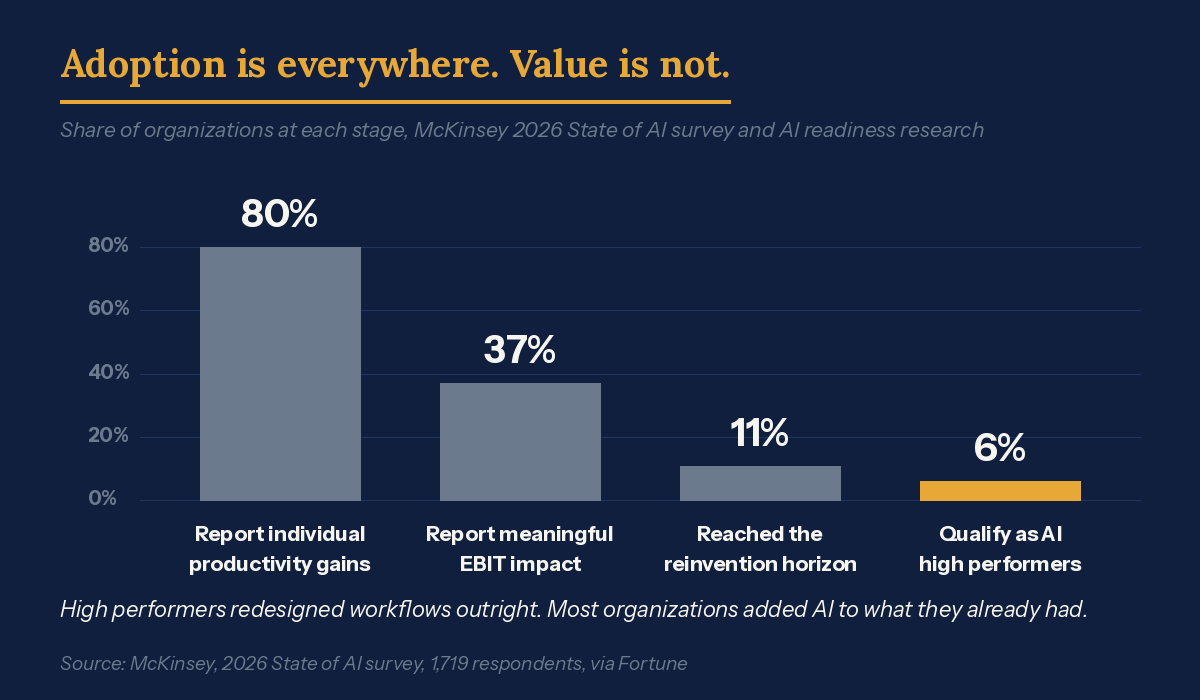
McKinsey makes the same point in the language of org design. A flatter pyramid, they write, enables value only if the lost coordination is replaced by better intelligence, clearer decision rights, and stronger human judgment. Their numbers suggest most companies are skipping that step. McKinsey’s 2026 State of AI survey of 1,719 professionals and business leaders, reported by Fortune, found that 80 percent of respondents say AI has improved their individual productivity, 37 percent say it has a meaningful effect on earnings before interest and taxes (EBIT), unchanged from a year earlier, and 6 percent attribute at least 5 percent of EBIT to AI. Nearly three-quarters of that top group have redesigned workflows outright, up from 55 percent the year before. Separately, just 11 percent of organizations have reached what McKinsey calls the reinvention horizon.
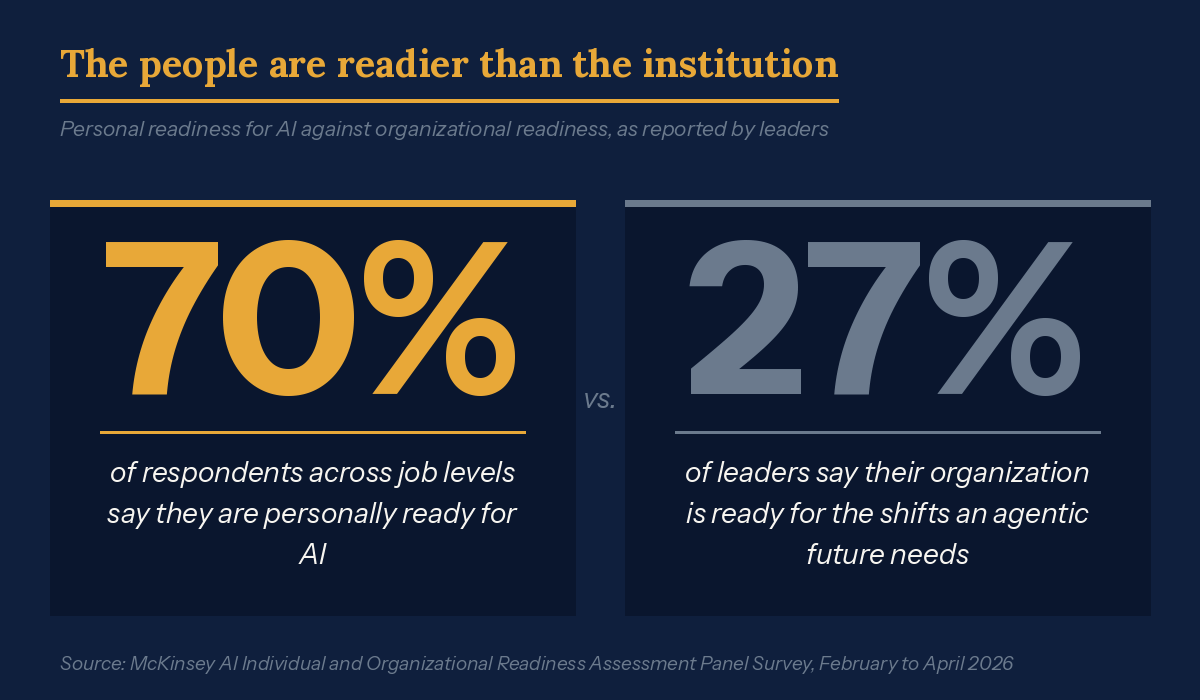
And the readiness split is the one I would put on a wall. Seventy percent of respondents say they are personally ready for AI. Twenty-seven percent of leaders say their organization is ready to make the shifts an agentic future requires. The people are nearly three times readier than the institution, which is the reverse of how most transformation decks describe the problem.
The apprenticeship question is the load-bearing wall in this argument, and it gets one paragraph. McKinsey names it fairly: if agents take on the entry-level work through which people historically built expertise, today’s productivity gain can become tomorrow’s judgment gap. That sentence is correct, and it sits in a twelve-page argument about the shape of the organization, next to four exhibits about operating models.
Look at what their own mechanism does. A pod of eight to ten had seats in it that existed partly because the work had to be done and partly because somebody had to learn. Four to six people plus agents does not have those extra seats. The team shape decided that, in advance of any leader deciding to stop hiring juniors and without appearing as a line item anyone voted on. Erik Brynjolfsson, Bharat Chandar and Ruyu Chen at Stanford found a 13 percent relative decline in employment for workers aged 22 to 25 in the most AI-exposed occupations, concentrated where AI automates rather than augments, while more experienced workers in those same occupations held steady. In the UK, Adzuna counted 8,383 graduate vacancies in July 2026 against 15,397 a year earlier, the lowest since it began recording in 2016.
I lead workforce strategy for Technology at Capital One, and we’re debating this very challenge right now. Team composition is one of the outputs of my job. When a team gets smaller and faster, the natural draw is to fill it with people who already know how to do the work, because that is the version that performs now. The cost of not hiring some of those as junior employees shows up in four years, in a bench nobody built.
Philip Johnson built a house in 1949 with almost no interior walls at all, and he said of it that the hearth is still the anchor of its open plan. The man who removed everything removable kept the one thing the house was organized around.
That is the question in front of every leader reading the McKinsey piece: what stays. The open plan amounted to a new idea about how a family lives, and the architects who got there first worked out what the house still needed before they opened it up. The organizations that get this right will be the ones that can say, before they shrink a team and redesign the organization around it, what each role carries and where it goes, deliberately.
Here’s how you take action
Find out what your coordination, people leaders, and adjacent roles are carrying. Before you remove a role, a layer or a meeting, write down what information moved through it and what decision it enabled. If the answer is nothing, remove it this quarter. If the answer is something, redesign it deliberately understanding the second and third order effects.
Count the junior seats in your new team shape. Take any team you have redesigned around AI in the last year and compare its entry-level headcount to the version before. Ask yourself if it’s enough to sustain your organization in four to five years.
Decide where the productivity dividend goes, in writing. McKinsey’s own exhibit shows roughly 40 percent of a customer service role freed by AI and five different places that capacity could land. Pick one on purpose and tell people which one.
Ask what is still the hearth. For every role you are redesigning, determine which part(s) stays human because the work is meaningless without it. Johnson kept the fireplace in a glass box for a reason.
Seventy percent of people say they are for what’s next with AI. Twenty-seven percent of leaders say the organization is. Stop describing your people as the obstacle.
Christina Lexa writes Workforce Rewired, on the intersection of workforce transformation, AI, and global talent.
The views expressed here are my own and do not represent the position of my employer or any organization I am affiliated with.