


TL;DR: The people running the biggest AI labs spent 2025 predicting an entry-level jobs apocalypse. In 2026 they walked it back. Their walk-back could be a tool to pump stock valuation ahead of planned IPOs. After all, a narrative that their technology could mean catastrophe for millions isn’t exactly a good PR story. Or, it could be a correction to the actual reality of AI. If AI turns out to be a multiplier instead of an eliminator, the first professional job survives, but the thing it used to teach does not, because that learning was never designed. It was smuggled inside the tasks AI now does. The companies rebuilding early-career work on purpose will own the next decade’s senior talent. Here is what that redesign looks like, down to the job description.
My first real job in consulting came with a title that promised more than the work delivered. Analyst. In practice the work was note-taking, data cleansing, formatting slides at eleven at night, and building the first ugly draft of a deliverable a partner would later reshape beyond recognition. If you had asked me then what I was learning, I would have said “PowerPoint and Excel.” I would have been wrong.
What I was actually learning sat underneath the tasks. Taking notes in the room, I watched a partner steer a tense client conversation back from the edge. Drafting the after-action summary, I had to reconstruct why the meeting went the way it did, which forced me to understand the moves I had just witnessed. Cleaning the data taught me where the numbers came from and which ones to distrust. The relationship-building, the reading of a room, the unwritten parts of doing business, none of that lived in a training module. I absorbed it by proximity, one deliverable at a time.
Professional services firms have always called this the apprenticeship model. The label was generous. Nobody designed it. The learning was a byproduct of the grunt work, smuggled inside the tasks that had to get done anyway. That distinction, byproduct versus design, is why AI can hollow out the first professional job without eliminating it.
The tone shifted, and it makes the point sharper
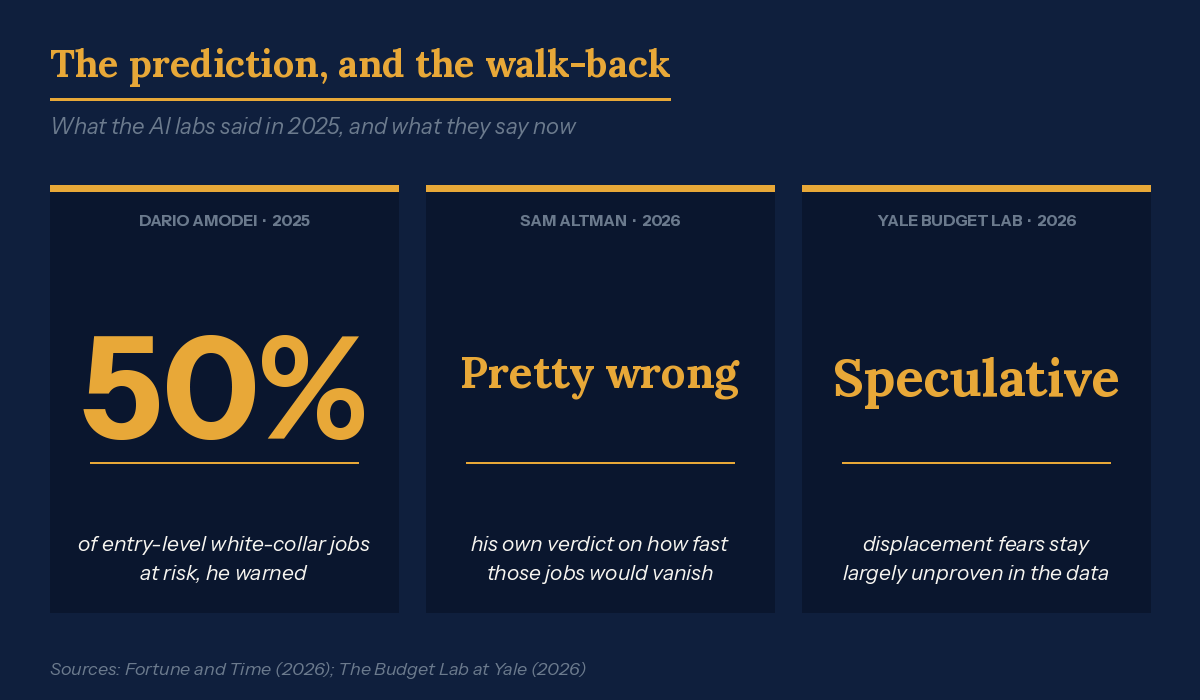
For most of 2025 the loudest voices in AI told us the entry-level job was finished. Dario Amodei warned that AI could wipe out half of all entry-level white-collar positions and push unemployment toward 20 percent. Sam Altman said a lot of jobs would simply go away. Then 2026 arrived and both men changed their tune.
Altman now says he was “pretty wrong,” that he expected more entry-level white-collar elimination than has actually happened.
Amodei’s framing has softened toward AI expanding the work people do rather than deleting it. The Budget Lab at Yale keeps finding no significant shift in the occupational mix since ChatGPT launched, calling the displacement fears largely speculative.
The obvious read is relief. The apocalypse got called off, so the entry-level corporate job is safe. That read is too easy. If AI is a multiplier rather than an eliminator, the entry-level headcount survives. The tasks that used to fill an analyst’s day do not. And those tasks were the apprenticeship.
When Amodei and Altman predicted mass elimination, at least the failure mode was legible. You would see the empty desks. The multiplier scenario is more dangerous because it looks fine. You keep hiring analysts. You give them AI. Output goes up. Everyone reports a productivity win. Three years later you cannot find anyone ready to run a client relationship or lead a hard conversation, because the reps that used to build those instincts got handed to a model (e.g., AI took the meeting notes, AI developed the first draft of the deck, and AI cleaned up the data tables). Nobody decided to stop developing people. It happened as a side effect of a tool rollout that looked like an unambiguous good.
The uncomfortable truth about the apprenticeship
Consulting’s apprenticeship, and every white-collar version of it, was structurally fragile the whole time. It depended on a coincidence: the work worth doing and the work worth learning from were the same work. The first draft was useful to the firm and formative for the analyst. Break the coincidence, hand the first draft to AI, and the firm still gets its draft while the analyst loses the rep. Learning that was never separated from the work cannot survive the work being automated. It was leaning on the grunt work the entire time.
This is the pipeline problem I have written about from the other direction, in the entry-level hiring collapse and the inverted pyramid in global talent. Those pieces were about the rungs disappearing. This one is about something subtler and, in the multiplier world, more likely: the rung stays, the paycheck stays, and the developmental content drains out of it while everyone looks at healthy headcount numbers and relaxes.
The multiplier is real. The redesign is the work.
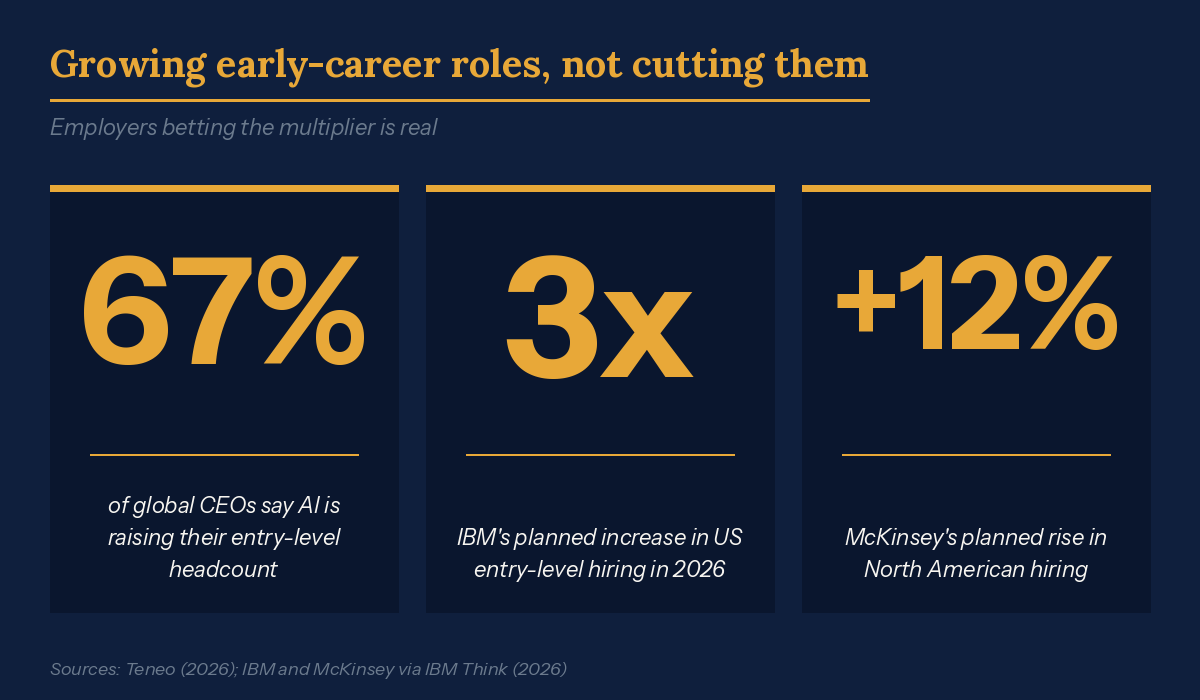
The good news is real, and a growing list of companies are acting on it rather than waiting. Teneo found that 67 percent of global CEOs say AI is increasing their entry-level headcount, not cutting it. IBM is tripling its US entry-level hiring in 2026, with CHRO Nickle LaMoreaux putting the logic plainly:
“If we don’t continue to invest in entry-level hires, what happens in 3 to 5 years? There’s no pipeline; the well simply dries up.”
McKinsey is raising North American hiring 12 percent and screening applicants with a gamified assessment that tests critical thinking and systems thinking instead of prior business knowledge. Cognizant is expanding entry-level recruiting to more liberal arts graduates, with CEO Ravi Kumar calling AI an amplifier of human potential, not a displacement strategy.
Notice what these companies are doing. They are changing what the job is. Handing analysts an AI license and hoping the old learning survives on its own is exactly what they refuse to do. The World Economic Forum’s June 2026 report with PwC, on the future of entry-level work, gives the shift a name: move from role-based structures, where you learn by grinding through whatever tasks your title inherits, to capability-based ones, where the experiences that build judgment are put into the job deliberately. Randstad, one of the report’s featured cases, describes elevating entry-level roles toward the judgment and human oversight AI cannot replicate, with the person in the lead while AI carries the routine load
What the redesign actually looks like
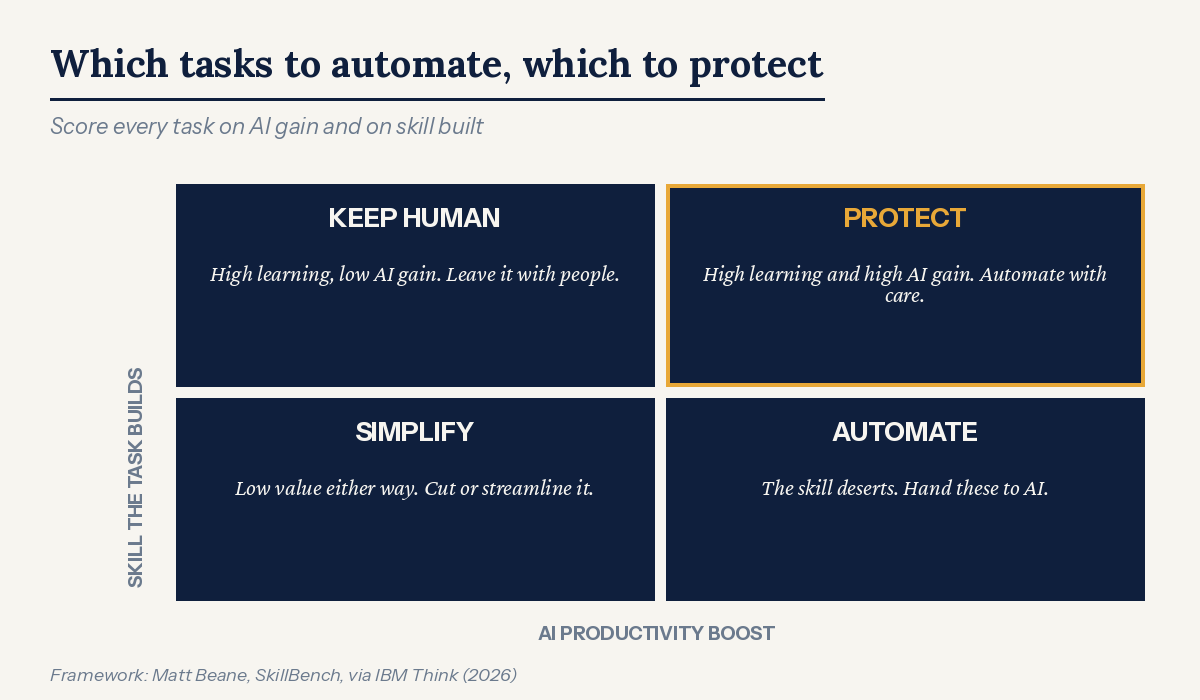
Doubling down on human skills is the easy sentence. The mechanics are the hard part, and the most useful model I have seen comes from Matt Beane, a management professor at UC Santa Barbara who built a company called SkillBench to run it. Beane maps a team’s real work into small task packets and scores each one on two axes: how much of a productivity boost AI gives it, and how much genuine skill the task builds. That two-by-two is the whole game. Automate the tasks that are high on productivity and low on learning, the skill deserts that were never teaching anyone anything. Protect the tasks that build judgment from over-automation, even when a model could do them faster. Their whole purpose is to develop people, and speed does nothing for that.
The rest of Beane’s approach rebuilds the parts of apprenticeship that used to happen by luck. Small pods of juniors work under a senior coach toward a deliberately hard goal. The coach runs a Socratic critique, asking questions that surface assumptions and alternate approaches rather than handing over answers. The juniors, fluent in the newest tools, teach the senior something back. That is the mentorship I got by accident in a conference room, turned into something a company can run on purpose.
A job description for the AI-era analyst
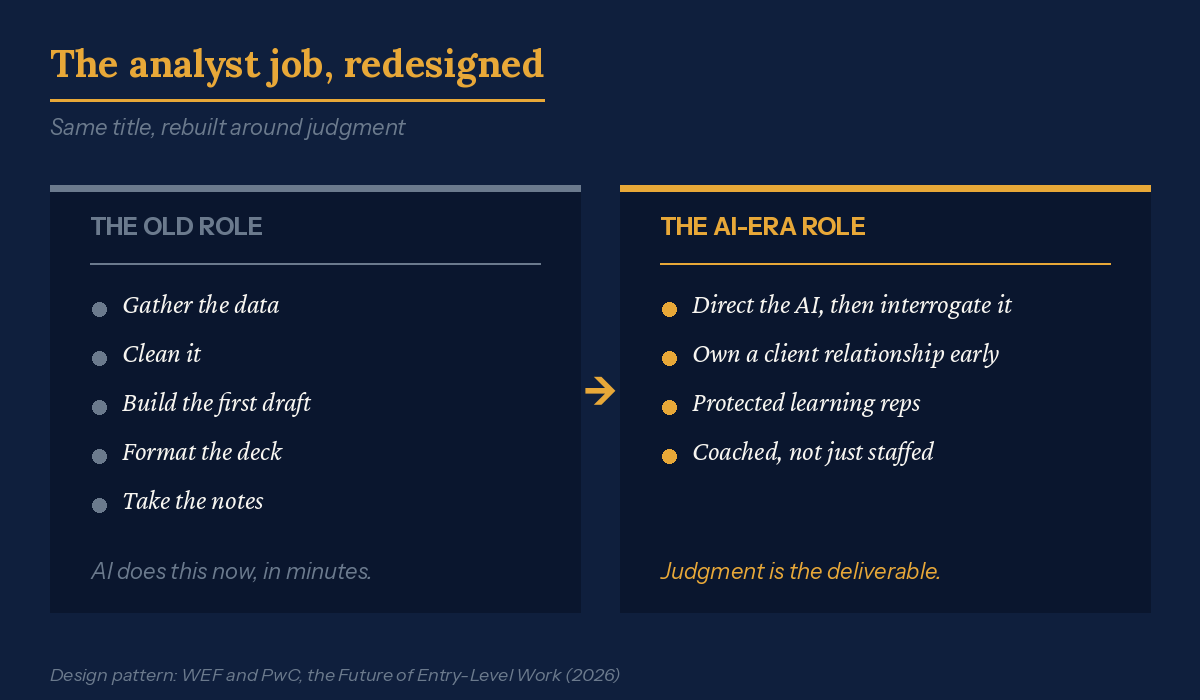
To make this concrete, here is what a redesigned version of my old job could look like. Call it the AI-era consulting analyst.
The old role: gather data, clean it, build the first draft, format the deck, take notes. AI does most of that now, in minutes.
The redesigned role starts where the old one used to end.
Direct the AI, then interrogate it. The analyst frames the problem, prompts the model for the first-pass analysis, then does the part that matters most: pressure-testing the output. Where is the model confidently wrong? Which assumption did it bury? What did it miss that only someone who understands this client would catch? The deliverable becomes the judgment applied to the draft.
Own a slice of the client relationship early. IBM notes its entry-level developers now work with real clients far sooner than before, because client-facing judgment is the thing AI cannot fake and the thing that takes years to build. The redesigned analyst sits in the room with a real stake, not just a notepad.
Protected learning reps. A defined share of the analyst’s month goes to high-learning, deliberately un-automated work: reconstructing why a recommendation landed or failed, shadowing a senior through a hard negotiation, building an argument from a blank page. These sit on the calendar as development, blocked and protected the way any real priority is.
Coached, not just staffed. A senior owns the analyst’s judgment development explicitly, through Socratic review of real work, the way Beane’s pods run. That coaching is part of the senior’s job, measured and rewarded, not a favor done between deadlines.
Measure success by judgment demonstrated: errors caught, recommendations sharpened, client trust earned. Measure that, and you are developing a future partner. Measure output alone, and you are training someone to supervise a model until the day you need judgment they never got to build.
The reprieve is a deadline
I want to be careful not to oversell the calm. The walk-back from Altman and Amodei is about timing, not direction, and the underlying data is mixed. Employment for 22-to-25-year-olds in the most AI-exposed roles has fallen roughly 13 percent since 2022 while older cohorts held steady. Whether the multiplier future or the eliminator future wins is still being decided, company by company, by the design choices in front of leaders right now. That is the optimistic part. This is architecture, and we are the architects.
Firms that treat the reprieve as permission to relax will keep hiring analysts, keep handing them AI, keep watching output rise, and keep wondering around 2030 why the bench is empty. Firms that treat it as a deadline will rebuild the apprenticeship as something designed rather than something hoped for. The accident is over. What replaces it is a choice.
Here’s How You Take Action
If you lead a team: Take one entry-level role and split its tasks into two piles, the work AI now does and the work that taught your people how to think. Automate the first pile without guilt. Put the second pile on the calendar as protected development, not as busywork you hope survives a busy week.
If you set workforce strategy: Stop measuring early-career roles by output. An analyst who ships more polished decks faster is not necessarily learning more. Measure the judgment a person demonstrates, because that is the leading indicator of your 2030 leadership bench.
If you are early in your career: Do not let the model do the reps that build your judgment. Prompt it for the first draft, then spend your real effort on the part that makes you valuable: finding where it is wrong, and understanding why. The person who can interrogate the output will out-earn the person who just forwards it.
If you manage entry-level people: Coaching is now the core of the job. The tacit knowledge that used to transfer by osmosis has to be taught on purpose, through real reviews of real work. If your calendar has no time for that, your org design decided your bench would be thin before you did.
For everyone: The next time your company gives a junior team AI and calls it a productivity win, ask one question: what are those people learning now that the grunt work is gone? If nobody has an answer, the apprenticeship just ended and nobody noticed.
Christina Lexa writes Workforce Rewired, on the intersection of workforce transformation, AI, and global talent.
The views expressed here are my own and do not represent the position of my employer or any organization I am affiliated with.