


TL;DR: Torsten Slok’s October charts show revenue per worker and profit margins climbing for the 7 biggest tech companies and sitting flat for everyone else, and most readers will take that as proof the technology is oversold. Both of those numbers are workforce ratios, and they move only when job design moves. McKinsey surveyed 1,719 leaders this year and found that the small group actually making money from AI is mostly the group that rebuilt how the work gets done. The question worth asking is why so few companies manage it.
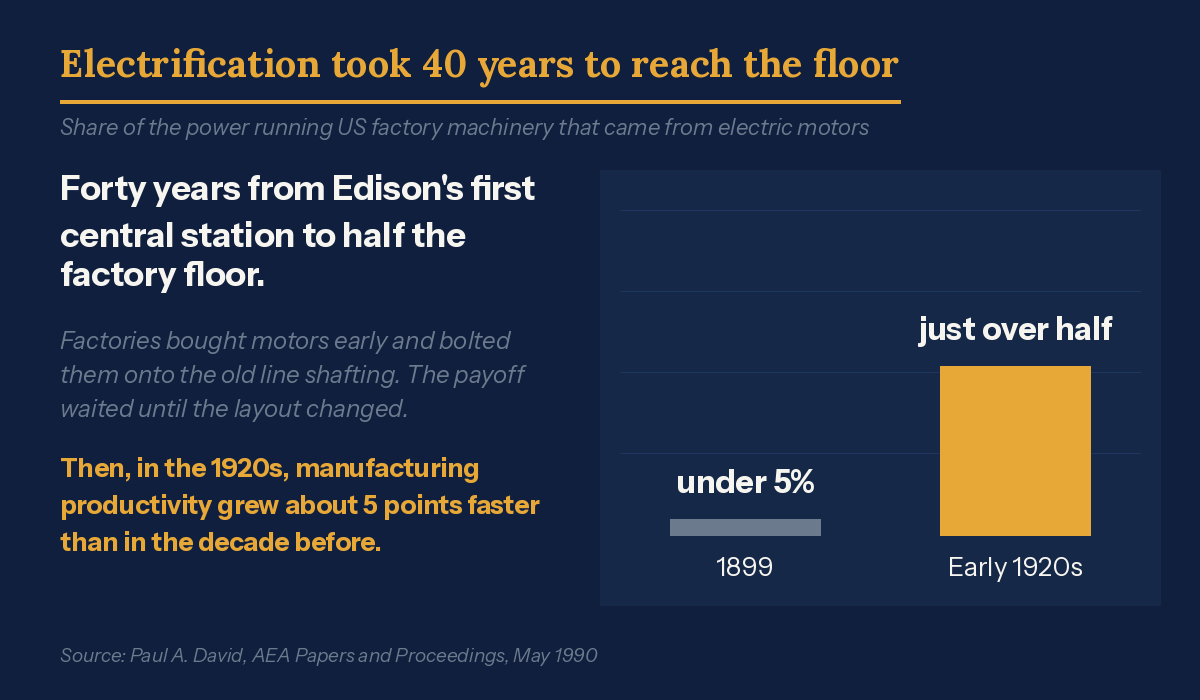
Thomas Edison opened his first central generating stations in New York and London in 1881. By 1899, electric motors supplied less than 5% of the power running American factory machinery. They passed half only in the early 1920s, 40 years after the first central station opened for business, and the economist Paul David laid out that timeline in 1990 while everyone around him was asking why computers hadn’t shown up in the productivity statistics.
The motors arrived long before the payoff did. Factories bought them early and wired them into the building they already had. A 19th-century plant ran on a steam engine turning a long overhead line shaft, with leather belts dropping down to every machine on the floor. The first wave of electrification swapped a motor in for the steam engine and kept all the shafting, an arrangement called group drive, and David reports it stayed the norm from the mid-1890s until about 1920. The power source changed. The floor plan did not.
What eventually paid was unit drive: a motor on each individual machine. Pull out the overhead shafting and the building itself changes. It needs no heavy bracing, so it can be built lighter and on a single story, since multistory plants existed partly to keep line shafts short. Machines can sit in the order the work flows instead of near a shaft. One machine can be serviced while the rest of the plant keeps running. In the 1920s, American manufacturing productivity grew about 5 percentage points faster than it had the decade before, and David ties about half of that to the spread of motors running individual machines. He’s careful to call it a strong link rather than proof.
The constraint was the floor plan.
Slok published 5 charts last week arguing that AI has produced no financial payoff outside the technology sector, and the first two are measuring a floor plan.
What the charts are counting
Torsten Slok is a partner and chief economist at Apollo Global Management. Writing in The Daily Spark on October 24, he argued that “the technology has delivered zero financial payoff to corporate America outside of tech” and closed on the line that the AI story will be decided in the S&P 493, not the Magnificent 7. (The Magnificent 7 are the biggest US tech companies, like Apple, Microsoft and Nvidia. The S&P 493 is everyone else in the S&P 500.) Apollo is an investment firm with its own money riding on AI, and this is a short market note rather than a research paper, so weigh it accordingly.
His first chart plots revenue per worker, inflation adjusted: about $790,000 per person at the Mag 7 by the third quarter of 2026, against roughly $525,000 at the other 493 companies in the index, about where they have sat for years. His second plots profit margin, near 30% for the Mag 7 and near 10% for the 493, flat across the decade. His third sets utilization-adjusted total factor productivity against the AI period and finds no acceleration, drawing on the San Francisco Fed’s series. This is all a little wonky, so let me unpack this in plain (but admittedly oversimplified) language.
The first two are workforce ratios. Revenue per worker divides the money coming in by the number of people on the payroll. Margin is what remains after the cost of those people and the tools they work with. The third chart asks the same question of the whole economy, and gets the same answer. A company that buys 10,000 licenses and leaves every role description, span of control, handoff and skill mix exactly where it found them has added a cost and changed nothing else. Both ratios will sit still.
Three weeks ago, in Your Org Chart Was Built Around a Chimney, I argued that American houses kept their center-chimney floor plans for generations after central heating removed the reason, and that org charts are doing the same thing now. Slok’s charts are the same argument showing up in earnings data, which is a harder thing to ignore.
The gains stopped at the individual
McKinsey published its 2026 State of AI survey earlier this year, with 1,719 participants across 97 countries. Close to 9 in 10 regularly use AI in at least one part of the business, and 44% are using it across the whole company, up from 38% a year earlier. Overall, 80% say AI has improved their own productivity.
Only 37% say it has a meaningful effect on earnings, essentially unchanged from the year before. Same survey, same year: 80% individual productivity gains but just 37% of organizations seeing a financial benefit.
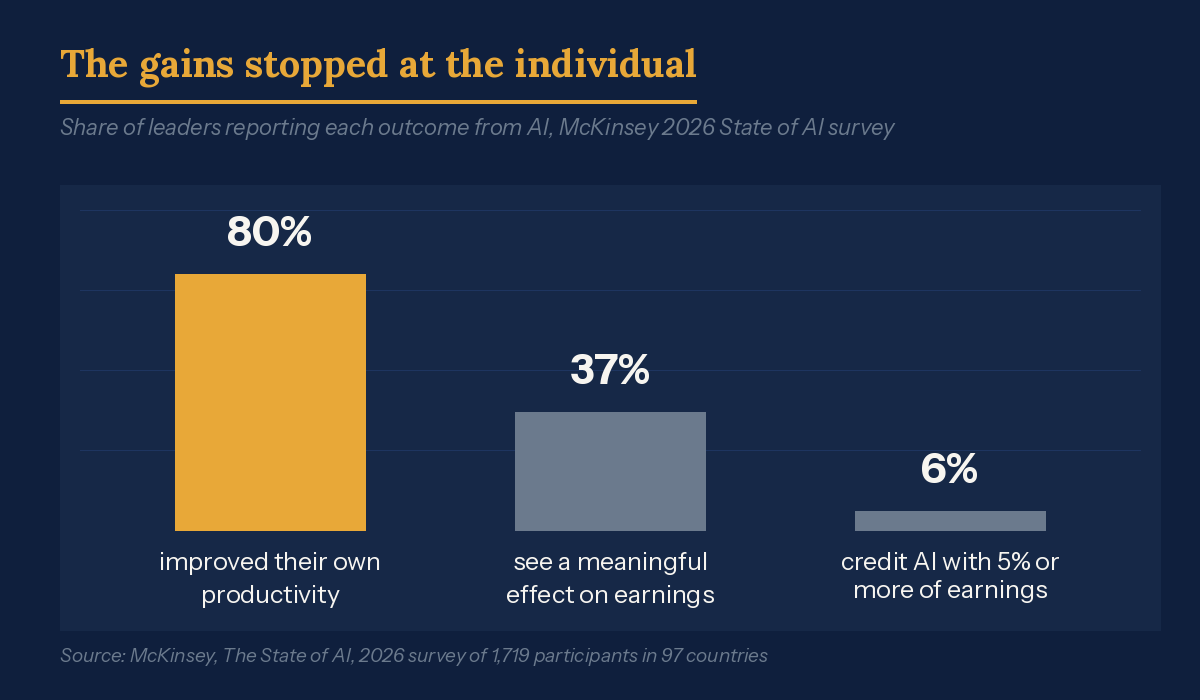
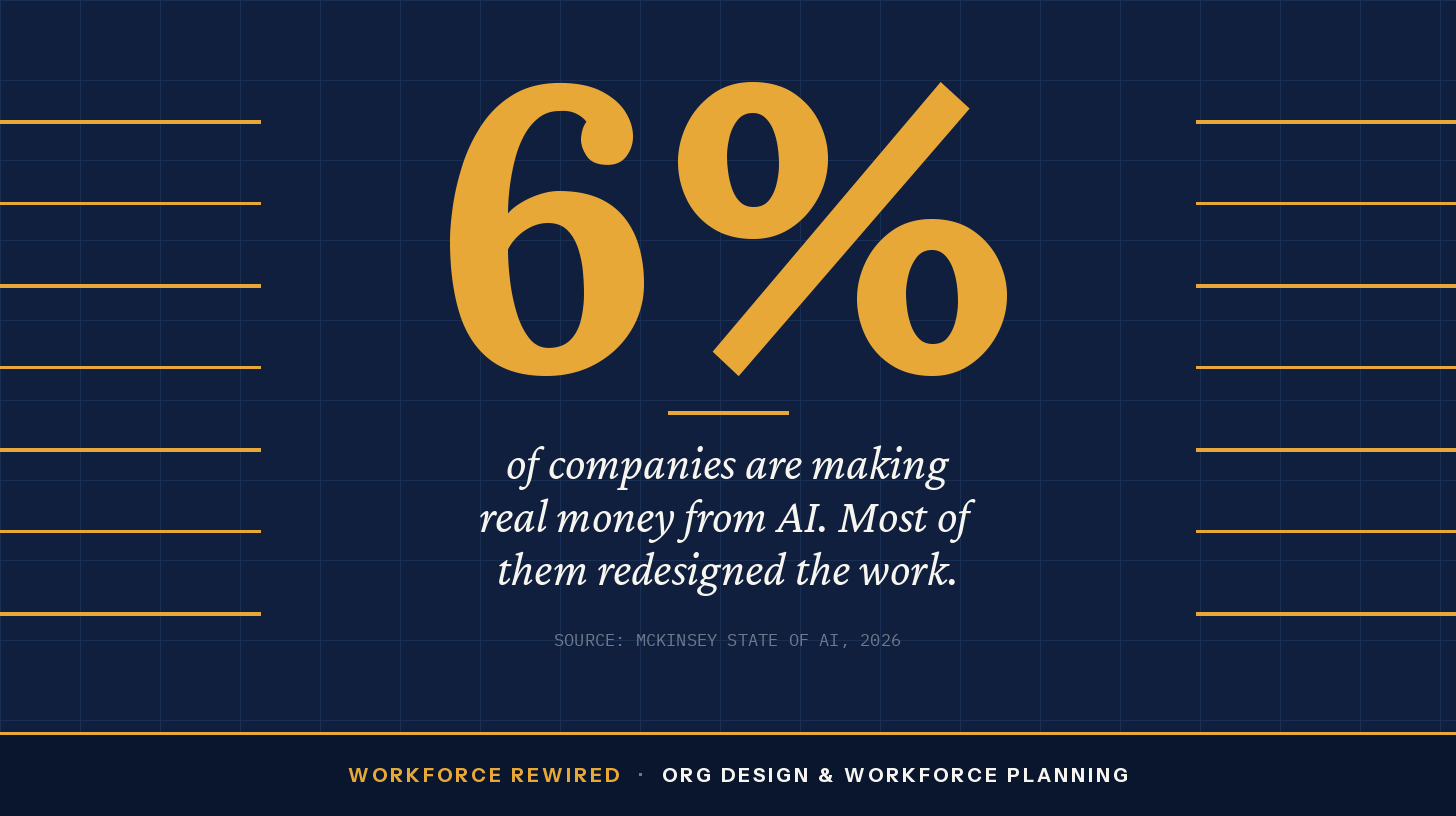
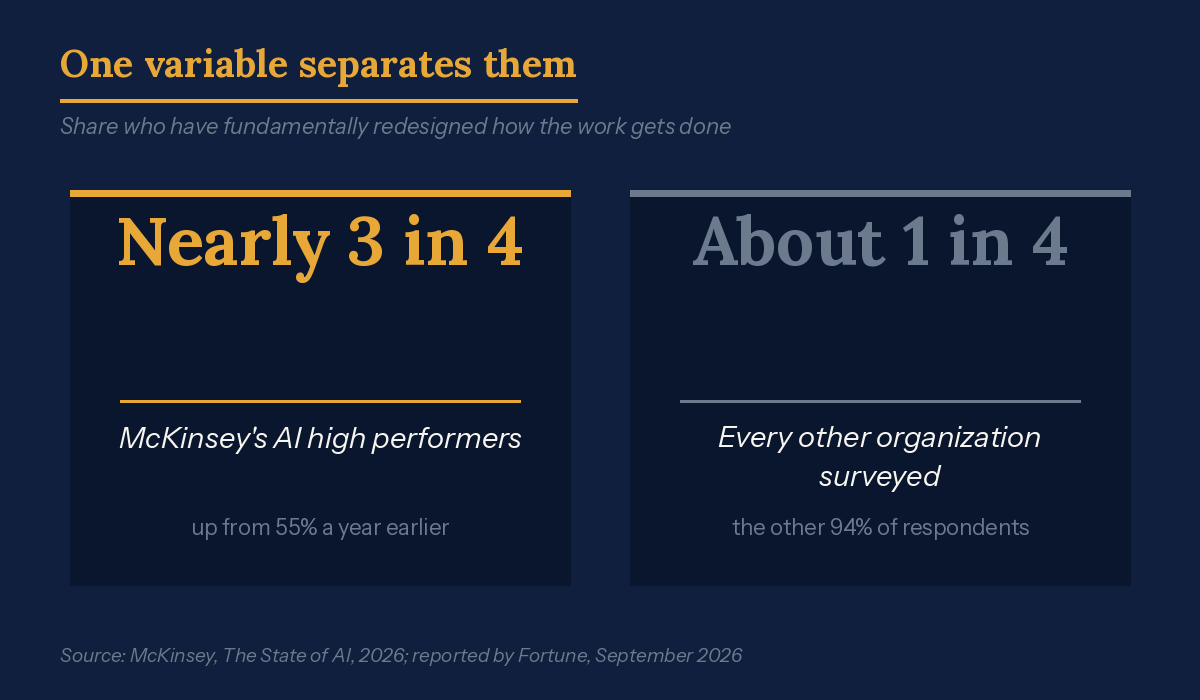
McKinsey calls the organizations that credit AI with at least 5% of their earnings “high performers.” About 6% of respondents qualify, flat year over year. The sharpest difference between them and everyone else: nearly 3 in 4 of the high performers have fundamentally redesigned how their work gets done, up from 55%, against roughly 1 in 4 of the rest. Sheryl Estrada reported the finding for Fortune in September.
McKinsey sells redesign consulting, so weigh the result accordingly. The number survives the discount. It’s the clearest thing in the survey separating the 6% from the 94%, and it describes an organizational change rather than a technical one.
Why the 6% stays small
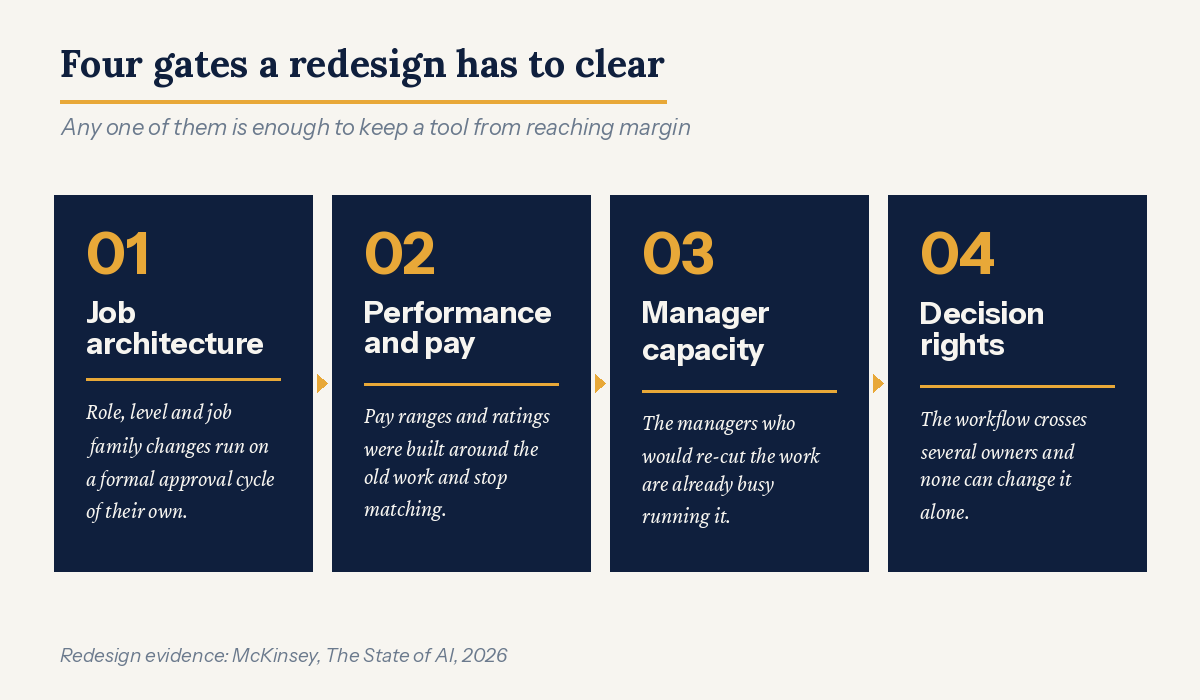
Four things stop a redesign inside a large company, and any single one of them is enough.
Job architecture comes first: the official map of titles, levels and job families. Changing what a role contains means rewriting its description, often its level, sometimes a whole family of related jobs, and in most large organizations that runs through a formal approval process on its own calendar. Org design and job architecture projects are famously tedious, sometimes taking years. Your company will have cycled through dozens of new Claude models by then.
Performance and pay come next. Performance ratings, pay ranges and job levels were built around the old work. Move the work and the compensation logic underneath it stops matching: a role that lost its most time-consuming task is now paid for a job it no longer does, while the role that absorbed the judgment is paid for the job it used to do. Correcting that takes a full pay cycle and somebody’s budget.
Then there’s manager capacity. Re-cutting work across a team is a project with a timeline, and the managers who would run it are already busy running the work as it exists. Nobody hands them relief for the time it takes.
Decision rights, meaning who gets to change what, finish the job. Any workflow worth redesigning crosses several owners, no one of them can change it alone, and the meeting where all of them sit down together isn’t scheduled, and good luck getting them to agree.
Nothing in that list concerns model quality or whether the technology works. The things that stop a redesign live in HR systems, budget calendars and approval chains, which is why buying more AI doesn’t move the ratio.
The second bill
Leaving the design alone costs something that never appears on Slok’s charts. When a tool takes over part of a job and the role stays as written, the work doesn’t disappear. It moves to whoever has room, usually the most senior person on the team, and the tasks that used to teach a new hire how the work goes are the first to go. The margin stays flat and the bench gets thinner at the same time.
Both versions of that team exist right now, and they look like group drive and unit drive. In the group-drive version, a company buys the licenses and the analyst who spent 3 days building the monthly reporting now spends half a day on it. The other 2 days fill with whatever was already queued. The role is untouched, the level is untouched, and nothing reaches margin.
The unit-drive version hands that reporting to the tool for good and rebuilds the role around the judgment work: a new description, probably a new level, a pay range to match, and a handoff that finance has to agree to. That’s 4 or 5 people and a pay cycle. It’s also the only version that shows up in Slok’s charts.
AI usage fees, billed in units called tokens, already limit about 1 in 5 organizations in McKinsey’s survey, the pressure I traced in The Price Fell 725-Fold and the Bill Still Broke the Budget. And Slok’s paragraph on accountability, trust and unwritten rules lands on the judgment premium, the part of a job that gains value as the routine work leaves.
The part leadership owns
Most people who read Slok’s charts this month will conclude that AI is oversold. The charts support a narrower and more useful claim: the payoff is missing at companies that bought the technology and kept the organization as it was. That’s an org design failure wearing a technology costume, and it belongs to leadership rather than to the vendors.
The optimistic reading is the accurate one. A constraint that turns out to be organizational is one somebody in the building can actually move, on a timeline they control, without waiting for a better model.
Here’s how you take action
Map one workflow this week, with the people who own the pieces. Pick a workflow where AI has already changed how the work gets done, get the 3 or 4 managers who own its parts into one room, order lunch, and write down what has to change before any saving shows up in margin: which roles, which spans, which handoffs, which decision rights, which skills. No budget cycle required, and that list is what every later step needs.
Fund the manager time before you fund the next license. Re-cutting work is a project, so set a timeline, name the manager, and take something else off their list for the duration. A redesign nobody has time to run won’t happen, whatever the roadmap says.
Address job architecture and compensation on day 1. Invite the people who own job families, levels and pay ranges into the design conversation at the start instead of meeting them at an approval gate in month 4.
Equip your managers to do design work, and advocate for a single owner of the workflow end to end. Most managers have never been taught to re-cut a job. Give them the craft: how to split a role, where accountability lands, what a span of control can carry. Then tell the executive who can create that authority that it doesn’t exist yet.
Electrification took 40 years because a factory full of leather belts had to become a factory laid out around the work, and the generation that managed it got a decade of productivity growth for the trouble. The companies that come out of this period with something to show will be the ones who spent 2027 arguing about job descriptions while everyone else was shopping for tokens.
Christina Lexa writes Workforce Rewired, on the intersection of workforce transformation, AI, and global talent.
The views expressed here are my own and do not represent the position of my employer or any organization I am affiliated with.