


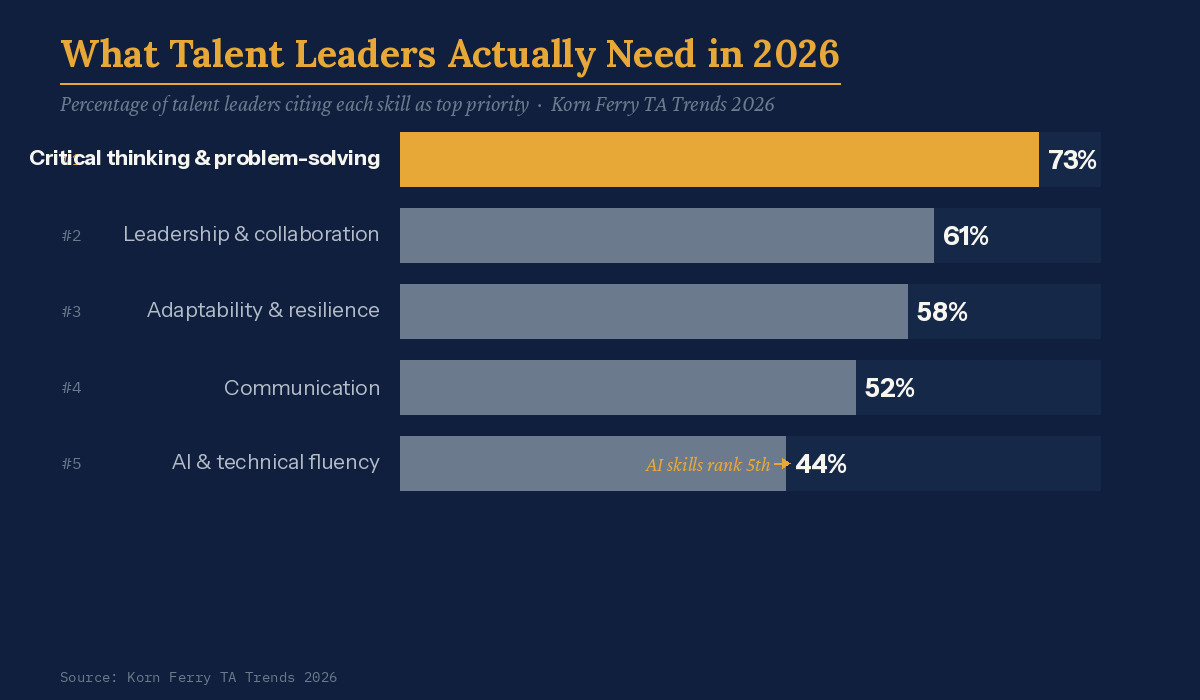
TL;DR: Workers who list AI skills on their resumes earn 56% more than those who don’t, per PwC’s 2025 Global AI Jobs Barometer. Companies read that and conclude they need to hire for AI fluency. Korn Ferry’s 2026 talent survey found that 73% of talent leaders say the skill they actually need most is critical thinking and problem-solving — AI technical skills ranked fifth. The organizations pulling ahead have figured out that the premium belongs to the combination of AI fluency and domain judgment, and those are two different things that require two different investments.
Last year, a large financial services firm required all managers to complete AI literacy training by Q3. Nearly everyone did. Then one of its mortgage analysts used an AI tool to produce a market comparison report with three factual errors and a miscalculated figure. The report went to a client without review. The analyst had passed her certification; she had never been taught to interrogate the tool’s output.
This is not a story about a negligent employee. It is about a company that treated fluency and judgment as the same investment, discovered they are not, and paid for the confusion with a client relationship.
The Number Everyone Quotes
The PwC 2025 Global AI Jobs Barometer analyzed nearly a billion job ads across six continents and found that roles requiring AI skills carry a 56% wage premium over comparable non-AI positions — up from 25% the year prior. In AI-exposed industries like financial services and software publishing, revenue per employee has grown more than three times as fast as in less-exposed sectors. Jobs requiring AI skills grew 7.5% year-over-year while total job postings fell 11.3%.
Executives read this data and move to hire AI-fluent people. That response is not wrong. It is incomplete.
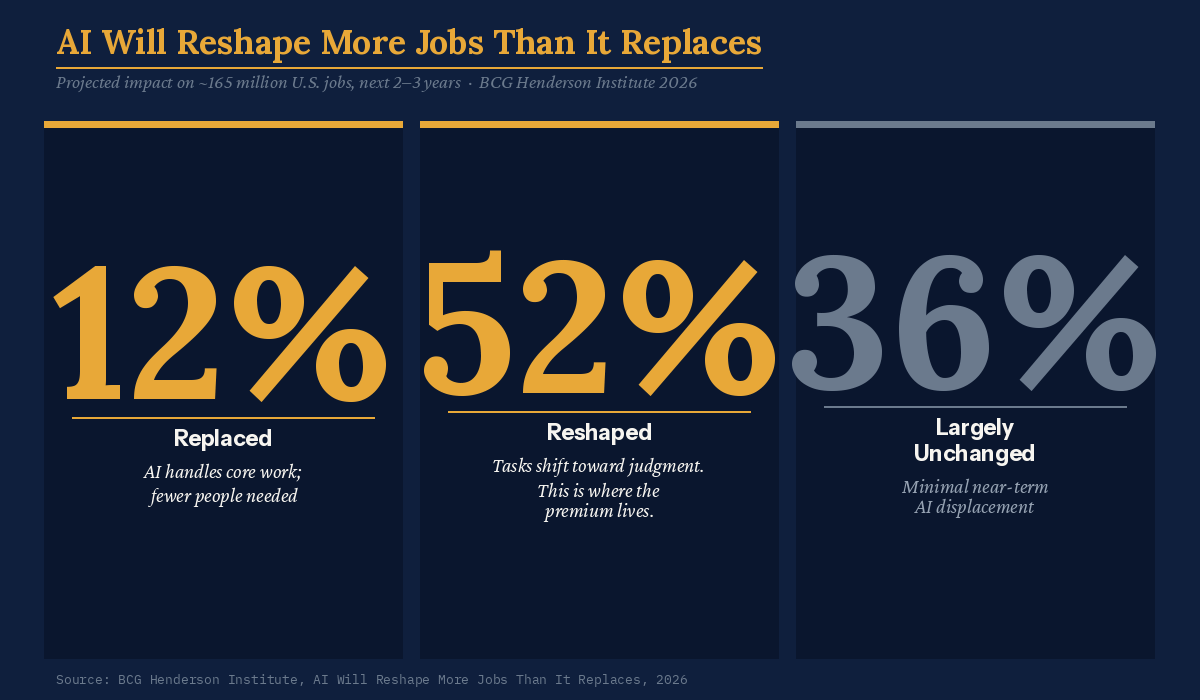
BCG’s 2026 analysis of approximately 165 million US jobs found that 50% to 55% of roles will be reshaped by AI within two to three years, with 10% to 15% potentially replaced outright. The majority will change shape: more automation of routine tasks, steeper expectations for the judgment work that remains. BCG calls one category “Divergent Roles” — where AI absorbs structured work, senior positions expand, and junior positions contract. The wage premium flows to the people who know what to do with AI’s output, not simply to the people who can generate it.
What Judgment Means, Specifically
“Judgment” is a word that can mean everything and therefore often means nothing, so let me pin it down.
Judgment in an AI context is the capacity to evaluate output against reality — to know the market comparison report is wrong because you understand the underlying market, not because you ran a spell-check. It is recognizing when an AI-generated summary has quietly shifted the meaning of its source document. It is the ability to ask, when the AI’s recommendation conflicts with what three years of domain experience tells you, which one to trust and why.
Deloitte’s 2026 Global Human Capital Trends report surveyed business leaders and found that 60% use AI in decision-making, and only 5% say they manage it well. Only 14% of leaders describe themselves as adept at shaping human-AI interactions. The gap between adoption and mastery is enormous, and organizations sitting in that gap are not collecting the 56% premium. They are getting AI-generated output that no one is equipped to challenge.
The same report found that 85% of leaders call adaptability critical, while 7% say they are actually leading on it. That disparity is a judgment problem: leaders who can identify the challenge but cannot translate their diagnosis into action. Technical skills did not cause that gap, and certifying more AI fluency will not close it.
What the Skills Data Actually Shows
The World Economic Forum’s 2025 Future of Jobs Report asked employers across industries to rank the core skills most essential to their organizations. Analytical thinking placed first, cited by seven in ten companies. Resilience and adaptability came second. Leadership and social influence came third. Creative thinking was fourth. AI and big data topped the list of fastest-growing new skills in demand — but the gap between “growing fast” and “most needed right now” is doing a lot of work.
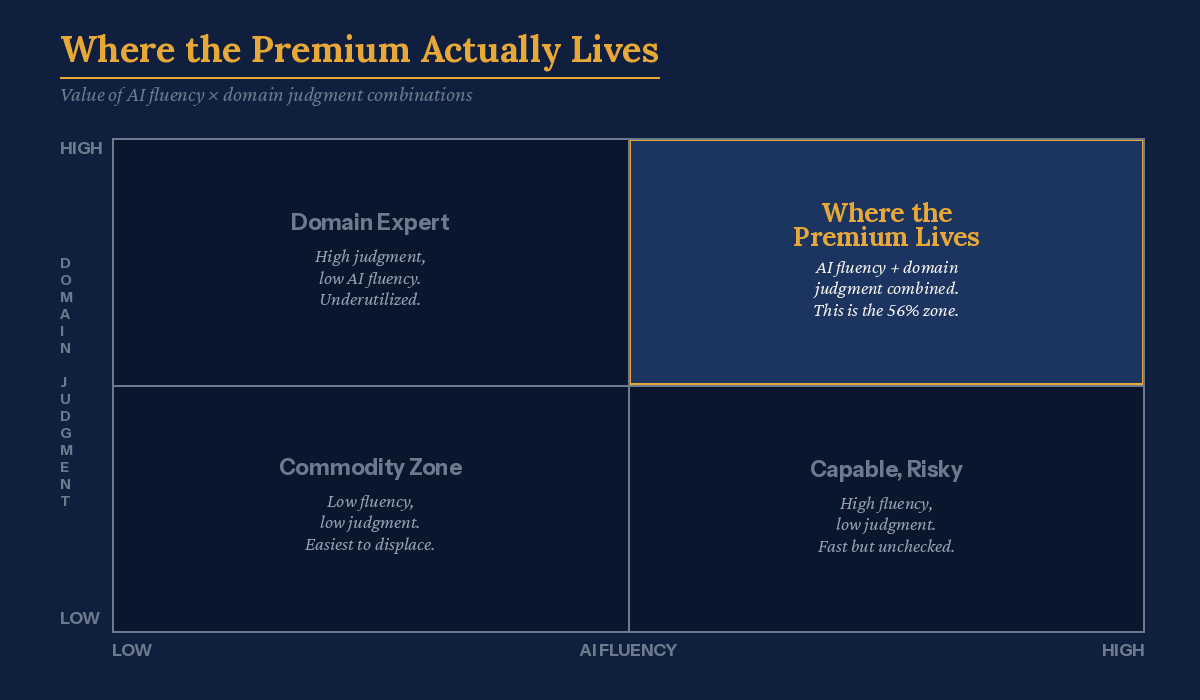
The WEF frames this as a “Great Skills Reset”: the half-life of a specific technical skill in 2026 is roughly 18 months. The professionals holding value across that constant churn can unlearn a method, evaluate a new tool, and apply domain expertise to the gap between what the tool produces and what the situation requires. PwC’s own read of its wage premium data lands in the same place: the jobs growing fastest are not “AI jobs” in isolation. They are roles where AI fluency operates inside deep domain knowledge. The software engineer who can code and prompt. The financial analyst who models and evaluates. The supply chain manager who runs the agents and catches what they miss.
The premium belongs to the combination.
The Lesson Most Companies Are Getting Wrong
Responding to a wage premium by hiring for the skill that generates it is a rational instinct. The problem is in the selection criteria.
AI fluency is screenable: you can test it, certify it, probe it in an interview. Judgment resists that kind of measurement. There is no judgment certification. “Quality of reasoning” does not appear on a standard competency rubric. So companies hire for what they can measure, and they get precisely the workforce they screened for — technically capable people with no particular preparation for knowing when to override the tool.
Korn Ferry’s 2026 talent acquisition data makes the executive-practitioner disconnect concrete: the CEOs setting hiring strategy are focused on AI technical expertise; the talent leaders executing that strategy cite critical thinking as the gap they actually cannot fill. They are solving for different problems.
The oversight-failure research supports this. The Boston University / MIT / BCG study on AI employee framing found that when AI is positioned as a colleague rather than a tool, manager oversight quality drops measurably and error-detection rates fall. The same dynamic runs through skills strategy: when “AI fluency” becomes the destination rather than the instrument, the critical evaluation that fluency is supposed to enable gets treated as optional.
I built workforce planning functions from zero across multiple organizations over nearly twenty years. The pattern was consistent: the most valuable people were not the fastest adopters of any given technology. They were the ones who understood the business well enough to tell you when the technology’s answer was wrong. That capability does not appear on a resume or in a certification. It accumulates from years of domain depth, and AI has made it more valuable, not less.
The Organizations Getting It Right
The companies pulling ahead are not necessarily running the largest AI training programs. They have redesigned work around an explicit question: where does human judgment belong?
That means being specific about it — not in a compliance sense, but in a capability sense. What is the AI most likely to get wrong, and who in this organization has the domain knowledge to catch it? Where does the AI’s answer need to be held against someone who knows the customer, the regulatory context, the history of how similar decisions played out?
Deloitte’s 2026 report describes the organizations leading on this as those that “redesign work for humans and machines for both business and human outcomes” and embed adaptation into the flow of work rather than treating it as a training event. That is a design problem, not a learning problem. Training tells your people how to use the AI. Design tells them where their judgment is irreplaceable. Most organizations are funding the first and ignoring the second.
Here’s How You Take Action
Audit your hiring criteria. If you cannot articulate how your interview process evaluates domain judgment — separately from AI fluency — you are probably not hiring for it. Fix the rubric before posting the next role.
Map the oversight points in your AI workflows. For every process where AI produces output that shapes a decision, name who has the domain expertise to evaluate that output and whether those people have explicit accountability for it. If no one does, the process is running without a judgment layer.
Disaggregate your training investment. Calculate what percentage of your AI learning spend teaches people to use tools versus teaching them to evaluate output. If that split is 90/10, your skills strategy is optimizing for the wrong variable.
Track mastery, not adoption. Deloitte found that 60% of executives use AI in decision-making and 5% say they manage it well. Most organizations report the first number. Report both, and close the gap between them.
Protect your domain depth. The experienced analyst who reads an AI-generated report and says “that’s wrong” is not a legacy employee awaiting replacement. She is the judgment layer that makes the AI worth running. Invest in her accordingly.
Christina Lexa leads workforce strategy for Technology at Capital One and writes about the intersection of AI, organizational design, and the future of work. Workforce Rewired publishes every week. If this piece made you think, share it with someone wrestling with the same questions.
The views expressed here are my own and do not represent the position of my employer or any organization I am affiliated with.