


TL;DR: The price of running AI has fallen faster than almost any technology in history, yet company AI bills keep climbing. Jevons Paradox explains why: cheaper AI invited far more use. Now every company has to decide, task by task, which work gets the expensive model, which gets the cheap one, and which still needs a person. Global capability centers show what that decision does to jobs.
I spent this week at Deloitte University, my old stomping grounds, at a conference on technology sourcing and global capability centers, in a room of people who decide for a living where work gets done and who does it. Tokenomics had its own slot on the agenda, and before that session I had never heard the word. Deloitte has been publishing research on it since January. Half the room nodded like it was old news. I made a note to look it up more deeply later.
Here is the plain version. A token is the unit AI providers bill by: a small chunk of text, a little less than a word. About 100 tokens make up 75 words of English. Inference is the model doing its job, answering a question, writing code, summarizing a document, as opposed to training, when it first learns. Tokenomics is managing what all those tokens cost, and Deloitte argues companies should track that spending as carefully as any major capital investment.
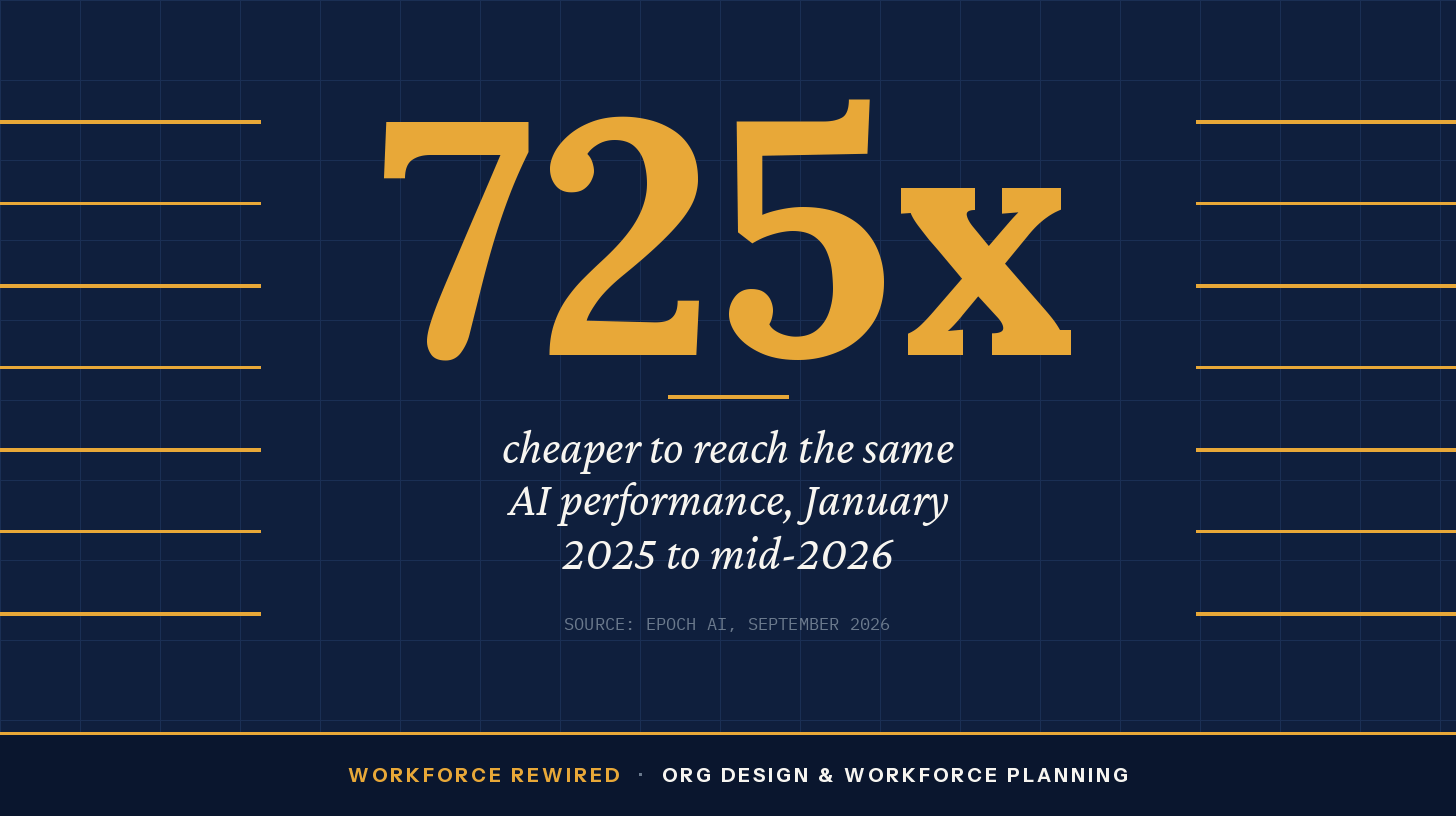
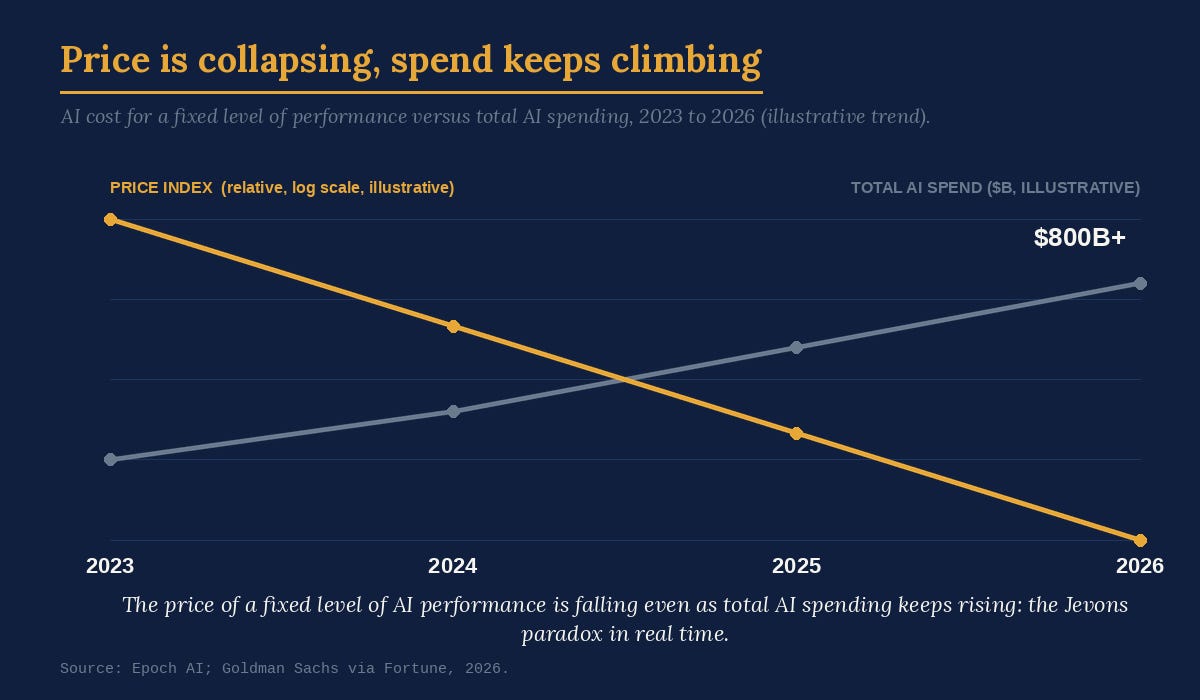
The cost of a token keeps dropping. Epoch AI found that the price of a given level of AI performance has fallen about 13-fold a year since 2023, faster than DNA sequencing, computer chips, or lithium batteries ever got cheaper. In January 2025, OpenAI’s o3 model scored 75 percent on a PhD-level science test at 30 cents a question. Eighteen months later, a newer model matched that score for four-hundredths of a cent: 725 times cheaper.
Enterprise AI bills did not fall 725-fold. Many of them did not fall at all. Lan Guan, Accenture’s chief AI and data officer, put it to Fortune in July:
“Clients are ready to scale AI, but then they hit this unexpected cost wall.”
Deloitte describes a healthcare company hit with more than $6 million in unbudgeted annual costs after its token use grew 8 to 10 percent a month for six months. AT&T, Deloitte reports, went from 8 billion tokens a day to 27 billion after rolling out AI agents, software that completes multistep tasks on its own. Uber spent its entire 2026 AI coding budget in four months, and its chief operating officer, Andrew Macdonald, told Fortune he could not connect that spending to more useful features shipped.
Jevons Paradox explains the gap. In 1865, the economist William Stanley Jevons noticed that as steam engines burned coal more efficiently, Britain burned more coal overall. Cheap AI works the same way. Companies ran more queries, built more agents, and put the tools in more hands, and use grew faster than prices fell. Google’s monthly token count rose from 9.7 trillion in 2023 to more than 3.2 quadrillion now, a 330-fold jump. Goldman Sachs expects total AI-related spending to top $800 billion this year.
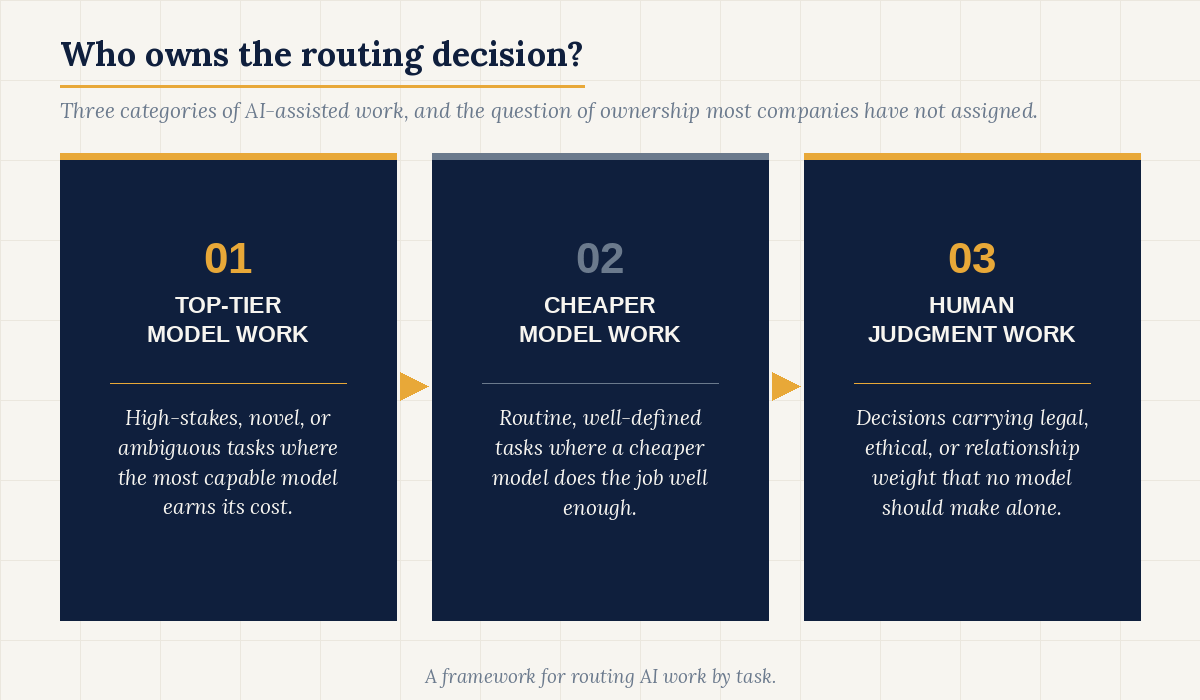
That gap turns a purchasing question into a workforce question. Accenture estimates that only 10 to 20 percent of business tasks need the most advanced and expensive models. So every company now has to sort its work: which tasks earn the expensive model, which can run on a cheaper one, and which still need a person who answers for the result. I sort work like this every day. I lead workforce strategy for Technology at Capital One, including its Non-Associate Labor program, which governs the strategy which work goes to employees and which goes to contractors. AI adds a third option to that decision: the model.
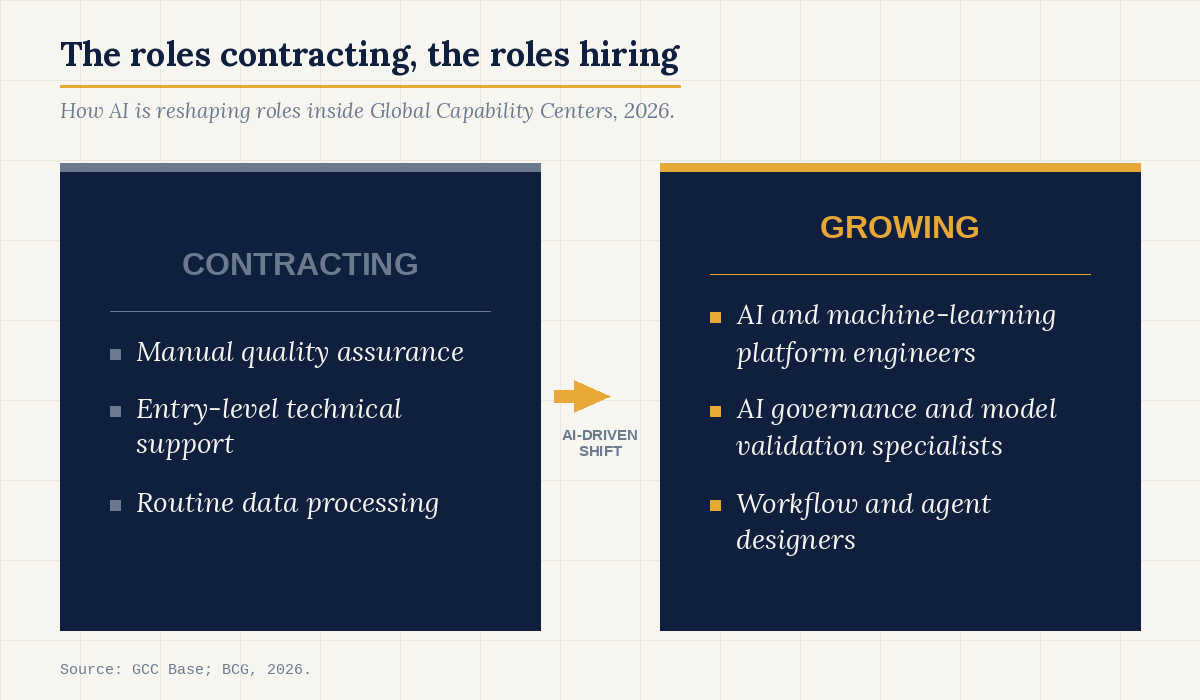
Global capability centers, the hubs where companies run finance, IT, and engineering work in cities like Bangalore, Krakow, and Manilla, show the change first. GCC Base reports that work once done by ten people by hand now runs with three people supervising AI agents. Those three do a different job: checking the agents’ output and making the judgment calls. The jobs shrinking fastest are manual quality testing, entry-level tech support, and routine data processing. The jobs growing are engineers who run AI platforms, specialists who check AI systems for errors and risk, and people who design the workflows agents follow.
BCG found in September that companies that redesigned jobs around AI beat their peers’ annual shareholder returns by more than 11 percentage points. Reserv, an insurance technology company, cut the time to build a training program from eighteen months to four weeks, and its response time to regulators from three days to one hour. BCG says the companies pulling ahead are creating new kinds of jobs: people who capture what experts know so an agent can use it, and people who redesign workflows end to end, with a person still answering for the result.
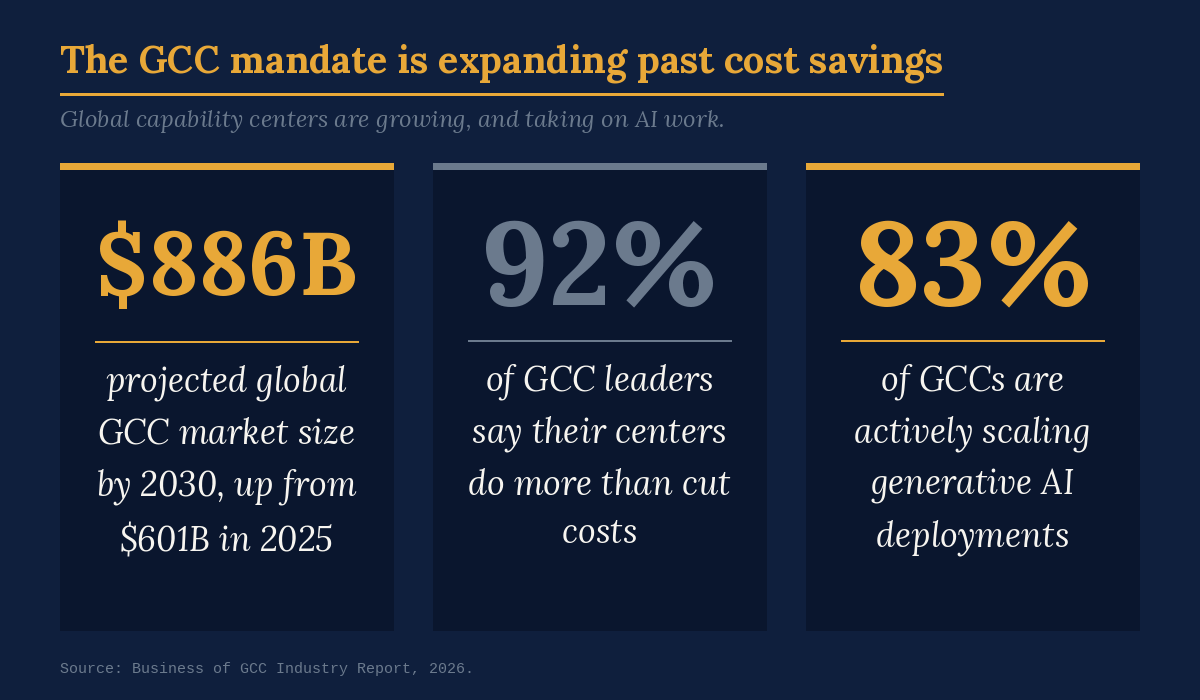
Before Capital One, I led Deloitte Global’s talent strategy. In both jobs the question has been the same: which work goes to a global capability center or international talent hub and where, which goes to a contractor, and which stays close to the corporate center. GCCs now face that question with AI in the mix, and their numbers point one direction. Business of GCC values the market at $601 billion, headed for $886 billion by 2030. Ninety-two percent of GCC leaders say their centers now do far more than cut labor costs, and 83 percent are expanding their use of generative AI. If GCCs existed only to be cheap, cheaper AI would be shrinking them. Instead, McKinsey found that 84 percent of companies plan to expand the scope of their shared-services operations within two years. Companies are moving judgment work into the hubs.
McKinsey also found that 88 percent of companies experiment with AI but only 19 percent see a meaningful bottom-line gain. One in six has no executive who owns AI decisions, and only 14 percent plan their workforce flexibly; most do it once a year or less often. The token decisions, which work gets the expensive model, the cheap one, or a person, are being made mostly by finance and engineering. Workforce leaders are rarely in the room. A CFO who rules that a task is not worth the top-tier model has just made an org design decision without calling it one.
Here’s how you take action
If you lead people or design organizations, do not wait for Finance to hand you the org chart it just drew by accident.
Ask for a seat where token budgets get set. Finance and Tech are deciding which work to automate without workforce strategy weighing in on the plan.
Sort your work before someone sorts it for you. For each task, decide whether it needs the top-tier model, a cheaper one, or a person you can stand behind in front of a client or a regulator.
Check your GCC plan. If it still reads like a plan to do the same work somewhere cheaper, it is out of date.
Christina Lexa writes Workforce Rewired, on the intersection of workforce transformation, AI, and global talent.
The views expressed here are my own and do not represent the position of my employer or any organization I am affiliated with.