


TL;DR: Two-thirds of companies now require or push their people to learn AI. The best research on what makes training stick puts one component near the top, and it is that the learner chose to be there. A requirement removes exactly that, which makes the mandate the most expensive part of the plan rather than the cheap part. Georgia ran the controlled version of this experiment on teenage drivers, and the fix that finally worked contained no course at all.
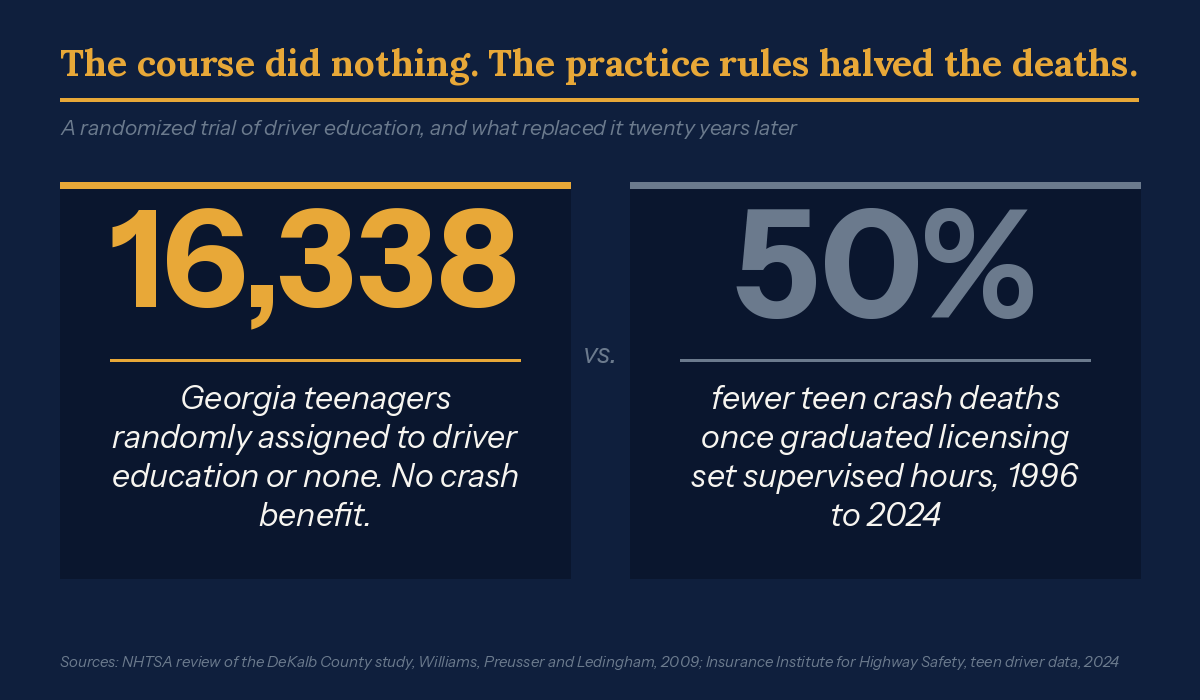
The government once paid for the most rigorous experiment anyone has run on teaching people to drive. The DeKalb County study, reported in 1983, enrolled 16,338 high school students in DeKalb County, Georgia who wanted their licenses. Researchers sorted them by grade point average, gender, and family income, then randomly assigned them inside each school to one of three groups: a long designed driver education course, a short minimum course, or no instruction at all. The project cost more than four million dollars and was sized to catch a crash difference as small as 15 percent.
It caught nothing. NHTSA’s own review of the project reports no crash benefit across the assigned groups. The reanalysis went further in the other direction. Lund, Williams and Zador returned to the data in 1986 and found that students who took the full course carried a higher risk of crashes and violations than the control group, roughly 8 percent more crashes and 11 percent more violations. The mechanism was exposure. Driver education taught teenagers to get licensed sooner, 16 percent sooner for the full-curriculum group, which put more of them on the road younger. Every analysis of DeKalb agrees on that one finding. The course moved the licensing date forward and left driving ability where it found it.
What finally worked arrived thirteen years later and contained no curriculum. Florida passed the first graduated licensing law in 1996: a minimum age, a waiting period, a night driving restriction, limits on teenage passengers, and required hours of supervised practice before anyone drove alone. Susan Baker, LiHui Chen and Guohua Li at Johns Hopkins measured an 11 percent drop in fatal crashes among 16-year-old drivers across states with these laws, and about 20 percent in states that adopted at least five of the seven components. Teen crash deaths fell by half between 1996 and 2024, from 5,819 to 2,899, according to the Insurance Institute for Highway Safety, which now recommends at least 70 hours of supervised practice and reports that the variety of the practice matters more than the hours. The same institute sums up the classroom research in one line: formal evaluations of American high school driver education show little or no reduction in crashes per licensed driver.
Companies are at the DeKalb stage with AI, and they are buying the course.
The requirement is the new part
Two-thirds of employers now require or strongly encourage their people to learn AI, according to Forbes’s account of a Study.com survey of 1,000 employees in March. That compulsion is recent.
I argued in April, in The Upskilling Industrial Complex, that the workforce development market gets paid for activity rather than outcomes, that it counts enrollments because enrollments are countable, and that the programs with evidence behind them are the ones built around real work. That piece looked outward, at vendors, pledges and government money. It took for granted that the learner showed up because they wanted to. Inside a company in 2026 that is no longer true, and the requirement does something the market critique did not predict.
Nobody knows how much of the spending works. American organizations put $102.8 billion into training in 2025. The most quoted claim in the field is that only 10 percent of it transfers to the job. That figure comes from a 1982 article by David Georgenson, who opened by asking readers how often they had heard training directors say it. He cited no evidence for it, and Robert Fitzpatrick, tracing the claim decades later, found it repeated as a finding in peer-reviewed journals. The number everyone recites about whether training works started life as a rhetorical question.
Where AI skill is actually coming from
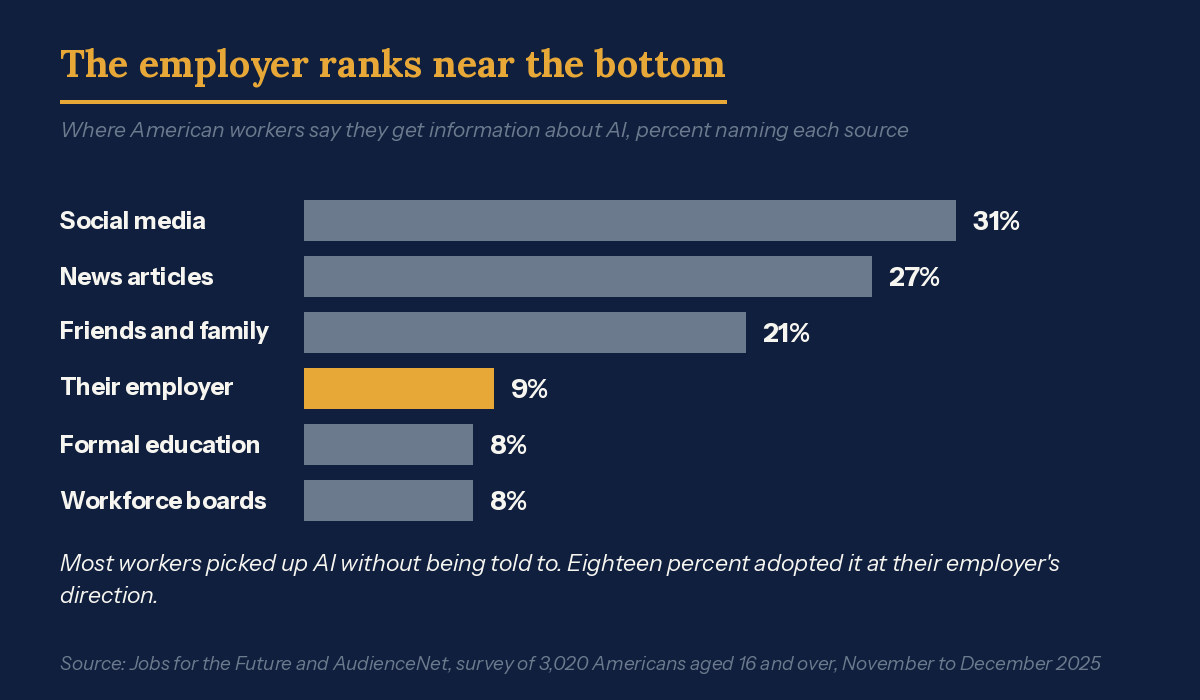
Jobs for the Future, a nonprofit, had AudienceNet survey 3,020 Americans aged 16 and over in late November and early December of 2025. Nine percent of workers name their employer as a place they get information about AI. Social media came in at 31 percent, news articles at 27, friends and family at 21. Formal education tied with the employer at 8.
Ask the same workers how they plan to get better and the answer keeps its shape. Sixty-two percent intend to experiment on their own. Eighteen percent took up AI because their employer told them to, up from 11 percent in 2024, which leaves most adoption happening without instruction.
The Conference Board found the squeeze underneath all that. In its Skilling for AI research, built on interviews with 35 enterprise leaders and a survey of nearly 1,300 workers, 55 percent use AI daily or weekly while 33 percent received employer AI training in the previous six months. Forty-eight percent say they have sufficient work time to build AI skills. Slightly more than half of the workforce is being asked to get good at this in time that does not exist. I raised that gap in a briefing in July and left it open.
What makes any of it stick
Brian Blume, Kevin Ford, Timothy Baldwin and Jason Huang pulled together 89 studies of training transfer covering 12,496 people for the Journal of Management in 2010. Their first result is the humbling one. Once they set aside the studies that asked the same person to rate both the training and their own improvement, very few predictors held a strong relationship with transfer at all.
Two of the survivors belong to the employer. Voluntary participation correlated at .34. Supervisor support came in at .31, on small enough samples that the authors flag it themselves. Transfer climate reached .27 and peer support .14.
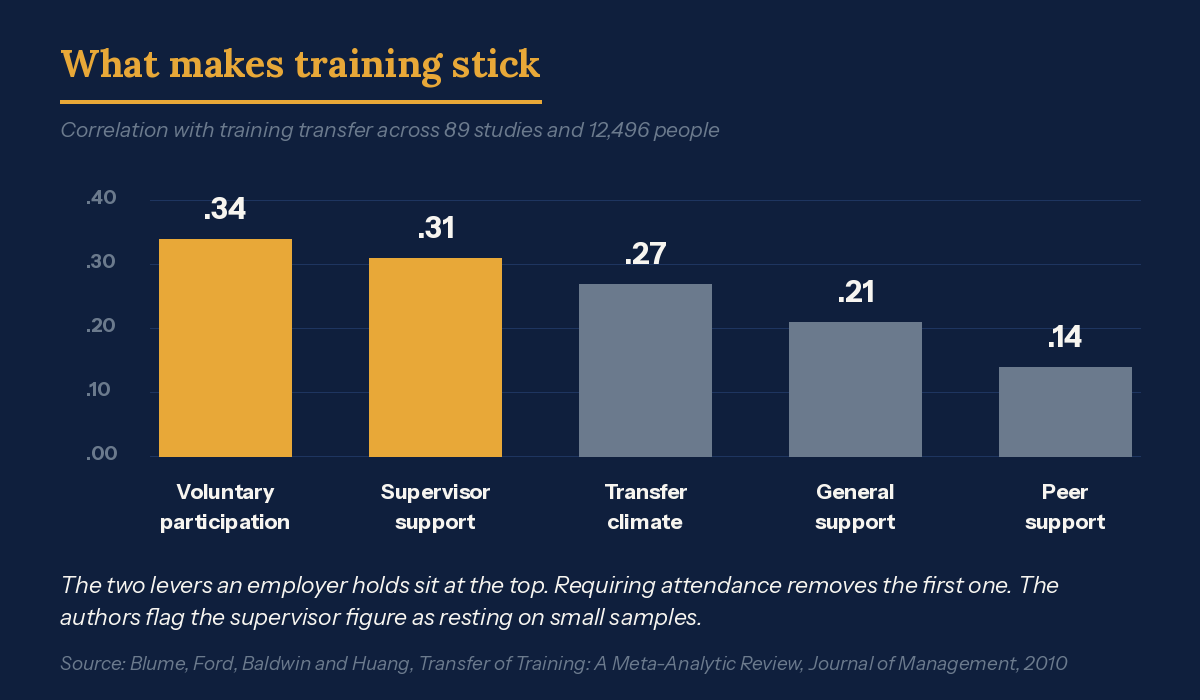
A mandate lands squarely on the first one. It merges the people who would have opted in with the people who would have stayed away, measures both the same way, and reliably produces attendance. Last month I wrote about Amazon’s AI leaderboard and the tokenmaxxing it produced, where counting AI use in a performance context corrupted the count within weeks. The requirement is the same move one step earlier in the process.
Be careful how much that correlation can carry. People who sign up arrive already motivated, and that motivation does some of the work the number gets credit for. The narrower claim survives the objection and still costs the mandate its case: the people who learn are the people who wanted to, and requiring attendance does not create that want.
The honest case for requiring it
The strongest objection is about fairness, and it has data behind it. Left to self-direction, learning follows whoever already has room to learn. JFF’s own numbers show the split: 37 percent of workers got AI training at work, and only 31 percent of workers without a four-year degree did. The person with a crowded shift and a manager who counts minutes is the one self-direction abandons. A mandate at least reaches them.
It usually reaches them with a course. The Conference Board asked leaders what building AI skill actually takes and got three things back: dedicated time, hands-on experience, and managerial support. A requirement to complete a module supplies none of them. The fairness argument is the best reason there is to fund those three deliberately, so they reach the people who did not draw a generous manager, and it is an argument for a budget line rather than a policy.
What the better version looks like
New York State built something close to the right shape this year. In April, Governor Hochul extended AI training to more than 100,000 state employees, a two-part responsible-use program developed with InnovateUS. AI Pro came with it, a protected assistant built by the state’s technology office where an employee can work on a real task without risking anything. The course is the small part. The sandbox and the real work are where the hours go. Last week the state added a $10 million AI Jobs Institute in Queens with Pursuit, aiming at 40,000 New Yorkers by 2032, built around placement rather than enrollment.
Building Deloitte Global’s and now Capital One Tech’s workforce planning function meant doing a job nobody had written down, and what taught me was delivered through early strategy attempts corrected by people senior enough to be blunt about their feedback. No course catalog carried any of that.
I firmly believe exposure, support, practice, and recognition/reward is the best way to solidify any learning, and that’s the method I try to implement with my own teams. I encourage my team to use protected practice hours, publicly celebrate applied AI work, and brainstorm with my teams on practical ways to use the tools. I also share how I’m using the tools to help spark ideas. I’ve also found that encouraging the team to share AI fails also helps reinforce learning as well as creates some real laughable moments - including the time Gemini got very creative in generating a map of our workforce footprint.
The default to want something to measure, like learning hours or participation counts, is why states kept mandating driver education for decades after Georgia showed what it did. A course is countable, relatively cheap to administer, and simple to prove you provided. Supervised hours are expensive and hard to count. The course keeps winning the budget meeting and keeps losing the experiment.
Here’s how you take action
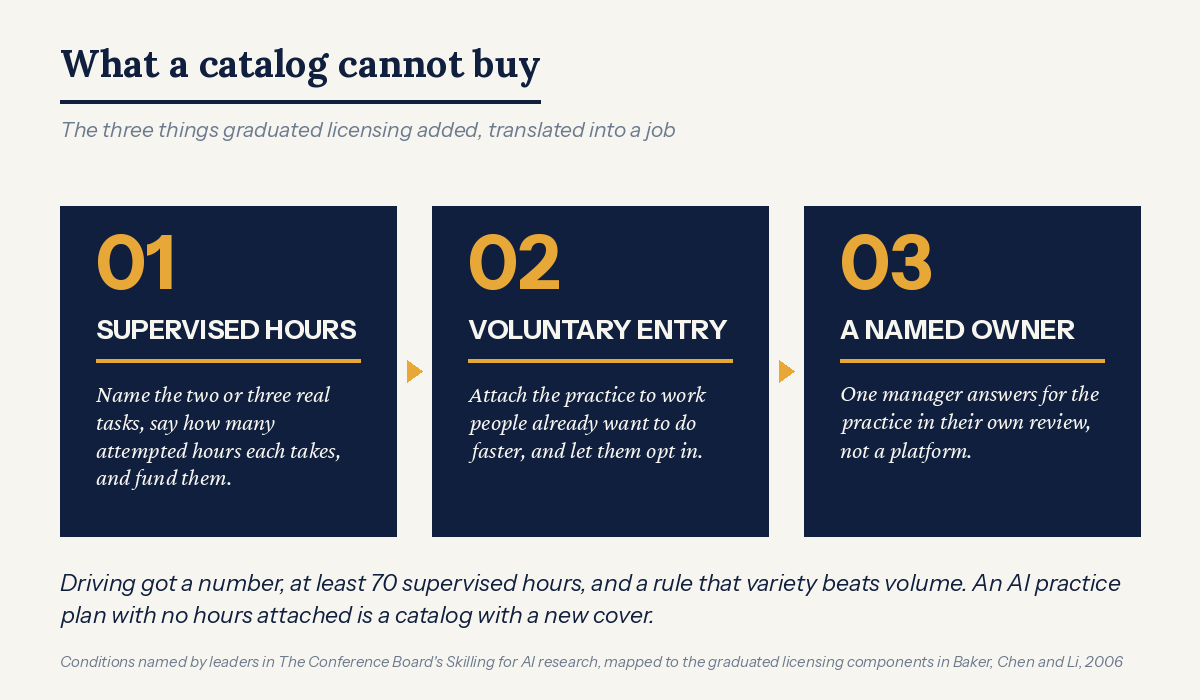
Identify and protect the practice hours before you buy another course. Pick two or three real tasks where AI should change how your team works, say how many hours of supervised attempts each one takes, and fund those hours. Provide lunch and do it in a social way by gathering them in a virtual or in-person meeting room to learn together. Half your people already say the time is not there, so a number somebody owns beats a catalog nobody finishes.
Make it voluntary, then make it worth volunteering for. Voluntary participation holds the strongest honest claim in that research, so stop converting it into a requirement. Attach the practice to a task people already want to do faster, let them opt in, and publish what the first group produced.
Put a manager on the hook instead of a platform. Managerial support is one of the three things the Conference Board’s leaders named and one of the two predictors that survived the meta-analysis, and it costs a manager’s time rather than a license fee. Equip your managers with ideas and tools to support their people, and be a visible advocate yourself.
Count finished work, not logins. Amazon’s leaderboard turned into a game because usage was the easiest thing to count. One piece of real output an employee could not have produced three months ago tells you more than a quarter of dashboard activity, and it cannot be “maxxed”.
The uncomfortable part is that the right answer has no easy path. Nobody sells supervised hours, no vendor reports a completion rate on them, and the cost lands on managers who are already short. What a mandate buys is a receipt. The companies whose people are actually good at this in 2030 will be the ones who paid for the practice while everyone else was buying the course.
Christina Lexa writes Workforce Rewired, on the intersection of workforce transformation, AI, and global talent.
The views expressed here are my own and do not represent the position of my employer or any organization I am affiliated with.