


Editor’s note: This piece is nonpartisan. It takes no side in the election, looks at how the outcome impacts AI, and describes each party’s position in its own terms. It exists because governments at the national, state/provincial, and local levels will decide how AI progresses as an industry, in how it impacts work and organizations, and as a tool people use. As of this writing, votes are still being counted and not every race has been called.
TL;DR: Tuesday’s results hand Democrats both chambers of Congress while the President keeps the veto through January 2029, which likely means more AI oversight and few new AI laws. The new rules that reach an HR department, from California and Colorado, start to come January 1, 2027. Voters from both parties told Gallup they want AI safety rules, towns in at least 7 states voted on data centers, and the market’s verdict on Wednesday was split down the middle and dramatically worse come today. Here’s what changes for workforce leaders, what doesn’t, and what to do before New Year’s Day.
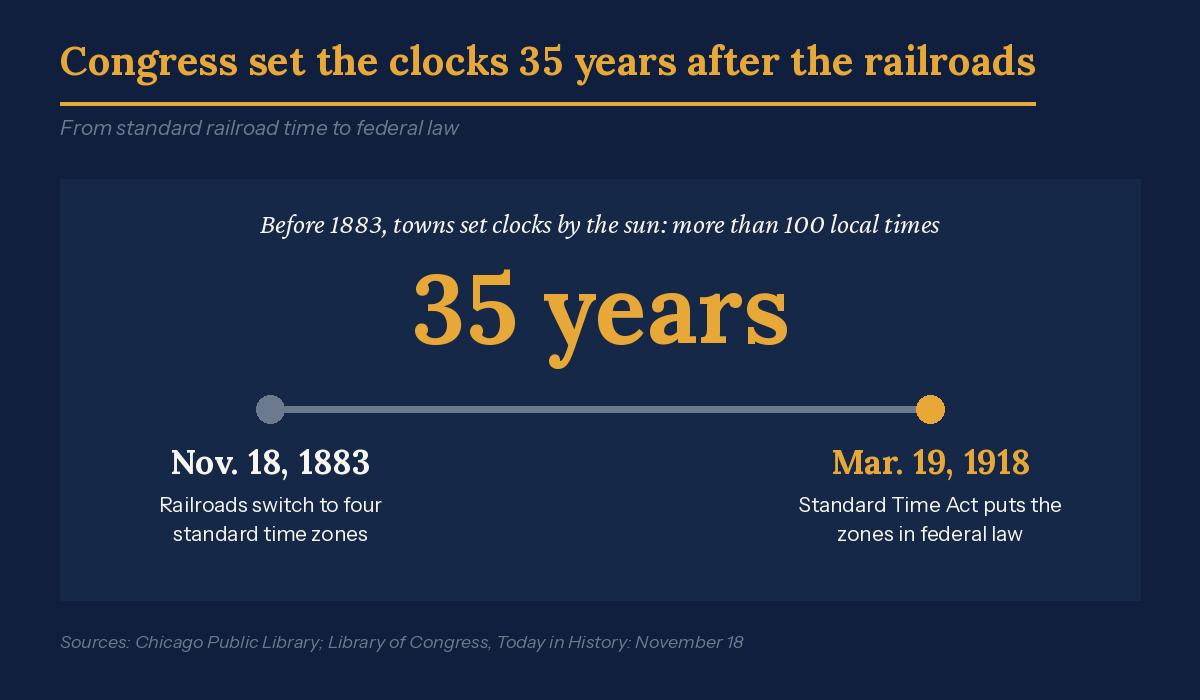
On Sunday, November 18, 1883, at noon, North American railroads switched to standard time. Before that day, towns set their clocks by the sun, and the Chicago Public Library counts more than 100 different local times in use, a nightmare for anyone printing a train schedule. Railroad executives had met at Chicago’s Grand Pacific Hotel on October 11 and adopted a plan from William F. Allen, secretary of their General Time Convention, for zones an hour apart. Towns whose clocks ran ahead of the new time set them back at noon and got what’s remembered as the Day of Two Noons.
Congress didn’t write standard time into federal law until the Standard Time Act of March 19, 1918. That’s 35 years later. By then the zones were so settled that the law mostly ratified a system the people running trains had built because they couldn’t wait for Washington.
The employers that use AI to decide who gets hired, promoted or cut are in the same position now, and Tuesday’s election doesn’t change that.
What changes in January
NBC News projections on November 4 gave Democrats 258 House seats and 54 in the Senate, and two Senate races were still open as of November 5. In Mississippi, Democrat Scott Colom led Sen. Cindy Hyde-Smith by just over 1,100 votes with about 96% counted, per CBS News. Alaska is still counting mailed ballots, with a ranked-choice tabulation set for November 18 if no one clears 50%, per KNOM. Those numbers will shift as counting finishes. The structure they produce won’t.
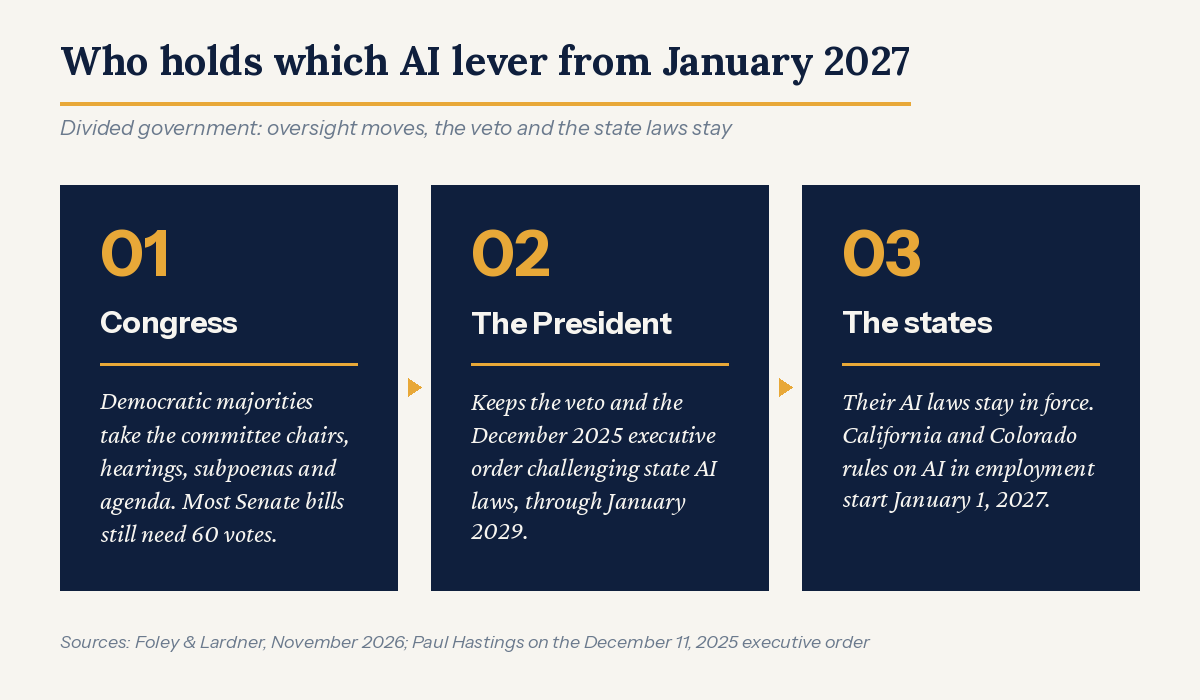
Starting with the 120th Congress in January, Democrats will chair the committees, set the hearing schedules and hold subpoena power. The law firm Foley & Lardner expects oversight to come first: hearings, document requests and testimony from AI executives on safety incidents and model testing.
The President keeps the veto, and most Senate bills still need 60 votes. Neither party has the numbers to pass a sweeping AI law alone, so Foley gives the best odds to bills that already have sponsors from both parties, such as children’s online safety and chip export controls.
One of those bills is a workforce bill. Sens. Mark Warner, a Virginia Democrat, and Josh Hawley, a Missouri Republican, announced the AI-Related Job Impacts Clarity Act in November 2025. It would require major companies and federal agencies to report AI-related layoffs to the Department of Labor every quarter, and the department would publish the totals. Today, every company decides for itself whether a cut gets explained as AI, restructuring, or “efficiency.”
The two sides start from different places. The administration’s December 2025 executive order, “Ensuring a National Policy Framework for Artificial Intelligence,” argues that a patchwork of state rules slows American AI development, and it set up a Justice Department task force to challenge state AI laws in court. Most Democratic proposals, per Foley, treat federal AI rules as a floor that states can build above. That disagreement is why Congress probably won’t settle the state question soon, which leaves the states writing the rules employers must follow.
What doesn’t change: the January 1 deadline
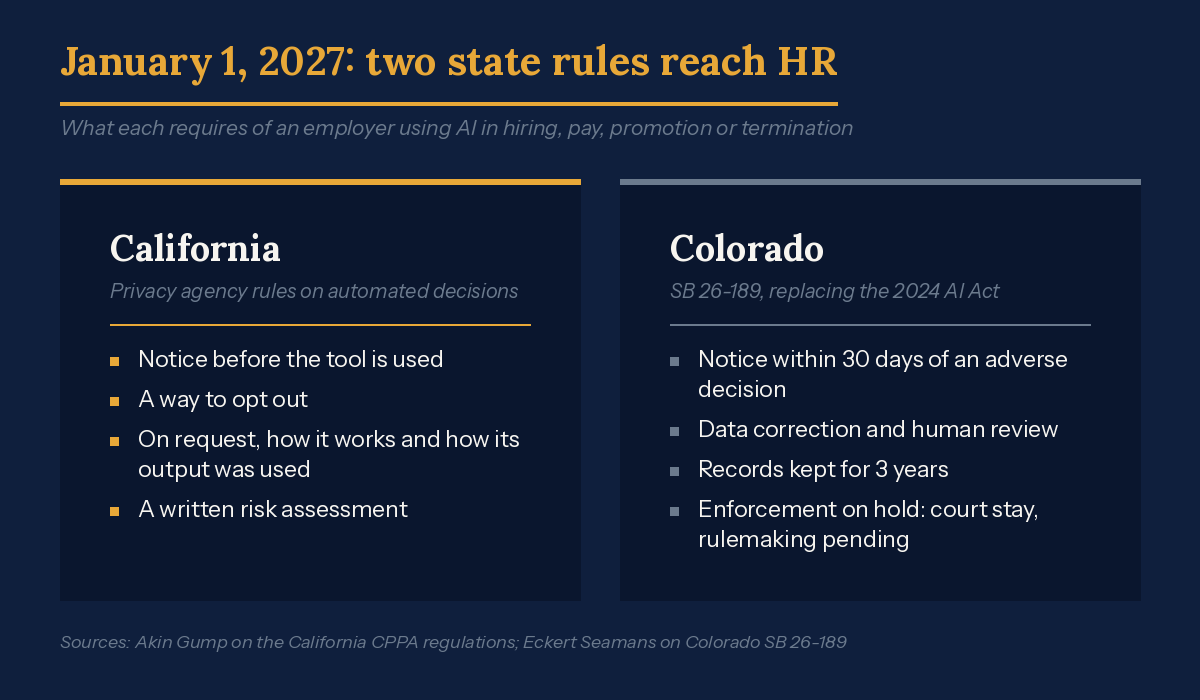
California’s privacy regulator finalized rules in 2025 on automated decision-making technology, the legal term for software that makes or heavily shapes a decision about a person. Hiring, promotion, pay and termination are covered. A company already using these tools has until January 1, 2027, to comply, per the law firm Akin Gump. That means a notice before the tool is used, a way to opt out, a plain explanation on request of how the tool works and how its output was used, and a written risk assessment.
Colorado replaced its 2024 AI law in May with a narrower one, SB 26-189, also set to take effect January 1, 2027, per Eckert Seamans. An employer whose AI tool materially contributes to an adverse decision has to tell the person within 30 days, explain the tool’s role, offer a way to correct the data and request meaningful human review, and keep records for 3 years. An AI developer sued over the original law in April, the Justice Department joined on the developer’s side, and a federal court paused enforcement. Eckert Seamans reports that the pause extends to the replacement law, and the state attorney general hasn’t started the required rulemaking.
The election didn’t change either state’s implementation date, and it didn’t move the lawsuit 26 Meta employees filed in federal court in Oakland in July, alleging that AI systems, activity monitoring and token-usage dashboards fed the choice of who was laid off, and that those metrics penalized people on medical or parental leave. Meta says the claims “lack merit and are not based on facts” and that people make its workforce decisions. Whichever account holds up, the case includes the question every one of these rules asks: what went into the decision, and can anyone explain it? I wrote about who carries the accountability when AI gets it wrong in Who Owns the Mistake. In this situation, the Courts will establish the rules before Congress writes the law.
Voters from both parties gave Gallup the same answer
The Special Competitive Studies Project and Gallup asked Americans this year what they want from AI policy. Among them, 79% favored keeping safety and data-security rules even if that slows development, and 75% wanted independent experts to test new systems before wide release. Republicans were 11 points more supportive than Democrats of reducing AI regulation, and Gallup reports that Republicans, Democrats and independents gave the same answers on safety-first rules and independent testing.
The poll didn’t ask about hiring or layoffs, but the pattern carries over. People of every party want a check on an AI system before it acts on them, and notice plus human review is that check in an HR department.
Data centers went on the local ballot
The most direct votes on AI on November 3 happened at the local level. Voters decided about 41 local measures on data centers across at least 7 states, according to Forbes’ tally of early results, and Ohio alone had 21. Most were moratoriums, bans on large facilities or zoning limits, and most appeared to pass. Bloomington, Illinois, backed an advisory moratorium with 78% of the vote. Edgewater, Florida, approved a moratorium with at least 77%, and more than 80% of voters in Ashville, Ohio, rejected a data center that was already under construction. Residents cited electricity bills, noise and land use. Supporters, including the President, argue the facilities bring tax revenue and jobs. The opposition crossed party lines, at uneven rates: a Politico poll in October, cited by Forbes, found 65% of Democratic voters and 36% of Republican voters opposed data centers.
For workforce planners, those town votes decide where the physical side of AI gets built, and with it the construction and electrical jobs I wrote about in The Smartest Industry in the World Can’t Find an Electrician. A moratorium in one county can move that work, and those jobs, to the next one.
The market swung both ways
The day after the vote, November 4, the Dow rose more than 1,500 points in its best session in more than a year, per ABC News, while the AI trade split in two. Intraday, Microsoft rose about 6% and Alphabet about 4.6%, while Nvidia fell about 2.2% and Intel about 5.8%, according to Decrypt’s review via Yahoo Finance, which cited Reuters on investor worries about tighter scrutiny of data centers.
The next day reversed it. On November 5, the Nasdaq Composite closed down 5.5%, its worst day in 18 months, the S&P 500 fell 4.4% and the Dow fell 3.4%. Nvidia lost about 9% and AMD about 17%. Yahoo Finance tied the selloff to two things: investors reassessing whether heavy AI infrastructure spending will pay off, and concern that the election results could bring regulatory limits on data-center development, the same fight that showed up on local ballots.
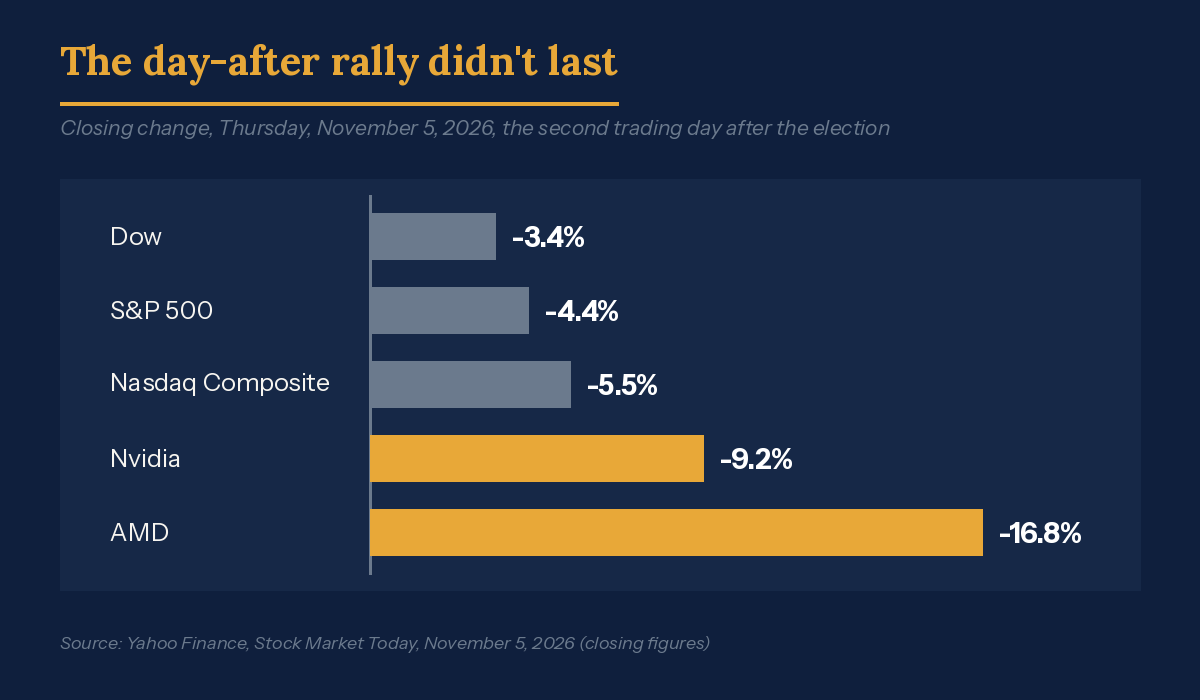
Two trading days that moved in opposite directions say investors are still working out how much of the AI build-out carries political risk, and it’s too early to read anything about jobs into either one.
Why this lands on HR
Every rule above governs a people decision. The software in question is usually embedded inside something the company already does: a screening step in the applicant tracking system, a ranking in the performance tool, a dashboard someone started using in a layoff review. In most companies, nobody has a complete list of where those tools touch a decision about a person.
Here’s how you take action
Map every AI tool that touches a people decision this week. Get HR technology, talent acquisition and employment counsel into one room, order lunch, and list every screening feature, ranking, score and dashboard that feeds a hiring, promotion, pay or termination decision, including the ones built into vendor software. No budget cycle required, and both California and Colorado’s rules start from that list.
Equip managers to explain a decision in plain language. California gives people the right to ask how a tool’s output was used, and Colorado gives them a right to request human review. A manager who can’t explain what the tool did can’t do either one, so teach them ASAP.
Protect the human review step with real time. A review that takes 4 minutes because the manager has 40 of them is a not a defensible review.
Advocate inside your company for one rule set across every state you operate in. A company with employees in 10 states can build 10 compliance maps, or it can meet the strictest common rule once and run a single process everywhere. The second option is usually cheaper to maintain and easier to explain to the people affected.
Decide now how your company would explain an AI-related reduction in public. If a quarterly federal count of AI layoffs arrives, the companies that have already settled what they count, and why, will have an easier first report.
Christina Lexa writes Workforce Rewired, on the intersection of workforce transformation, AI, and global talent.
The views expressed here are my own and do not represent the position of my employer or any organization I am affiliated with.