


TL;DR: Satya Nadella says Microsoft owns AI chips it cannot turn on, because there is nowhere with enough power to plug them in. Goldman Sachs expects US data center power demand to more than double by 2027, and its own analysts name labor shortages as the most common reason projects miss their activation date. The workers best positioned to profit from the AI boom carry tool belts. The reason that bet holds up even after this specific boom cools is that a licensed trade outlives any one customer’s spending cycle, and the data already shows the cycle turning.
Satya Nadella runs one of the largest concentrations of AI computing power on the planet, and this year he admitted something that should stop every workforce planner mid-sentence. Microsoft owns GPUs it cannot turn on.
“The biggest issue we are now having is not a compute glut, it’s power,” he said. “You may actually have a bunch of chips sitting in inventory that I can’t plug in. I don’t have warm shells to plug into.” (TechSpot)
Picture that literally: some of the most sought-after silicon on Earth, sitting in a warehouse, next to a wall nobody has wired to the grid yet. The constraint on the most advanced industry in human history turns out to be the person who runs the conduit.
Jensen Huang has been saying this for a year, in public, to anyone who would listen.
“AI gives America the opportunity to build again,” he told a room full of tradespeople in May. “Electricians, plumbers, iron workers, technicians, builders, this is your time.” (Fortune)
Microsoft president Brad Smith went further. He asked his own leadership team to name the single biggest obstacle to the company’s US data center expansion, expecting to hear about permitting or transmission lines. The answer that came back was a national shortage of electricians. (Fox Business)
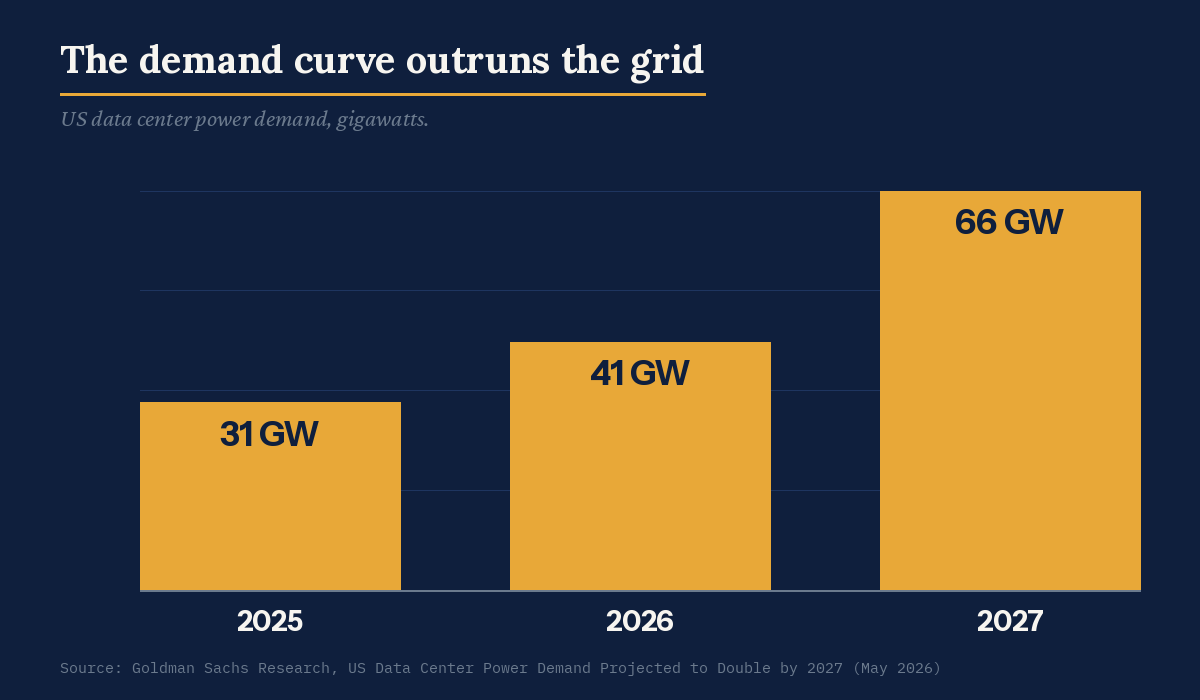
The scale of what these companies are building explains why. Goldman Sachs Research puts US data center power demand at 31 gigawatts in 2025, climbing to 41 gigawatts this year and 66 gigawatts by 2027, more than double in two years. In the same report, Goldman’s own analysts name the most common reason scheduled projects slip: labor and supply chain shortages. Only 50 to 60 percent of the capacity currently scheduled is expected to come online on time. (Goldman Sachs)
McKinsey sizes the buildout driving that demand at nearly $6.7 trillion in cumulative data center capital spending worldwide through 2030, more than 40 percent of it in the United States. A single large facility employs up to 1,500 workers during construction, and McKinsey’s own researchers flag the exact bottleneck Nadella and Smith are living: finding trained talent for data center and power infrastructure work is a real constraint when those same electricians and technicians are already booked on other jobs. (McKinsey) Electrical work alone accounts for 45 to 70 percent of a data center’s total construction cost, according to the electricians’ own union, which is why a first-year apprentice on a Virginia data center job can now clear six figures with overtime. (IBEW Local 26, via NPR)
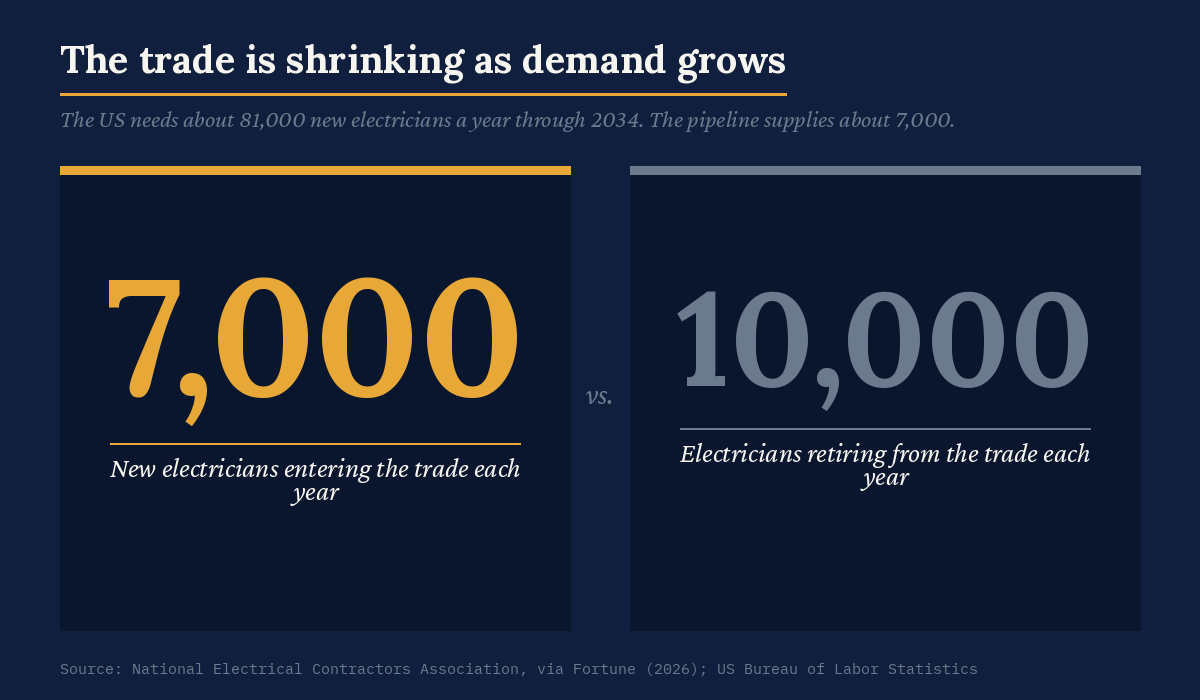
Here is the math behind the shortage. The National Electrical Contractors Association estimates that roughly 7,000 new electricians enter the trade each year while 10,000 retire, a standing deficit that predates the AI boom and worsens because of it. (Fortune) Close to 30 percent of union electricians are already between 50 and 70 years old. (Qmerit) The Bureau of Labor Statistics projects about 81,000 electrician openings a year through 2034, most of them from retirements and workers who transfer out of the trade. (BLS) McKinsey separately estimates the data center build-out alone requires 130,000 more electricians, 240,000 more construction laborers, and 150,000 more construction supervisors between 2023 and 2030. (USBE, reporting McKinsey)
None of this happened by accident. For twenty years, the loudest career advice in America pointed one direction: college, then a desk. Career counselors got measured on four-year enrollment rates, so that is what they optimized for. Parents who could afford a fallback for their kids chose the one with a lecture hall in it. Vocational and trade programs got cut from high schools first when budgets tightened, treated as the plan for students the system had already written off.
Other countries built the opposite habit. Germany’s dual system runs roughly 1.2 million apprentices at any given time, pairing paid on-the-job training with vocational school, and treats that path as a first choice rather than a consolation prize for students who did not get into university. (German Trade and Invest).
That bet is now inverted, and not enough people have noticed. The AI economy’s most valuable new workers over the next decade will run conduit through a live data hall, terminate a medium-voltage cable safely, and read a single-line diagram, skills the compute layer depends on and a laptop cannot replace. The roles that actually limit the buildout carry a training pipeline that money cannot compress.
Some of the largest AI companies have started to notice too. Meta, Google, and BlackRock have pledged more than $265 million combined to train electricians and other tradespeople for data center work, and Google’s commitment to the Electrical Training Alliance alone targets 100,000 upskilled electricians and 30,000 new apprenticeships by 2030. (UBOS) Microsoft’s own Datacenter Academy is now more than 40 partner colleges deep, pairing students with paid internships inside working facilities. (Microsoft)
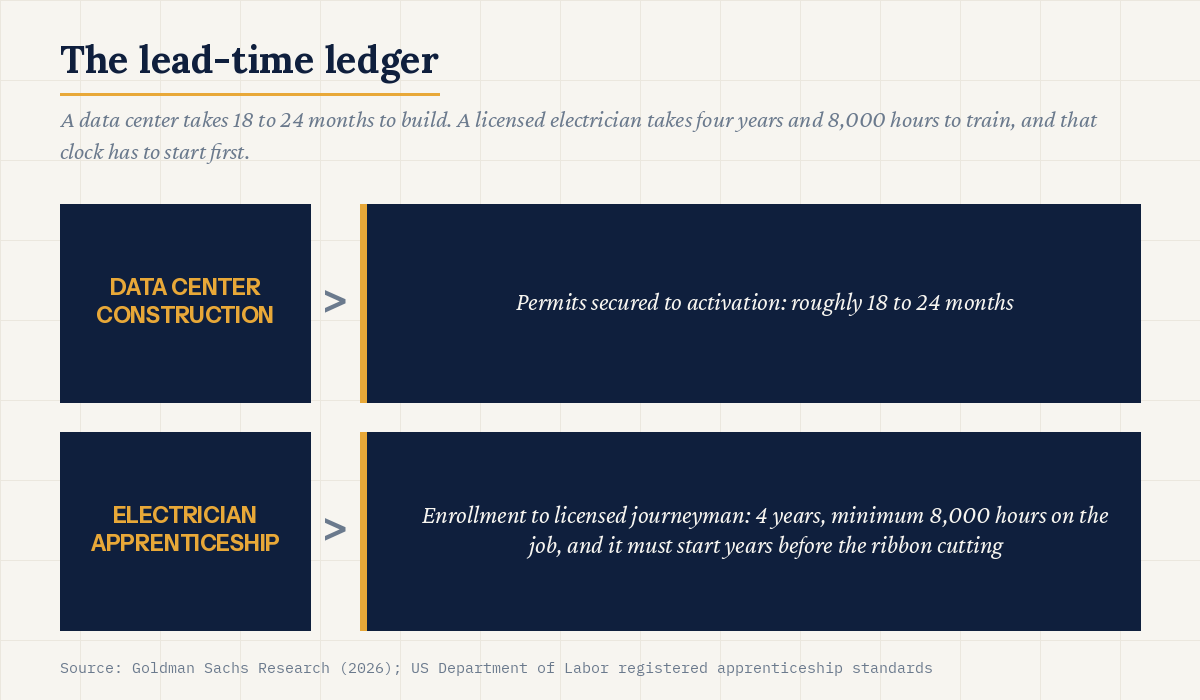
Take the steelman seriously for a moment. Maybe this is simply the market working exactly as it should: demand spikes, wages rise, and the trades absorb a generation of workers who might otherwise have chased a degree with diminishing returns. That is a real and welcome effect, and Huang is right to point at it. But wages rising this year do not produce a licensed electrician this year. A standard registered electrical apprenticeship runs four years and a minimum of 8,000 hours of on-the-job training under the US Department of Labor’s own rules, most of it spent working alongside a journeyman on live jobs, before a candidate ever sits a state licensing exam. (GetLicenseReady) A cohort that started training in 2026, the year these pledges were announced, graduates around 2030, the same year Goldman’s demand curve and McKinsey’s capital projections both assume the buildout is well underway. The apprenticeship’s calendar decides when the gap closes, regardless of how fast the money moves.
The boom straining the trade today will not run forever, and the evidence is already piling up. Bain’s own mid-2026 forecast describes the industry moving from “the early scramble of generative AI-driven demand” to “a more disciplined, selective, power-constrained” phase, with hyperscalers growing choosier about where and what they build. (Bain) CBRE and Wood Mackenzie clocked the first construction slowdown in six years in the back half of 2025: new capacity additions fell by half quarter over quarter even as capital spending kept climbing toward a trillion dollars. (CIO Dive) The slowdown has political help. Senator Bernie Sanders and Representative Alexandria Ocasio-Cortez introduced federal legislation in March 2026 to pause new large-scale AI data center construction, and more than 100 local communities have already passed their own moratoriums. (Brookings) Gallup polling puts the opposition at 7 in 10 Americans who say they do not want a data center built for AI in their area. (NPR)
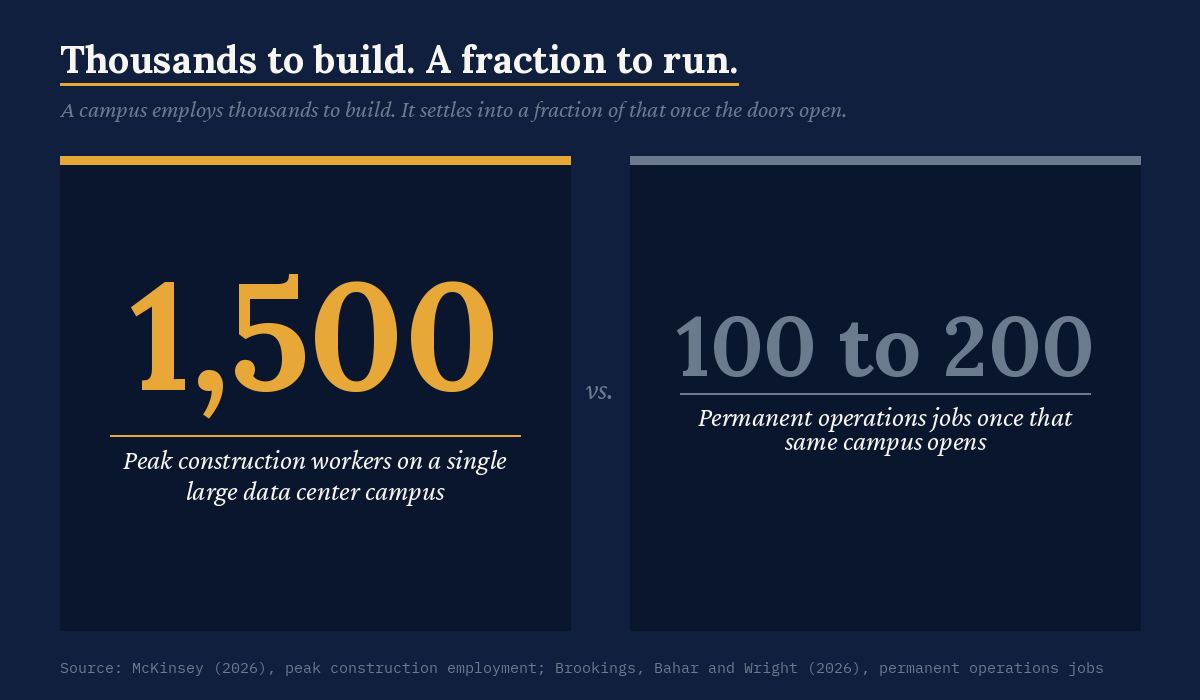
Even where construction stays on schedule, the work has an expiration date that has nothing to do with politics. A hyperscale campus that employs up to 1,500 workers to build it settles into roughly 100 to 200 permanent jobs once it opens, according to a rigorous county-level study by Brookings economists Dany Bahar and Greg Wright. (Brookings) The crew that wired the building moves to the next site. Eventually, in any given metro area, there is no next site.
Chris Brooks has already lived through one cycle of this. He wired his first data center in Virginia in 1999, long before most people had heard the term, and has spent the current boom watching his union brothers do well. He has also spent this year watching opposition spread.
“Every time I turn on TV, I’m hearing moratoriums have been put in place because people don’t want data centers,” he told NPR this month. “It’s popular not to want a data center now. And not that long ago, no one knew what they were.” (NPR)
Brooks is right, and the apprentice’s bet was never really on data centers. The credential a fourth-year apprentice earns wiring a hyperscale campus is the same credential that wires a solar farm, an EV charging depot, or the substation a strained grid needs next. Data centers already account for roughly two-thirds of a single year’s spike in wholesale power costs across the PJM grid, the operator serving 65 million people from Virginia to Illinois, and every megawatt of that new load requires the same trade to build the lines and stations that carry it. (Brookings) Grid modernization, building electrification, and the renewable buildout all draw from the same finite pool of licensed electricians, and none of them have a completion date the way one campus does. Someone who spends four years learning to run conduit is betting on a portable license, and the specific industry paying the premium today is almost beside the point.
This is the durable rule underneath every AI headcount story this newsletter has told, extended one step further: capital can be raised in a quarter, and it can walk away just as fast when the politics or the economics shift. Capability compounds on a training calendar nobody can rush, and once it exists, it does not expire when one customer’s spending slows. Whatever the industry, whoever the smartest people in the room happen to be, the workforce constraint always shows up on the calendar the training program set, and the credential that calendar produces outlasts the deal that funded it.
Here’s how you take action
If you are advising a young person on where to point their next four years, or setting workforce strategy for an organization racing to build anything AI touches, treat trade and technical training capacity as seriously as you treat chip supply or cloud contracts. Ask where your organization’s electricians, high-voltage technicians, and controls engineers will come from in three years. The budget question is the easy one. Then ask the question almost nobody in this boom is asking yet: when this specific site’s construction wraps, where does the crew go next. A training pipeline built around one customer is a bad bet. One built around a portable, licensed trade is not, no matter how the AI story ends.
Christina Lexa writes Workforce Rewired, on the intersection of workforce transformation, AI, and global talent.
The views expressed here are my own and do not represent the position of my employer or any organization I am affiliated with.