


TL;DR: The Big Four are handing routine audit testing to AI just as more students are choosing accounting again. That testing is how new auditors learned to spot a wrong number, the skill a CPA’s signature stands behind. Aviation hit the same problem first, at a terrible cost, and found a fix. The accounting version costs senior reviewers’ time, and firms can budget for it.
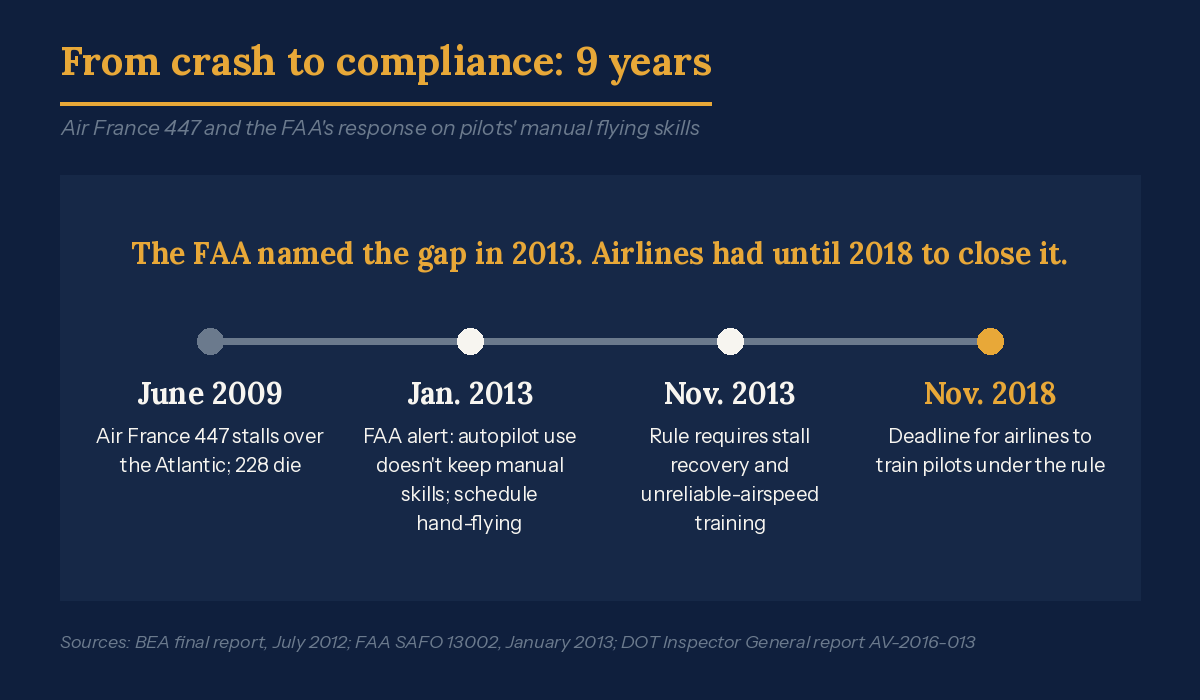
On June 1, 2009, Air France Flight 447 was cruising at 35,000 feet over the Atlantic, on its way from Rio de Janeiro to Paris. About two hours and 10 minutes in, ice crystals blocked the plane’s airspeed sensors. The autopilot, which needs reliable speed readings to fly, switched itself off and handed the plane back to the crew. The pilot at the controls pulled the nose up, following instruments fed by the same bad data. A stall warning sounded continuously for 54 seconds, according to AVweb’s account of the final report. The crew fought the plane for almost four minutes before it hit the ocean, and all 228 people aboard died.
France’s accident investigator, the BEA, listed among the causes “an absence of training, at high altitude, in manual aeroplane handling.” The investigators also found that the pilots’ training met regulatory standards.
Autopilot flies a modern airliner about 90% of the time, by an FAA estimate. Pilots used to keep their hand-flying skills sharp by flying the routine hours themselves. Once autopilot took those hours over, pilots got less practice, and it showed in the rare moment the autopilot quit. In January 2013 the FAA said so in a safety alert to airlines: constant use of automation “does not reinforce a pilot’s knowledge and skills in manual flight operations.”
Public accounting is now handing its routine work to AI, and that work was also how it trained its people.
What KPMG and PwC are automating
In the last week of April 2026, KPMG told about 100 of its US audit partners, roughly 10% of the group, that they were leaving through layoffs or early retirement. The firm tied the cut to “a multiyear strategy to align the size, shape and skills of our team to the power of our audit platform,” per CFO Dive.
About two weeks earlier, KPMG’s audit chief digital officer, Thomas Mackenzie, told The Wall Street Journal that “for those routine transactions, I think there will be next to no human beings in that bubble.” A KPMG briefing showed routine testing as the only part of the audit with no people assigned to it within two to three years, as Going Concern reported from the Journal’s story. Mackenzie also said he no longer hires recent graduates to prepare workpapers, per a Controllers Council summary. He wants new hires who can make sense of what the AI found.
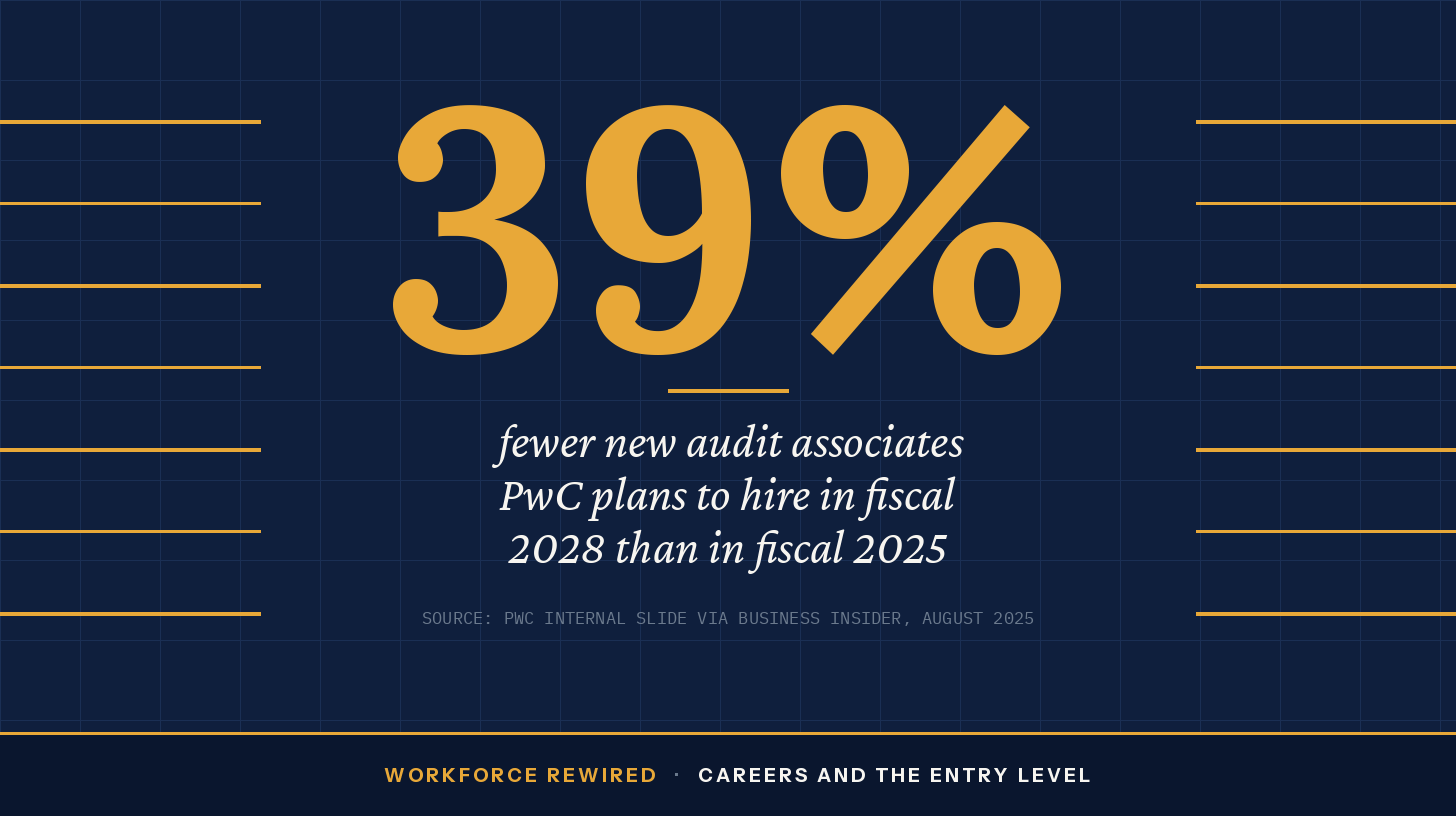
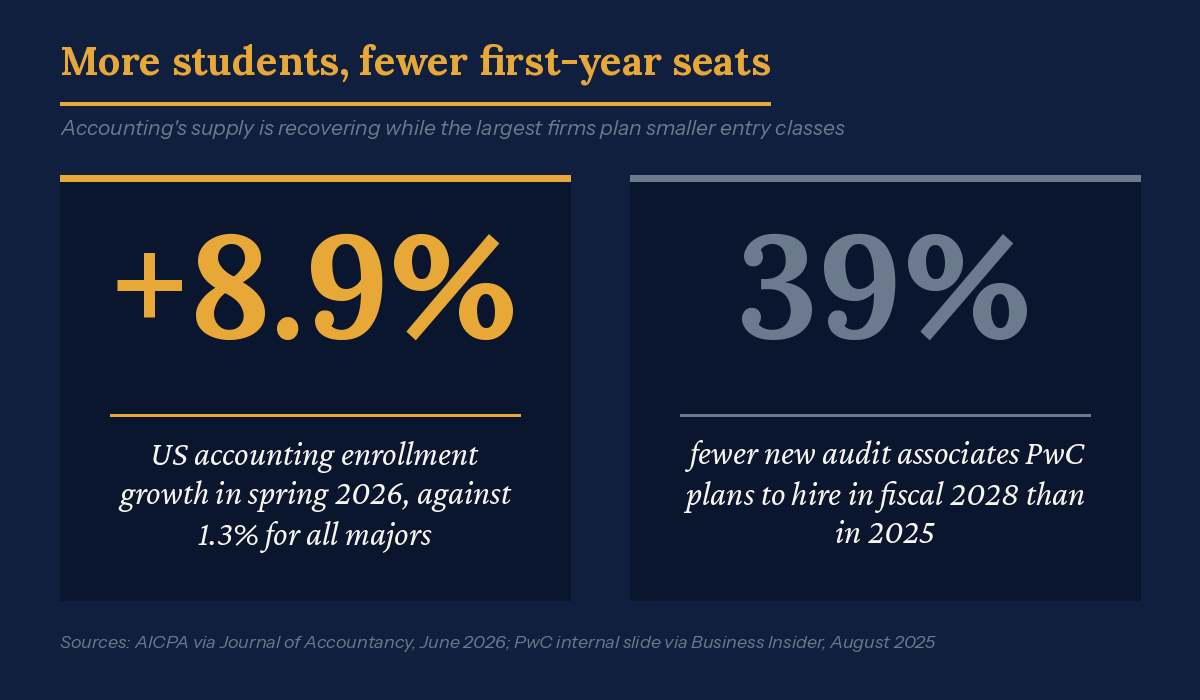
PwC is hiring fewer people for the same work. An internal slide obtained by Business Insider showed the firm planning to hire 39% fewer new audit associates in fiscal 2028 than the 1,676 it hired in fiscal 2025. The slide listed “the impact of AI” among the reasons.
Donald Wells runs an 11-person CPA firm. He told the Journal of Accountancy this month that AI finishes a first review of a client’s documents in two to three hours. A midlevel staffer might need a week. He also sees a new habit in younger staff, who “tend to say, ‘Hey, AI said this is a risk, therefore it’s a risk.’”
More students, fewer entry jobs
The accountant shortage of the early 2020s is easing. The profession still has 340,000 fewer accountants than it did five years earlier, per a Bloomberg Tax analysis of BLS data. The AICPA estimates that 75% of licensed CPAs are within 15 years of retirement, per CPA Practice Advisor. But more students are coming. Undergraduate accounting enrollment rose 8.9% in spring 2026, against 1.3% for all majors, the Journal of Accountancy reported. The AICPA’s 2026 Trends report, released November 4, found accounting bachelor’s degrees up 8.5% in 2024 to 2025, the first increase in years. More people took the CPA exam for the first time than in any year since 2018.
Getting licensed is getting easier, too. At least 25 states had dropped the 150-credit-hour requirement or added another route by January, CFO Dive counted. Most let candidates qualify with a bachelor’s degree and more supervised work experience. The shortage now sits in the entry-level seats where new accountants learn the work, more than in the number of people who want the job.
What the grunt work taught
One of the primary questions I continue to ask is this: how does a 24-year-old become a 34-year-old a client trusts with its hardest problem? The answer, every time, is a thousand small, boring tasks, done on deadline, checked by someone senior, and gotten wrong often enough that the person learns to catch errors before they reach a client.
When I coach my teams, I push for two things to be true: 1) they are actively exploring ways to leverage AI as it’s a true skill that will help them do more and 2) they have to be able to explain and defend all the details anyway.
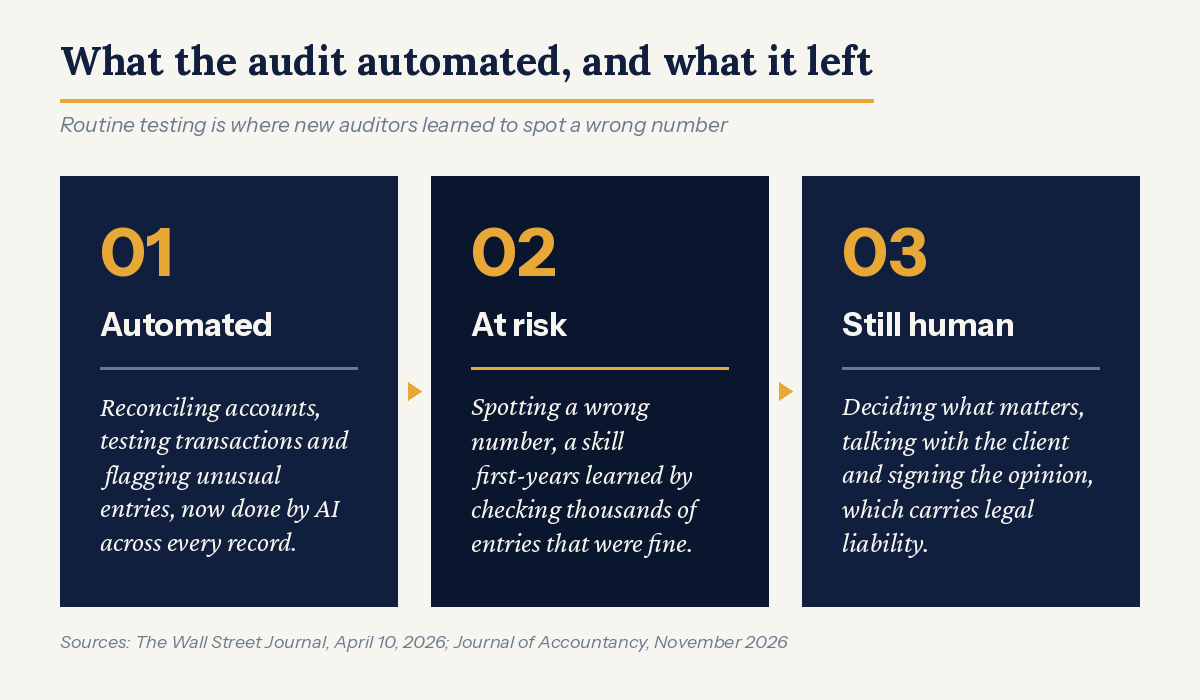
In audit, those tasks were reconciliations and transaction testing. A first-year worked through a population of transactions, most of them fine, and learned to spot the ones that weren’t. That’s how a partner later learns to glance at a set of numbers and know something is off before running a single test. AI now does that work faster, and because it can test the full population instead of a sample, usually better.
Carl Mayes of the AICPA asked the Thomson Reuters Institute in September:
“how do you know what good looks like if you’ve never done the work yourself?”
For 40 years in audit, the routine work and the training were the same work. Nobody had to separate them, because nobody was taking the routine part away. In The Accidental Apprenticeship, I argued that the first professional job taught the profession as a byproduct of the grunt work, and that once AI takes those tasks, the learning has to be designed back in on purpose. Audit is that argument playing out in one profession, with public numbers attached.
The signature stays human
Accounting has something most professions this newsletter covers don’t: a legal requirement that a person sign off. A CPA signs the audit opinion and carries personal liability for it, however much of the testing software did.
The regulator sees the gap. George Botic was acting chair of the PCAOB, the regulator that inspects public company audits. In December 2025 he told a conference that relying more on AI could “erode qualities that go to the core” of auditing. He said the risk “will also necessitate the identification of new and different paths for junior auditors to gain those important skills,” per Accounting Today.
Mackenzie told the Journal he doesn’t expect the change to necessarily shrink junior hiring, per the same Controllers Council summary. PwC’s AI assurance leader, Jenn Kosar, told Business Insider she expects new hires to do work managers do now within three years. Enrollment is up and licensing is easier. If juniors start as reviewers, maybe they learn faster.
They might, if someone teaches them how to review. A reviewer who has never done the work can only check that the boxes are filled in, and Wells’s younger staff show what that looks like. Faster licensing cuts classroom hours and adds no practice. The Air France crew’s training met the rules too. Aviation’s answer was to schedule the practice back in. The FAA told airlines to have pilots hand-fly during routine flights, and a rule finalized in November 2013 required training in stall recovery and flying without reliable speed readings. Airlines had until November 2018 to comply, nine years after the crash. Accounting firms can see the same gap now, before a major audit failure, and build the practice into the schedule deliberately.
Here’s how you take action
Sort the junior work now, before AI takes more of it. Put a senior manager and two first-years in a room, order lunch, and list every task a first-year did two years ago. Mark which ones taught judgment and which were just throughput. The list costs nothing and makes every later decision easier.
Keep some of the learning work on purpose. When the AI flags exceptions, have juniors take turns working through them and explain out loud, to a senior person, why each one is or isn’t a real problem. It gives them the practice that reconciliations used to provide.
Fund the senior time it takes. A senior reviewer’s time is the scarce part, and it’s the first thing cut when utilization targets tighten. Budget it as its own line, because it’s how the firm trains its next partners.
Equip early-career accountants to ask for it. The CPA license is worth more as AI takes over the routine work, because the law still holds a person responsible for the signature. Anyone entering the field should look for a senior person willing to go through the AI’s exceptions with them and debate which ones matter, and ask for that time in the first year.
Christina Lexa writes Workforce Rewired, on the intersection of workforce transformation, AI, and global talent.
The views expressed here are my own and do not represent the position of my employer or any organization I am affiliated with.
Christina, the Air France parallel lands because the cost of losing manual skill showed up years after the automation decision, on a different crew. Audit firms face the same timing problem. The partner who cuts associate hiring this year books the savings now, while the risk to the signature arrives after that partner has moved on. I'd want a firm's quality review to track how often new associates catch a wrong number by hand, the way airlines came to watch hand-flying time. A number like that gets attention before the failure does.