


Editor’s note: I’m in India for work this week. I left last Friday, flying United, staying at a Marriott property, and carrying multiple Apple devices. To say I’m living the technology bumps of the last week would be an understatement.
TL;DR: Nobody has proven yet that AI caused last week’s outages, and the companies involved say it didn’t. Both popular theories, that AI is finding flaws faster than anyone can safely patch them and that AI is writing code faster than anyone can review it, end at the same place: a shortage of experienced people who test and approve change. Here’s what the evidence says, what the counter-claims say, and what workforce leaders should fund and staff now.
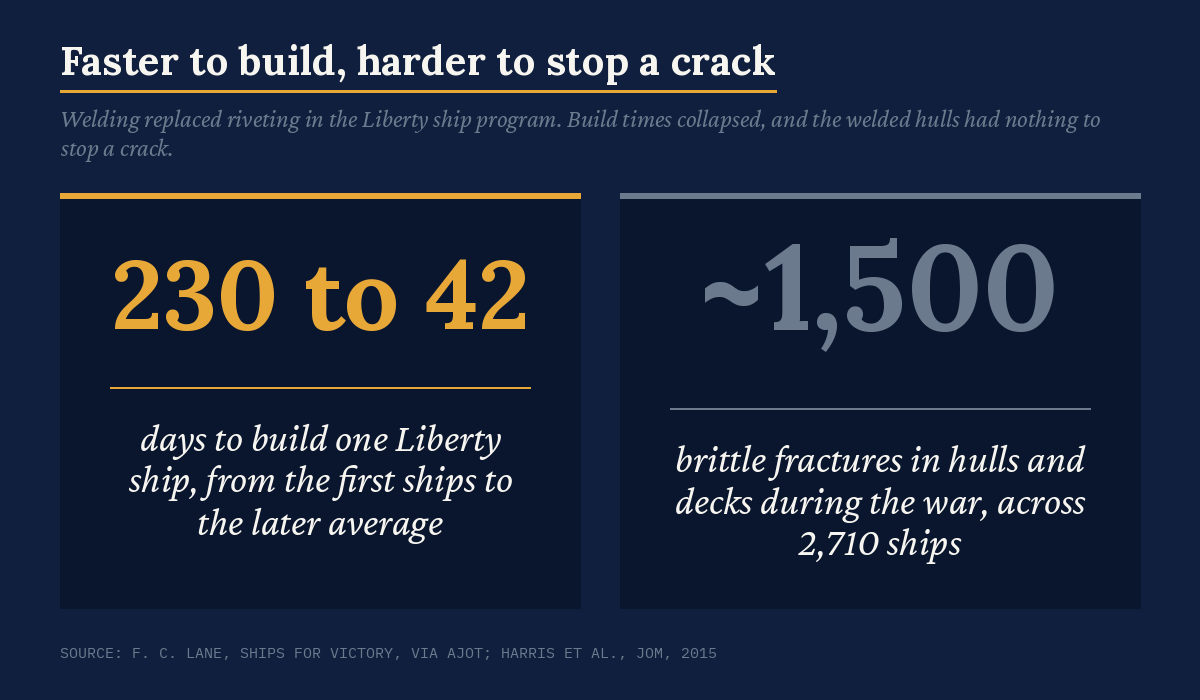
On January 16, 1943, the SS Schenectady was tied up at the fitting dock in Portland, Oregon, in calm water, about two weeks after she’d been declared ready for service. Then her hull cracked almost in half, with a sound people heard more than a mile away. She was a new tanker built with the same all-welded methods as the other Liberty ships, the cargo ships America turned out by the thousand. Welding had replaced riveting, and it was fast. The first Liberty ships took about 230 days to build, and the average later fell to 42. Most of the people doing the work were new to it. One executive said more than 90% of his workers had never worked in a shipyard, and at a Georgia yard, new welders often started after about a week of school.
The early verdict blamed the welders. Metallurgists took decades to settle the cause. The US built 2,710 Liberty ships and logged about 1,500 brittle fractures in hulls and decks during the war. The steel turned brittle in cold water, cracks started at square hatch corners, and a welded hull had none of the riveted seams that used to stop a crack from running the length of the ship. Researchers writing in 2015 say welders such as “Wendy the Welder” took blame they didn’t deserve. The fix was to add riveted seam straps across the deck as crack arrestors, then change the steel and the tests for it. A 2016 review of the failures still calls the Liberty ships a success, and the investigation started the modern science of fracture mechanics.
AI has handed software its own welding torch, and last week’s outages put the shipyards’ problem on every technology leader’s desk: faster work needs something that stops a small failure before it runs the length of the system.
Six days, seven outages, ordinary explanations
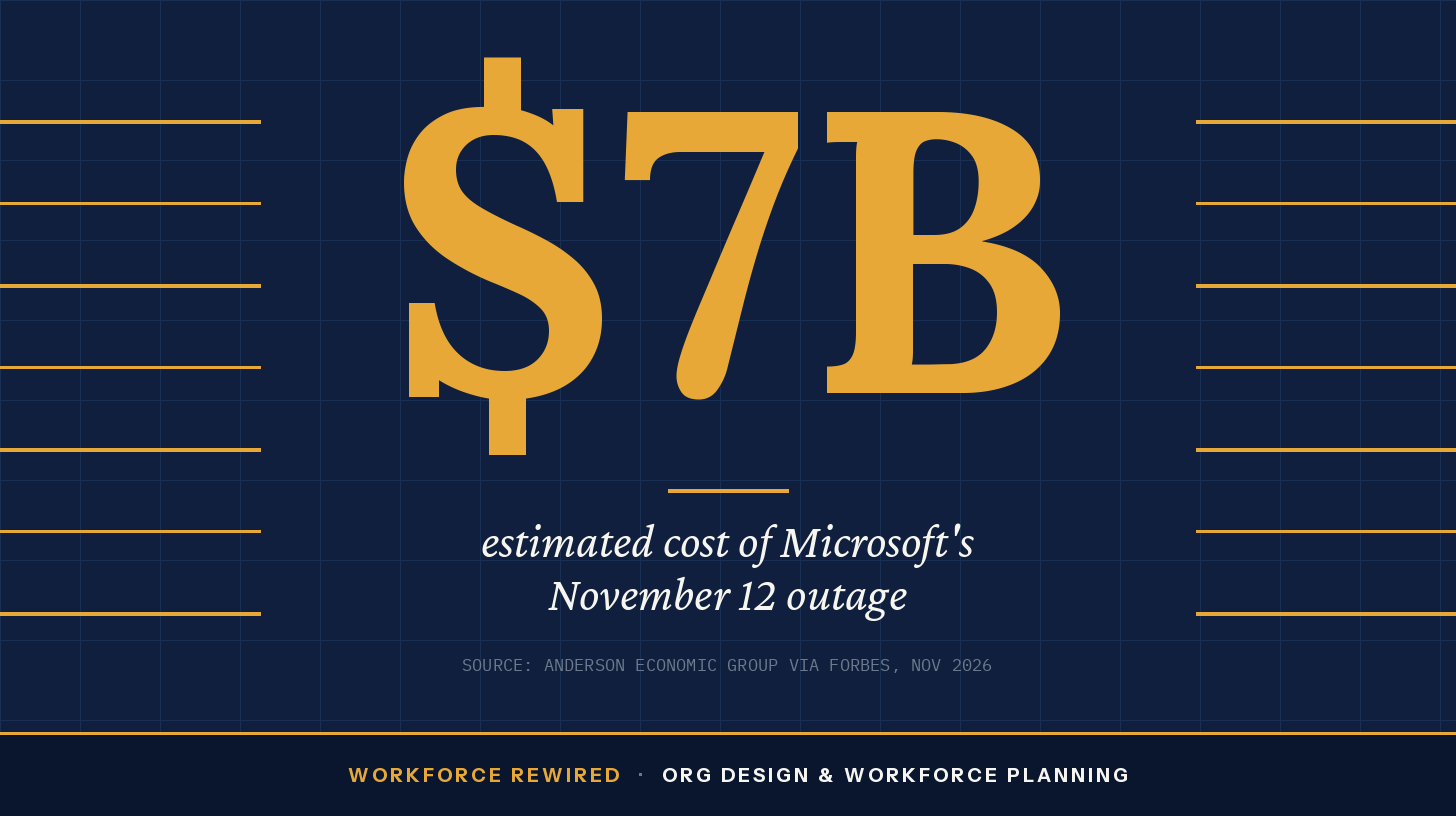
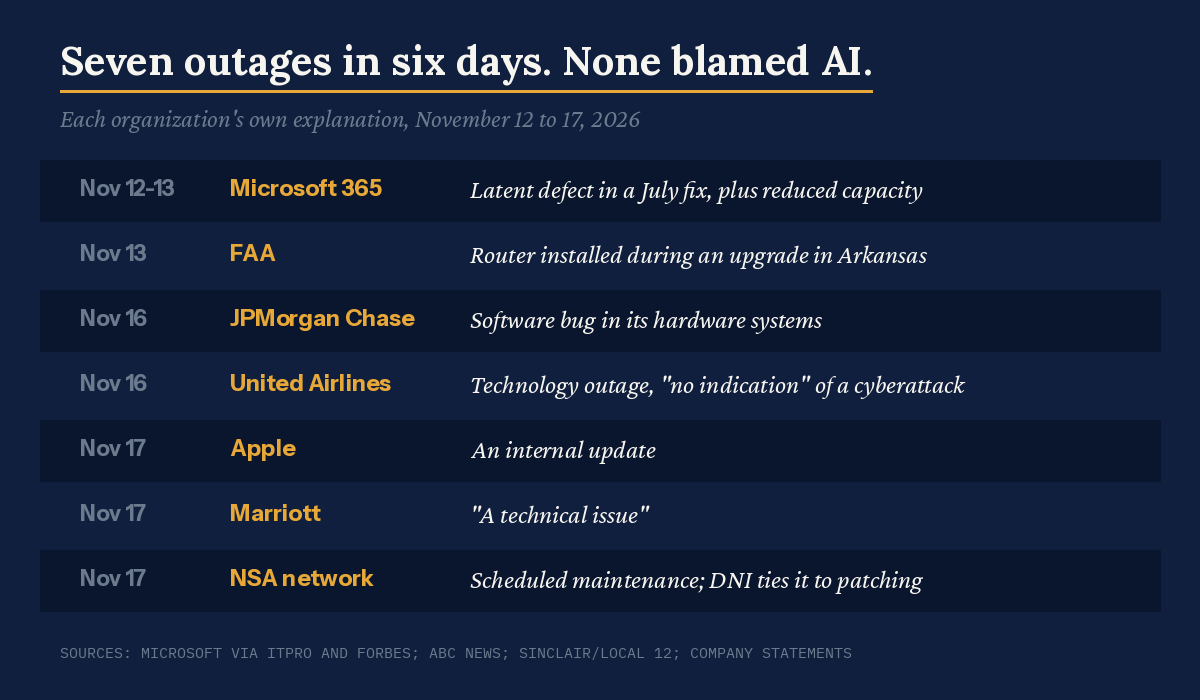
Microsoft’s Outlook, Teams and other O365 services failed on November 12 and 13. Microsoft executive Charles Lamanna traced it to a latent defect in a fix rolled out in July. It ran harmlessly for three months, until extra traffic arrived while about 14% of gateway capacity was unusable for an unrelated reason. At the worst point, more than 80% of the gateway servers stopped responding. A Microsoft spokesperson told Forbes it was “not related to cyber or AI / agents,”. The Anderson Economic Group put the cost of the outage at $7 billion.
On Friday, November 13, a router installed during an upgrade in Arkansas triggered a nationwide FAA ground stop. On Monday, Chase customers lost access to accounts after what the bank called a software bug in its hardware systems, and United delayed departures after a technology outage it said showed “no indication” of a cyberattack. On Tuesday, Apple said an internal update caused its outage, Marriott resolved “a technical issue,” and the NSA’s classified network went down during what the agency called scheduled maintenance.
The case for an AI link
The NSA is where the patching theory has its strongest evidence. Director of National Intelligence Jay Clayton told CNBC the outages were not a cyberattack and tied them to patching and upgrades: “As you patch and upgrade your systems, taking them down and bringing them back up.” He added that AI scans systems faster, so more vulnerabilities are being found. Sen. Mark Warner, vice chairman of the Senate Intelligence Committee, said in a statement that “the evidence so far points toward legitimate efforts to secure our systems, not malicious activity,” and told CNN that the outages are “indirectly related to artificial intelligence.” His version of the mechanism: “If you’re trying to patch 10 or 12 in a single week, you have these kind of outages.”
The background makes that plausible. Earlier this year, a researcher at the security firm Calif, working with AI tools, turned a PHP bug first reported as a minor crash into a way to take over servers. The flaws, now called PHP2Shell, went public on October 21, and IEEE Spectrum reports that four engineers spent two months on the patch. PHP runs a large share of the web, and the NSA, FBI, the UK’s National Cyber Security Centre and CERT-EU all told organizations to patch immediately and to consider taking systems offline. The Cloud Security Alliance also notes that Anthropic’s Project Glasswing, a consortium that gives companies AI vulnerability hunting, surfaced high-severity flaws faster than maintainers could absorb them. I covered the attacker’s side of the same capability in You Already Interviewed the Threat.
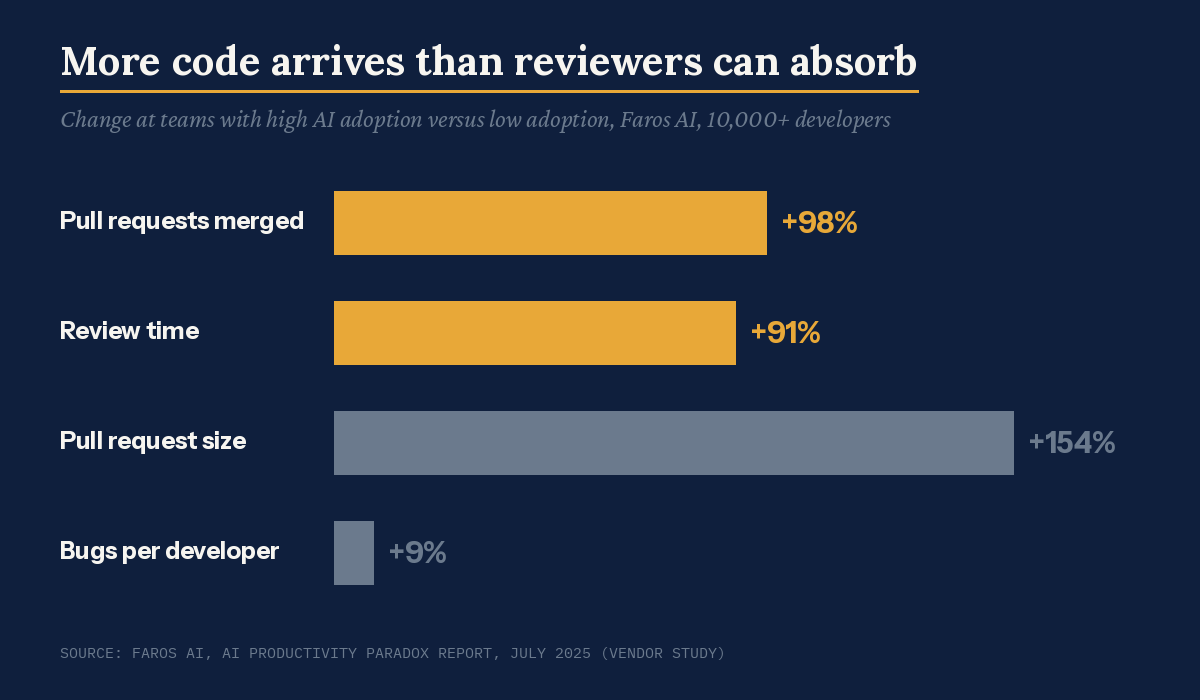
The second theory has a public example of its own. In March, the Financial Times reported that a “trend of incidents” with a “high blast radius” at Amazon included several caused by AI-assisted code changes, and Amazon now reportedly requires senior engineers to approve those changes before they ship. Google’s DORA research team found in 2024 that rising AI adoption came with an estimated 7.2% drop in delivery stability. Faros AI, which sells engineering analytics and has an interest in the problem looking measurable, studied more than 10,000 developers and found high-AI teams merging 98% more pull requests while review time rose 91%.
The case against AI as the culprit
Every company named a cause, and none of them named AI or a rushed security patch. Christiaan Beek of the security firm Rapid7 said “complex systems fail in boring ways far more often than because of an adversary,” and that nothing public shows rushed security updates caused these outages. William Bruce Wray, a cybersecurity expert at Creighton University, told WOWT there’s no evidence AI caused the FAA or bank outages, and that “anytime you are upgrading or modifying infrastructure, you have the possibility of introducing an error or a bug.” The Uptime Institute’s 2026 annual analysis found outage rates falling for five straight years, with power still the leading cause. And CrowdStrike’s faulty update crashed about 8.5 million Windows machines in 2024, before AI coding assistants were writing much of anyone’s code.
The fairest reading today: possible at the NSA, unproven everywhere else. The account that agencies rushed through more patches than their systems were built for rests on anonymous sources.
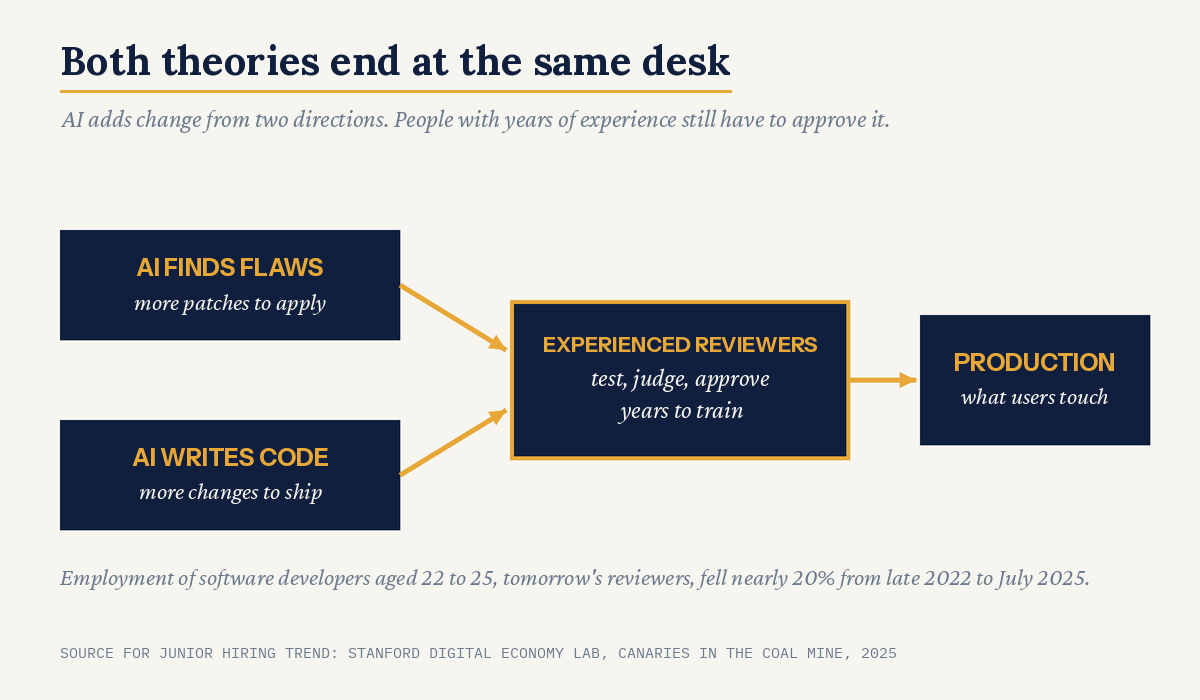
Both theories end at the same desk
Set aside whether AI caused last week. Both theories describe something measurable that’s already happening: more change is reaching production systems, from AI-found flaws and from AI-written code, and every change needs a person who can judge whether it’s safe. That person is usually a senior engineer, the one who knows which server has the odd configuration and which fix looked fine in the lab. Amazon’s reported rule makes those engineers the filter for every AI-assisted change. Microsoft’s own write-up says its lab tests missed the July defect because the lab hardware didn’t match production, which is the kind of gap experienced reviewers learn to suspect.
Meanwhile, the pipeline that grows those reviewers is shrinking. Stanford’s Digital Economy Lab found employment for software developers aged 22 to 25 down nearly 20% from its late-2022 peak by July 2025. Junior engineers learn to review by being reviewed and by breaking things in places where the damage is small. A company that automates the junior work and asks seniors to approve twice as much has bought this year’s speed with next decade’s judgment. I made the same argument about accountants in The Audit Got Faster. The Bench Got Thinner., and software is running the same experiment on a shorter timeline.
A better design can ration the reviewer’s attention. Capital One, where I lead Tech workforce strategy, open-sourced an AI security tool called VulnHunter in July. It tries to disprove each of its own findings before anyone sees them, and only the findings it fails to rule out reach a human reviewer, with an exploit path and a proposed fix for engineering review. Capital One says it has run the tool across thousands of its own repositories. Let the machine argue with itself first, so the scarce human hour goes to findings that survived.
I’ll share a humorous, extreme, and real example of what not spending the time to review AI output can get you. About a year ago, a team member of mine was excited to try his hand at using AI to develop a map showcasing some geographic areas of focus. This was the result:
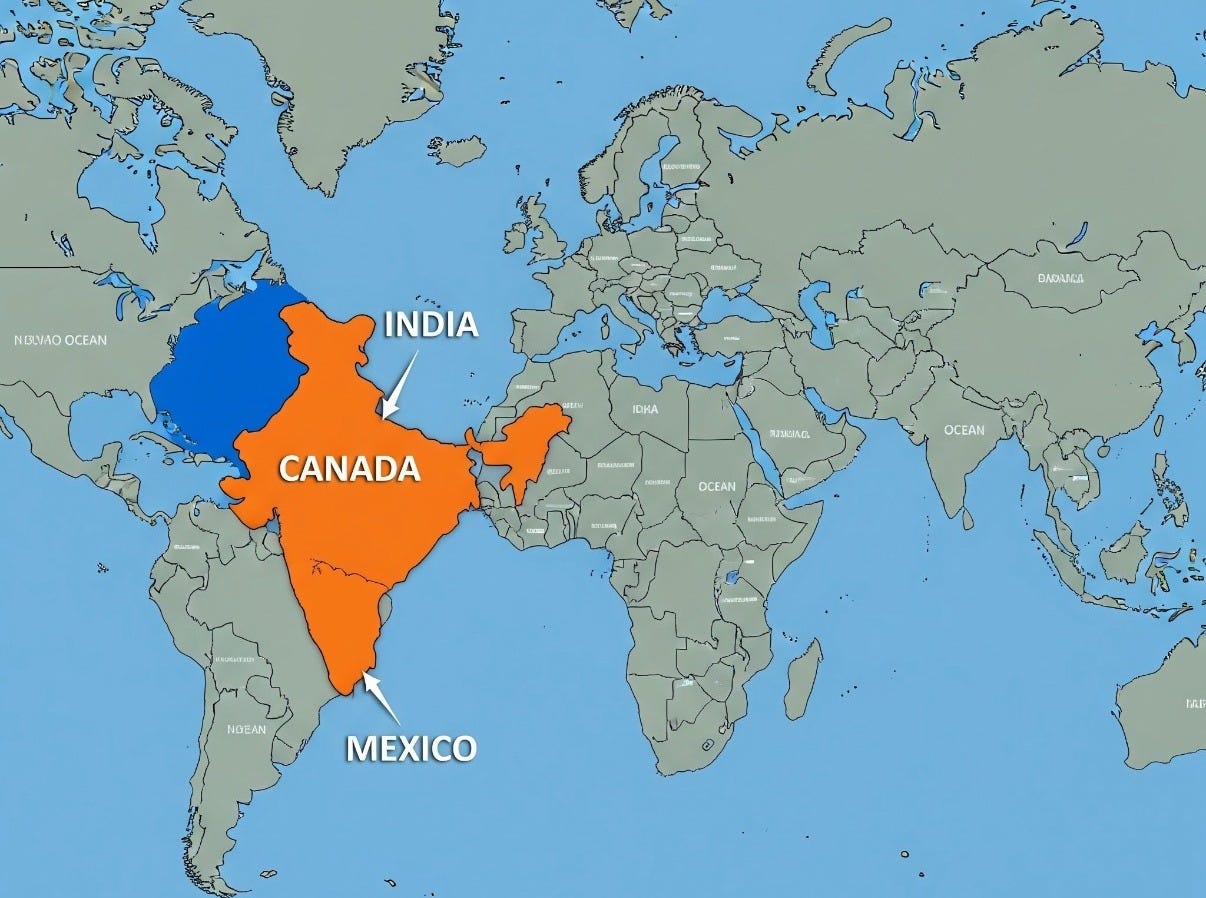
Can you spot the number of Oceans on this map?
Obviously one quick glance shows this map is very wrong. But if this was shipped quickly, we would lose credibility with our stakeholders in the same way, companies with offline services lose theirs.
The brand impact arrives later
Outages also tell job candidates how a company treats its engineers, and the record stays public for years. After CrowdStrike’s 2024 failure, Semafor interviewed 24 former employees who described speed winning over testing, and a former senior engineer who said he’d asked more than 20 times for time to fix old code. CrowdStrike disputed the reporting and called the sources disgruntled. Either way, a software failure became a story about what it’s like to work there.
In an experiment published in the Journal of Management Studies this year, Keyan Lai and Kristina Potočnik of the University of Edinburgh found that product-failure scandals lowered job seekers’ attraction to a company and their intention to apply, and that corporate social responsibility did little to offset it. Many engineers read post-incident write-ups the way other candidates read Glassdoor. A clear, technical explanation like Microsoft’s Lamanna’s tells them the company learns from failure. A vague one, or a public hunt for the engineer who pushed the change, tells them who gets blamed next time.
Here’s how you take action
Hold a postmortem lunch on one of these outages this week. Ask one senior engineer to walk junior staff through Microsoft’s public write-up of last week’s outage: what the lab missed, why the defect waited three months, what they’d have checked.
Fund review time in the project plan not just the build time. If AI doubles the changes your teams ship, the hours to test and approve them have to come from somewhere. Count senior review time as capacity and protect it from being the first thing cut in a busy quarter, or in your workforce plan for next year.
Protect the junior seat in incident work. Put early-career engineers in on-call shadowing and post-incident reviews, where the stakes are visible and the cost of a mistake is low. They’re the reviewers you’ll need in 2030.
Advocate for blameless, published post-incident reviews. The engineer who pushed the change is rarely the root cause, and candidates are watching how your company handles that question. Stop rewarding change volume too: the lesson of tokenmaxxing applies to commits as much as to tokens.
The shipyards kept their pace and kept their welders. They added riveted seam straps across the deck so a crack had somewhere to stop, then fixed the steel and the tests. In software, the seam straps are people: experienced reviewers with protected time, and a junior bench learning to replace them. They take longer to grow than steel takes to change, so the planning starts now.
Christina Lexa writes Workforce Rewired, on the intersection of workforce transformation, AI, and global talent.
The views expressed here are my own and do not represent the position of my employer or any organization I am affiliated with.
This is the risk nobody prices, Christina. AI doesn’t just do the routine work, it multiplies the volume of routine changes, and the people who can catch a bad one still take years to train. The bottleneck moves from doing the change to checking it. The firms that staff and reward the checking will be the ones still standing after the speed catches up.