


TL;DR: Widening spans of control take the technical work away from engineering managers first. As the span keeps widening, the coaching and development work that made people leadership meaningful gets squeezed out twice over. The total time a manager spends on performance-management paperwork grows in direct proportion to headcount, and whatever coaching time survives that has to stretch across more people at the same time. What remains is a role built almost entirely from its least rewarding parts. We are actively generating a future supply problem: fewer good people will choose or stay in the role, and the fix is capping spans and giving real pay for coaching, not a pep talk about purpose.
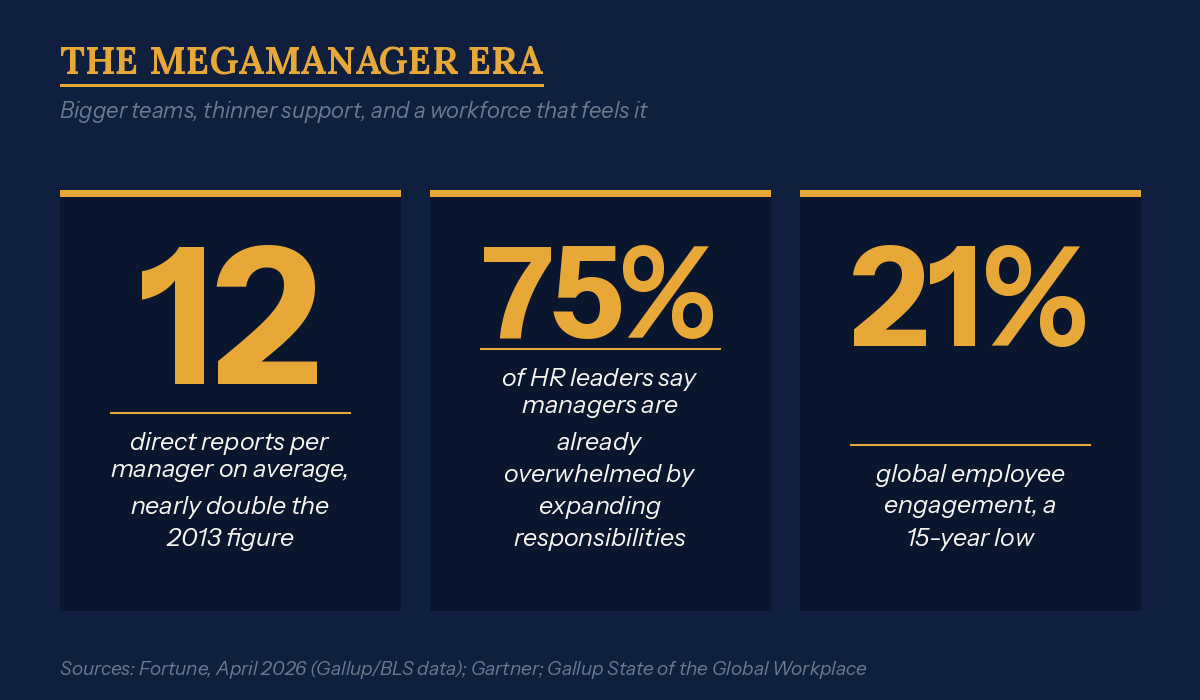
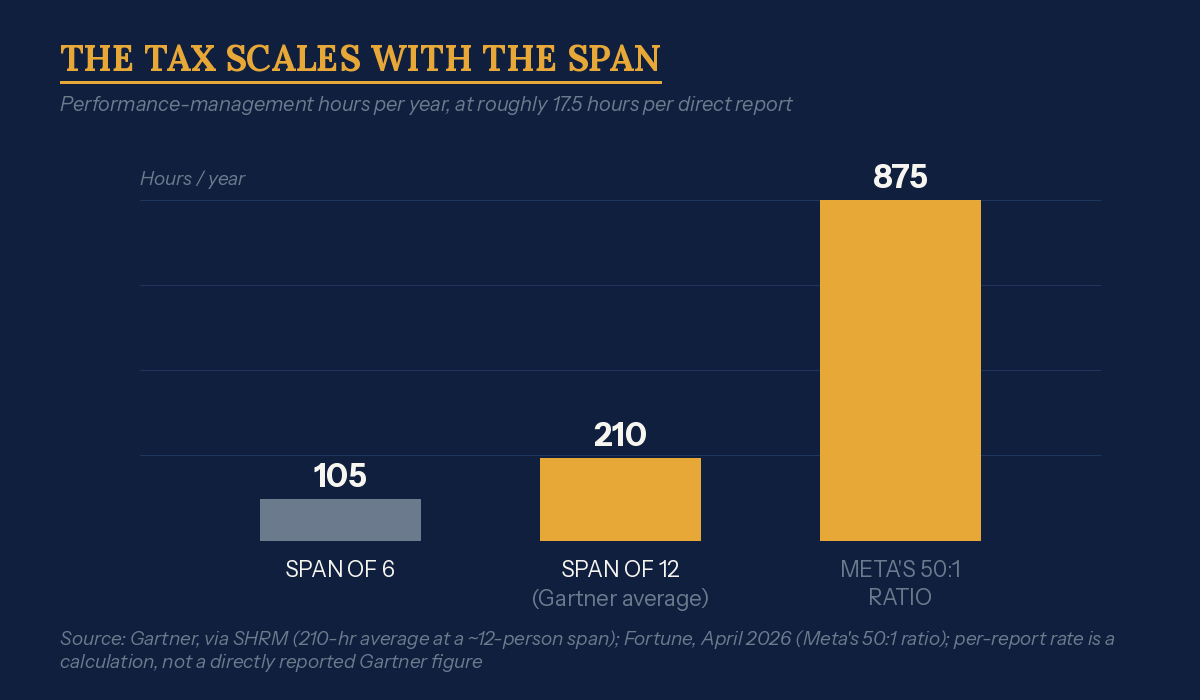
Meta’s new applied AI engineering division runs one manager for every fifty employees, roughly double what most organizations have ever considered the outer edge of a functional team. It is the most extreme data point in a trend that Fortune, reporting in April 2026, calls the megamanager era: the average American manager’s headcount has nearly doubled since Gallup started tracking the figure in 2013, and it now sits at around twelve direct reports. Companies spent three years cutting management layers and calling it efficiency. Whoever survived the cut inherited the load.
The technical work leaves this job first. LeadDev’s account of the engineer-to-manager handover lays out the sequence: architecture, production support, and code ownership transfer out early, while formal evaluations, budget, and hiring arrive last and stay. That loss gets talked about because it’s visible and specific. A person who used to ship code now attends meetings about code. But the technical work leaving isn’t the part that decides whether anyone wants this job in five years. What decides that is what happens to the work a manager does after the code is gone.
Coaching is supposed to be the trade. It isn’t happening.
Here’s the trade a people leader implicitly signs up for: give up the deep technical work, and in exchange, get the part of the job that’s actually human. Coaching someone through a hard year. Building a case for a promotion you believe in. Noticing the quiet problem before it becomes a resignation letter. That trade is the whole argument for wanting to lead people instead of just building things.
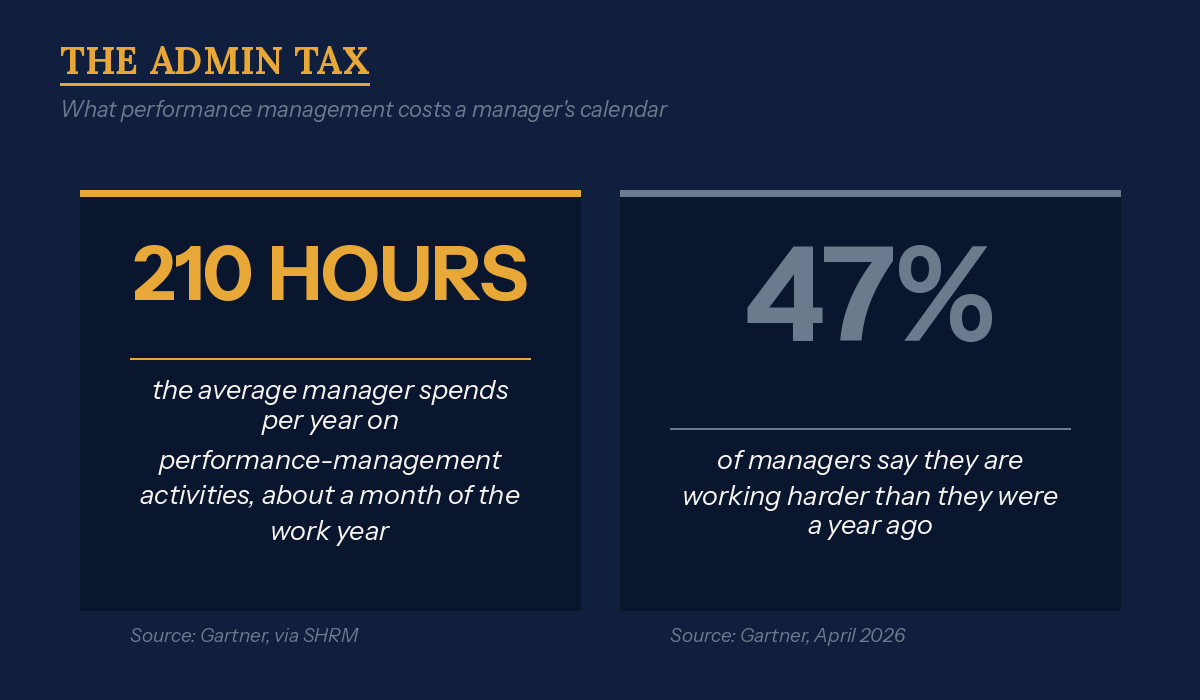
The trade is failing, and it’s failing on the coaching side, not the admin side. Gartner’s HR research puts the average manager’s performance-management load at 210 hours a year, close to a month of the working year, at the roughly twelve-person span that’s typical today. Divide one figure by the other and the rate comes out to about 17.5 hours of performance-management work per direct report, per year, a rate that holds steady even as a manager’s team grows. A manager with six reports is looking at something like 105 hours a year on evaluations, calibration, and documentation. A manager with twelve is looking at the full 210. Widen the span further and the number keeps climbing in direct proportion to headcount, simply because there are more people to formally track. The hours in a manager’s week don’t expand to match, so whatever’s left for everything else, including coaching, gets squeezed twice at once: the admin block itself grows, and whatever survives it has to stretch across more people.
Deloitte ran the experiment for real: one life sciences company nearly tripled the number of field representatives a single manager oversaw. The managers absorbed the operational load fine. What they couldn’t absorb was the coaching and development time, and engagement and turnover both moved in the wrong direction until the company reversed course and found a smaller number that actually worked.
Jim Harter, Gallup’s chief scientist of workplace management, told Forbes that poorly managed teams struggle even when small, and well-managed teams can thrive at scale, but scaling well “requires investment most organizations skip.”
The investment being skipped is time, specifically the time a manager needs to sit with one person and actually pay attention to them. Harter’s larger point cuts to the heart of it: leaders who inherit bigger teams after a restructuring rarely get more time or more support. They just get more names on a chart.
Automating the paperwork would help. Automating the coaching is the trap.
MIT research from Neil Thompson, done with economist David Autor, offers a useful distinction here. When a technology automates the low-expertise scaffolding around a job, the people left doing it get more valuable and often get paid more, because what remains is the part only they can do. When a technology eats into the expert core of a role instead, the job hollows out and the person doing it becomes less valuable, the way GPS didn’t just make cab drivers faster, it erased the navigational mastery that used to define the profession.
People leadership is living through both versions of that story at once, and most companies aren’t distinguishing between them. AI genuinely can take the scheduling, the status-chasing, and a good chunk of the documentation off a manager’s plate, and where that happens, it’s the good kind of automation: it hands back time. But the performance-management tax isn’t mostly scheduling. A calibration conversation still needs a human who watched the work closely enough to argue for someone convincingly. A promotion case still needs a manager who can describe, specifically, why this person is ready. None of that compresses. So when a company widens spans and calls AI the justification, it’s often removing the easy, replaceable part of the job while leaving the hard, human part fully intact, and growing, just spread across more people. That’s the expert core getting squeezed by volume even as the busywork shrinks. The job doesn’t get easier. It gets hollowed out from the coaching side instead of the technical side.
That’s the retention problem hiding inside the burnout numbers. Seventy-five percent of HR leaders already believe their managers are overwhelmed by expanding responsibilities, and global employee engagement has fallen to 21 percent, a fifteen-year low, with managers themselves posting some of the sharpest drops in workplace satisfaction of any group Gallup tracks.
Layer LeadDev’s numbers on top: 65 percent of engineering leaders report expanded scope, 40 percent are managing more direct reports than a year ago, and 22 percent already score at critical burnout levels.
People are leaving management for a specific, traceable reason: the part of the job they wanted keeps shrinking while the part they tolerate keeps growing.
Two fixes, and neither one is a pep talk
Two fixes actually change this, and both are structural, not motivational.
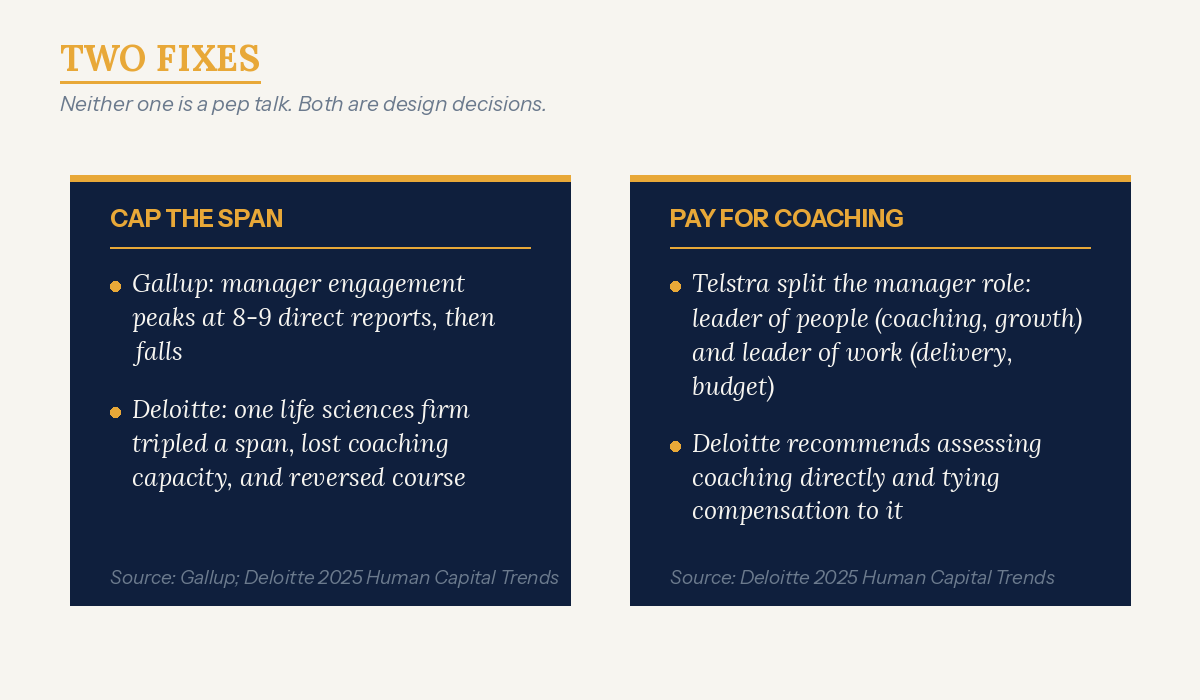
Cap the span so coaching time survives the math. Gallup’s own research shows manager engagement peaks at eight to nine direct reports and falls from there. Deloitte’s life sciences company found this the expensive way, by tripling a span and watching coaching disappear before dialing it back to a number that actually held. A company that wants people leadership to remain a job worth having has to treat the ceiling as a design constraint, not a target to push past for one more efficiency win.
Pay for coaching the way you now pay for technical depth. Deloitte’s own recommendation for supporting managers as developers of people includes assessing coaching and development directly, and tying compensation to that assessment, the same discipline companies already apply to revenue targets or delivery deadlines. A handful of companies are already restructuring around this logic. Telstra split its manager role in two: a leader of people, who owns coaching, skill-building, and career paths, and a separate leader of work, who owns delivery and budget without managing anyone directly. That split does something the current default job description doesn’t: it stops asking one person to be excellent at both administering a team and developing one, and it lets a company actually reward the coaching half instead of treating it as a value that’s assumed rather than paid for.
None of this erases the separate, real problem of engineers who miss writing code. A well-built technical ladder, the kind where a staff or principal engineer can out-earn a director without ever running a team, gives people who genuinely don’t want to lead humans a real place to go instead of forcing the choice. That track deserves to be built well. It just isn’t the fix for the question this piece is actually asking, which is what happens to the people who do want to lead humans and are getting buried in performance paperwork instead.
Companies didn’t set out to make people leadership unbearable. They made a series of separate, locally reasonable decisions, cut a layer here, add a report there, automate a status update, and never once asked what the job looked like after all of them landed on the same person. The answer is a role with the interesting parts removed and the tedious parts protected by law and audit trail. Keep building that job and the people best suited to lead others will keep opting out, and the ones who stay will be running teams they don’t have the time to actually develop.
Here’s How You Take Action
If you lead an engineering organization: Pull the actual time allocation for your managers, not their calendars, their real hours. If performance-management administration is eating a bigger share than coaching and development, you have already answered the question of why more leaders keep opting out.
If you set workforce strategy: Treat span of control as a coaching-capacity constraint, not a cost lever. Gallup’s 8-to-9 peak and Deloitte’s tripling experiment both point to the same conclusion: past a certain span, you’re not saving management cost, you’re spending down your bench without noticing.
If you’re deciding whether to become a manager: Ask what percentage of a real week goes to administration versus actual coaching, and ask a current manager, not the job description.
If you already manage and the job feels like paperwork: You’re describing a structural fact, what happens when performance-management load stays fixed per employee while your span keeps growing, not a personal failure to prioritize. Take that framing to whoever owns your org design.
For everyone: The next time your company widens a span and calls it efficiency, ask what happens to coaching time specifically, not headcount cost generally. That answer tells you whether leadership was redesigned or just diluted.
Christina Lexa writes Workforce Rewired, on the intersection of workforce transformation, AI, and global talent.
The views expressed here are my own and do not represent the position of my employer or any organization I am affiliated with.