


Every conversation about AI and the workforce eventually arrives at the same number.
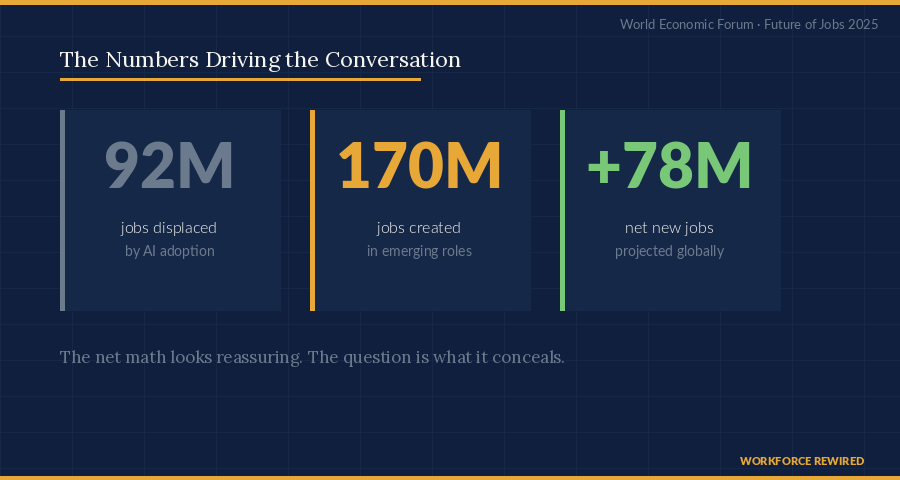
Ninety-two million jobs displaced. One hundred seventy million created. Net gain: seventy-eight million. The World Economic Forum published these figures in its Future of Jobs Report 2025, and they rippled through every boardroom deck, every policy brief, every LinkedIn thought piece that followed.
The numbers aren’t wrong. But they are, I’d argue, the wrong question.
When we ask “how many jobs will AI eliminate?” we’re treating the workforce like a spreadsheet — a column of inputs that gets recalculated when a new variable is introduced. Add AI. Run formula. Check net total. If the number is positive, exhale.
But work isn’t a spreadsheet. It’s an architecture. And architecture isn’t just about how many rooms a building has. It’s about how they connect. Who has access. What gets built where. Whether the structure holds.
That’s what’s actually changing — and it’s far more complex, and far more interesting, than the headcount math suggests.
What the numbers miss
Here’s what I’ve seen in eighteen years of building and transforming workforces across three continents:
Roles don’t just disappear. They collapse into each other, stretch into new shapes, shed functions they used to own, and absorb functions that didn’t exist before. A job title stays the same on the org chart while the actual work inside it transforms almost completely. That’s harder to count. It doesn’t make headlines. But it’s where most of the real disruption is happening.
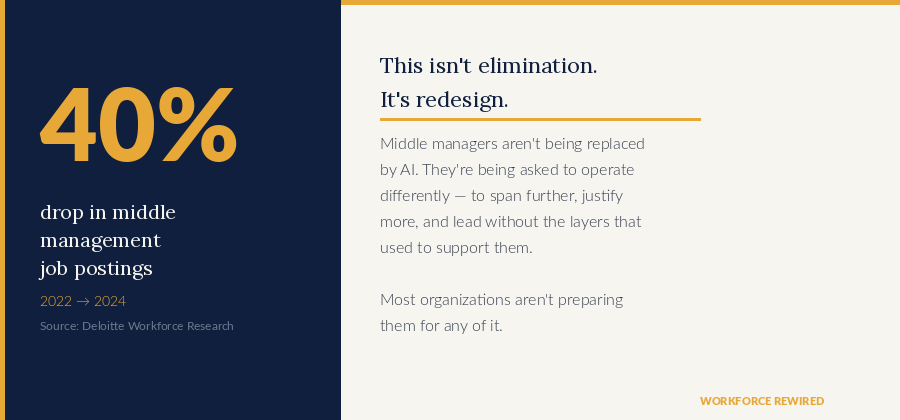
Consider what’s already documented. Deloitte’s research shows that middle management job postings dropped more than 40% between 2022 and 2024. That’s not those jobs being eliminated — it’s layers of organizational architecture being redesigned in real time. The people in those roles aren’t being replaced by a robot. They’re being asked to operate differently, span differently, justify their existence differently. Many aren’t equipped for it. Most organizations aren’t helping them.
Meanwhile, at the entry level, something quieter and arguably more consequential is underway. AI is absorbing the tasks that used to constitute the training ground for early-career professionals — the research, the first drafts, the data pulls, the scheduling, the analysis. These weren’t glamorous tasks. They were, however, how people learned. They were the apprenticeship. When AI does the apprenticeship work, who teaches the next generation?
I don’t think anyone has a satisfying answer to that question yet. I’ve spent time with organizations, universities, and workforce developers who are all grappling with it — and arriving at partial solutions at best.
The institutional gap nobody is talking about loudly enough
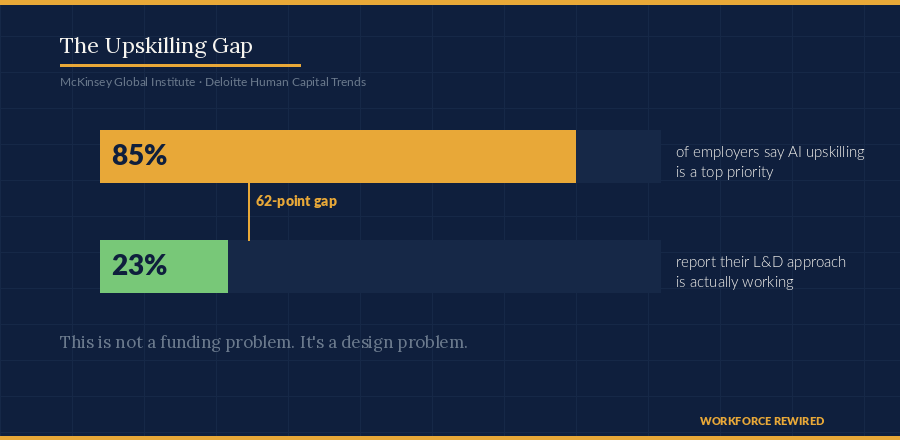
The research is consistent on one finding that should be alarming to anyone responsible for workforce strategy: 85% of employers say they prioritize upskilling for AI. Yet 77% of current learning and development approaches are falling short.
That gap — between stated priority and actual outcome — is not a funding problem. It’s a design problem.
Organizations are trying to solve a structural challenge with programmatic responses. A four-hour AI fluency training module doesn’t address the fact that the career progression architecture your organization built over decades assumed a set of tasks that are now being automated away. You can’t patch a redesign problem with a workshop.
Universities face a parallel challenge. They’re producing graduates with degrees whose underlying skill assumptions were formed before generative AI existed. The curriculum revision cycles at most institutions run three to five years. The pace of AI adoption is outrunning that by an order of magnitude.
Governments, meanwhile, are mostly watching. A few are acting thoughtfully — Singapore’s SkillsFuture program remains arguably the most sophisticated national workforce adaptation model in the world, and it predates the current AI wave. Most others are publishing task force reports.
Why I’m writing this
I’ve spent my career at the intersection of people strategy and organizational design including leading workforce transformation in technology organizations that had to function across cultures, time zones, and regulatory environments simultaneously.
That work has given me a particular vantage point on this moment. The AI-and-workforce conversation is dominated by economists modeling aggregate outcomes and technologists describing capabilities. Both perspectives matter. But there’s a third perspective that’s underrepresented: the practitioner who has actually built workforces at scale, managed the human complexity of transformation (and organizations in general, let’s be honest). Perhaps most consequentially, I’m trying to lead talent strategy ahead of this change curve and learn myself.
That’s the perspective I’m bringing here.
Workforce Rewired is my ongoing research project into how AI is reshaping roles, institutions, and the architecture of work itself. Each issue will synthesize what the research says, what I’ve seen in the field, and what I think companies, universities, and governments should actually do about it. Some pieces will be data-heavy. Some will be more personal. All of them will be trying to ask better questions than the ones currently dominating the conversation.
The goal isn’t just to analyze. It’s to build toward solutions. I’ll be sharing that work openly here as it develops.
If you’re a business leader, HR executive, or policymaker trying to navigate this, welcome. If you’re a researcher or academic working in this space, I’d genuinely like to talk. If you’re at a university or company thinking about how to redesign your programs for this moment, same.
The architecture of work is being rebuilt. Let’s figure out what it should look like.
Next issue: The Entry-Level Crisis — what happens to career development when AI does the apprenticeship work?
If this resonated, share it with someone in your organization who needs to read it.