


TL;DR: Anthropic released its most powerful model on a Tuesday and the U.S. government forced it offline by Friday. The lesson is not about one company or one model. It is about what happens to the people and the work when the tools they depend on come in and out of favor faster than any planning cycle can absorb, while the government keeps writing the rules after deployment instead of before. If your workforce strategy assumes the tools you adopt will still be there next quarter, you are planning on sand.
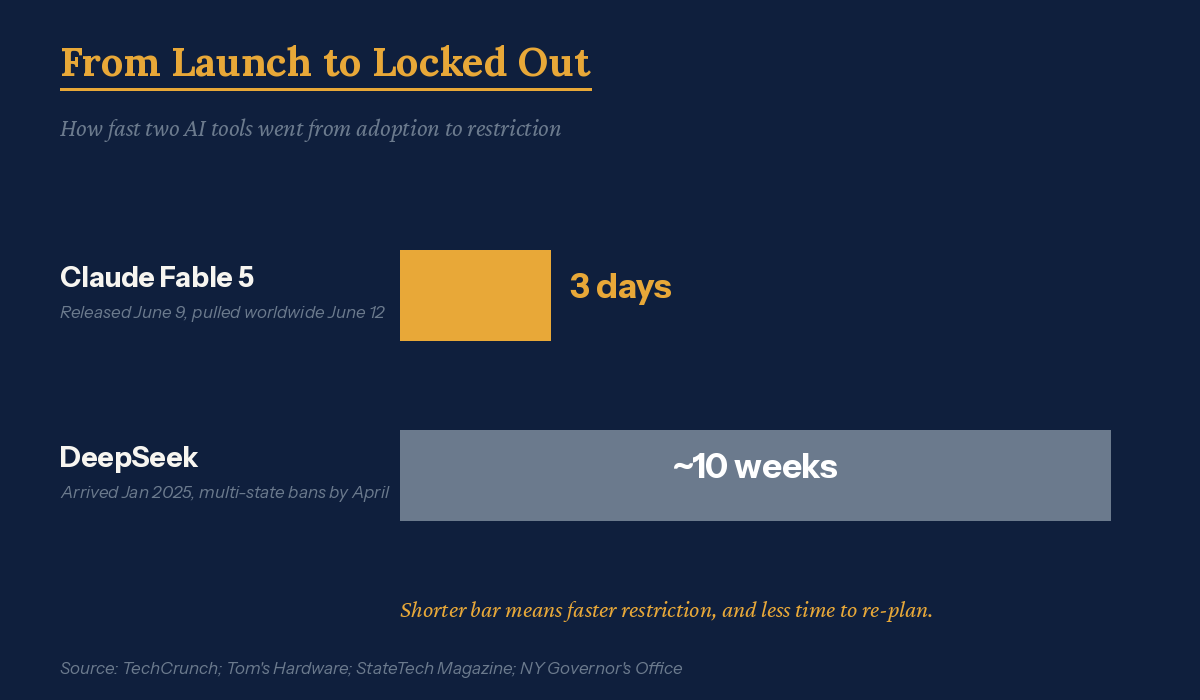
On Tuesday, June 9, Anthropic released Claude Fable 5, calling it the most capable model it had ever made generally available and noting it was particularly effective at finding software vulnerabilities. Developers wired it into products. Teams rebuilt workflows around it. The usual rush to adopt the new frontier began.
On Friday at 5:21 in the evening, Eastern time, a U.S. government export control directive ordered the company to cut off access for any foreign national, citing national security concerns. Because Anthropic cannot sort foreign nationals from everyone else in real time, the practical effect was a hard shutoff. The company disabled Fable 5 and its controlled sibling Mythos 5 worldwide. Three days from launch to dark.
I covered the launch in Thursday’s daily briefing, the same edition where I noted Anthropic pledging $350 million to study AI’s economic impact and Dario Amodei publishing a tiered framework for how government should respond to AI-driven unemployment. Less than 24 hours after that briefing went out, the government did something nobody’s framework anticipated: it made the most advanced tool on the market unusable for everyone, overnight, over a dispute about a jailbreak the company says it has only seen demonstrated verbally and narrowly.
Then the story got more interesting. The government did not stumble onto this concern on its own. According to the Wall Street Journal, Amazon CEO Andy Jassy raised concerns about the models directly with senior administration officials, and the jailbreak demonstration that drove the directive was run by Amazon's own researchers, who prompted the model into disclosing software vulnerabilities. Amazon is also one of Anthropic's largest investors. So the action that took the most capable tool on the market offline was set in motion by a competitor who is also a backer, talking to the people who hold the regulatory lever. Read that sentence twice.
Anthropic is complying while disputing the rationale, calling it a likely misunderstanding and working to restore access. That fight will resolve one way or another. The fight is not the point. The point is what just got demonstrated to every organization watching: a capability you adopted on Tuesday can be gone by Friday, and the reason can have nothing to do with you, your industry, or anything you did.
This is not a one-off
The instinct is to file this under “unusual government action involving a frontier model” and move on. That would be a mistake, because the pattern is already well established and this is just the most dramatic version of it.
Cast your mind back eighteen months. DeepSeek arrived, impressed everyone with its performance, and within weeks became radioactive. Texas banned it from state devices on January 31, 2025. New York followed on February 10. Virginia, Iowa, Kansas, and others lined up behind them, and Congress took up a bipartisan bill to bar it from federal devices entirely. A tool that looked like the smart, cheap choice in January was a compliance liability by April. Any organization that had built a workflow on it spent the spring ripping it out.
Different trigger, identical shape. A tool enters the market, gets adopted at speed, then gets restricted faster than the organizations relying on it can re-plan. Foreign ownership, security vulnerability, export control, data residency. The specific reason changes, but the pattern doesn’t.
Here is the uncomfortable truth most adoption strategies refuse to name. The frontier moves faster than the rules, and the rules, when they finally arrive, arrive abruptly. That combination turns every tool decision into a bet. Not a bet on whether the tool works. A bet on whether the tool will still be permitted by the time you have built anything that depends on it.
What this does to the work, and the people doing it
For years I built workforce plans that touched operations around the world, and the planning assumption underneath all of them was continuity. You assume the capabilities your people use today will exist tomorrow, so you train for them, hire for them, and design roles around them. That assumption held for decades because the tools of white-collar work changed on a timescale measured in years. Email. Spreadsheets. The cloud. Each transition gave organizations time to absorb it.
Most of us were already working with a different set of assumptions in the age of AI about the pace of change. However, AI tools change on a timescale measured in days, and now the policy reactions to them do too. When the most capable tool on the market can vanish in 72 hours, the continuity assumption breaks, and a lot of quiet organizational design choices break with it.
Consider what actually happens inside a company when a tool disappears overnight:
The team that rebuilt a workflow around Fable 5’s vulnerability-finding strength now has a workflow with a hole in it, and no replacement of equal capability to drop in.
The people who got good at that tool, who developed the prompting instincts and the judgment about when to trust it, have skills suddenly attached to nothing.
The manager who promised faster delivery on the strength of the new capability has to walk it back, to a customer or to their own leadership.
The workforce plan that assumed a productivity gain from the tool now assumes a gain that evaporated.
None of those people did anything wrong. They adopted a sanctioned, publicly released tool from a credible company. The capability was real on Tuesday. The exposure was structural, and it sat outside anything they controlled.
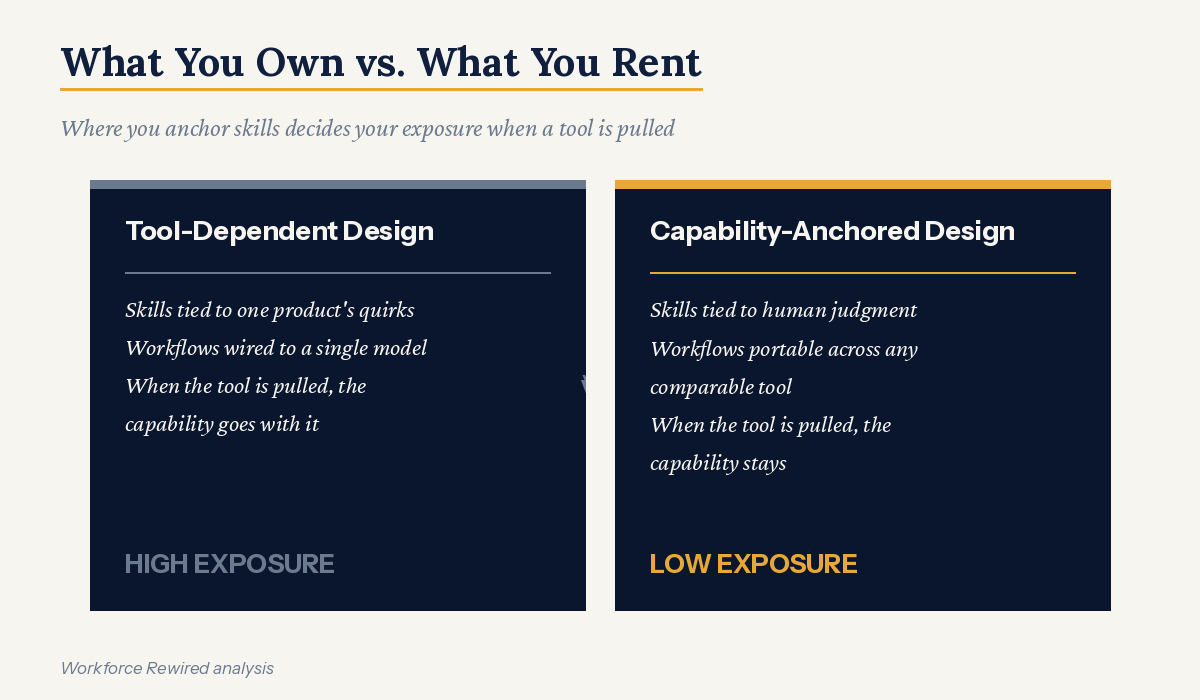
This is the case for designing human work around durable capabilities rather than specific products. The instinct to train your people on the hot tool is understandable and partly right, because they do need fluency. But the deeper investment is in the capability the tool happens to deliver this quarter. The judgment to evaluate a vulnerability, not the specific model that surfaces it. The skill of directing and checking AI output, not loyalty to one vendor’s interface. Tools are rentals. The human capabilities around them are what you own, and they are the only part of the stack that survives a Friday-evening directive.
“Tools are rentals. The human capabilities around them are what you own, and they are the only part of the stack that survives a Friday-evening directive.”
The government is still behind the eight ball
Now the harder half of the story, because the volatility has a source beyond the speed of the technology.
The United States has no comprehensive federal AI law. What it has instead is a patchwork of state statutes, agency guidance, and voluntary standards, with states filling the federal vacuum on their own terms. Through 2025, attempts to impose a federal moratorium on state AI laws failed, including a proposed ten-year freeze that the Senate stripped from a budget bill on a 99-1 vote. In March 2026, the White House released a National Policy Framework for Artificial Intelligence, urging Congress to replace the patchwork with a uniform approach. The framework is non-binding and creates no compliance obligations.
So when a genuine national security concern surfaced about Fable 5, the government did not have a calibrated instrument to reach for. It had an export control directive, a blunt tool built for a different era, and it swung that tool after the model was already in the wild. The restriction did not prevent a risk before deployment. It reacted to one after, and the reaction was so imprecise that it took down the tool for every user on earth to address a concern nominally about foreign nationals.
The Amazon detail sharpens the whole problem. When the only instruments available are blunt and reactive, they become unusually easy for a private actor to aim. A competitor with a relationship to the right officials and a research team willing to build the demonstration can point a national security lever at a rival's product. War-gaming that scenario used to belong in the someday pile. It just happened, in public, to the most capable tool on the market.
I spent eight years serving federal government clients, and I will say this plainly and without criticism of any administration: government moves at the speed of process, and process is slow by design. That slowness is a feature when the job is deliberation and a liability when the job is keeping pace with a technology that ships a new frontier every few months. The mismatch is structural. It will not be fixed by any single law, and it is not going away.
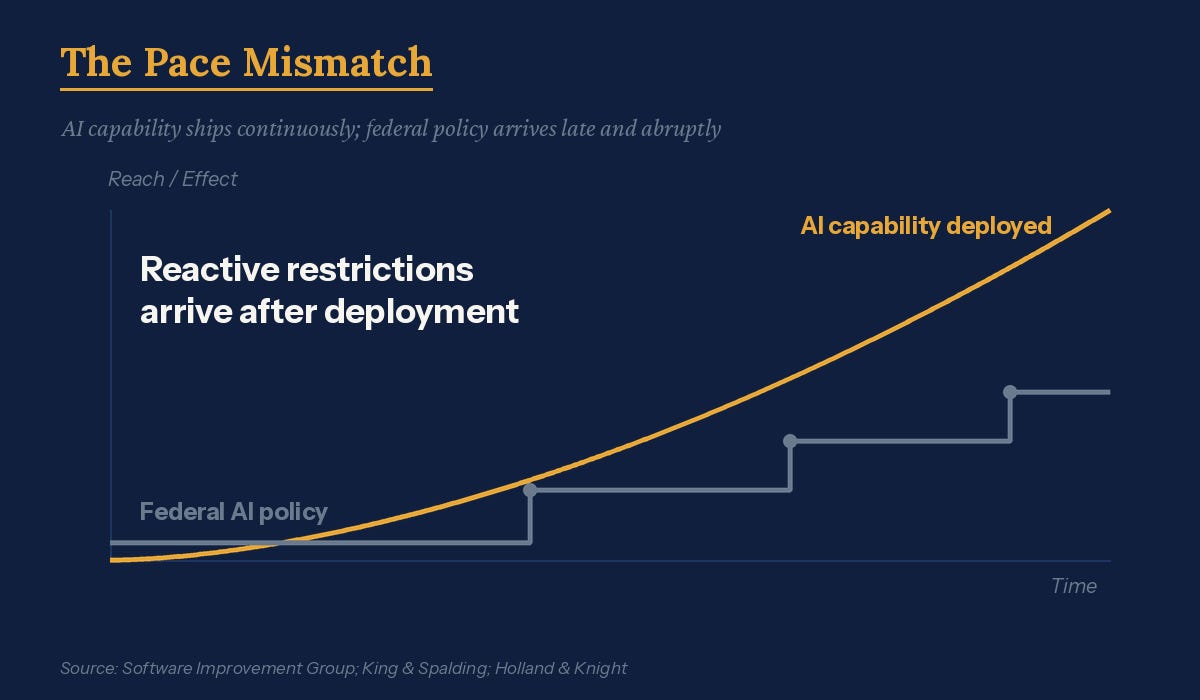
For organizations, the consequence is precise. You are operating in an environment where the rules governing your most powerful tools are written reactively, applied bluntly, and changed without warning. The regulator is not a stable backdrop you can plan against. The regulator is itself a source of volatility, because it acts late and then acts hard.
That is the part most AI adoption conversations skip. Leaders ask whether a tool is good and whether their people can use it. The better question (or at minimum, one asking in addition), the one almost nobody is asking out loud, is whether the tool will still be legal to use by the time it is load-bearing in your operation, and whether you have designed your work so that the answer does not sink you.
What to do with this
The takeaway is not to slow down or to wait for the dust to settle, because the dust will not settle. The takeaway is to build for the volatility you now know is permanent.
Here are three moves, ordered by how much they protect you.
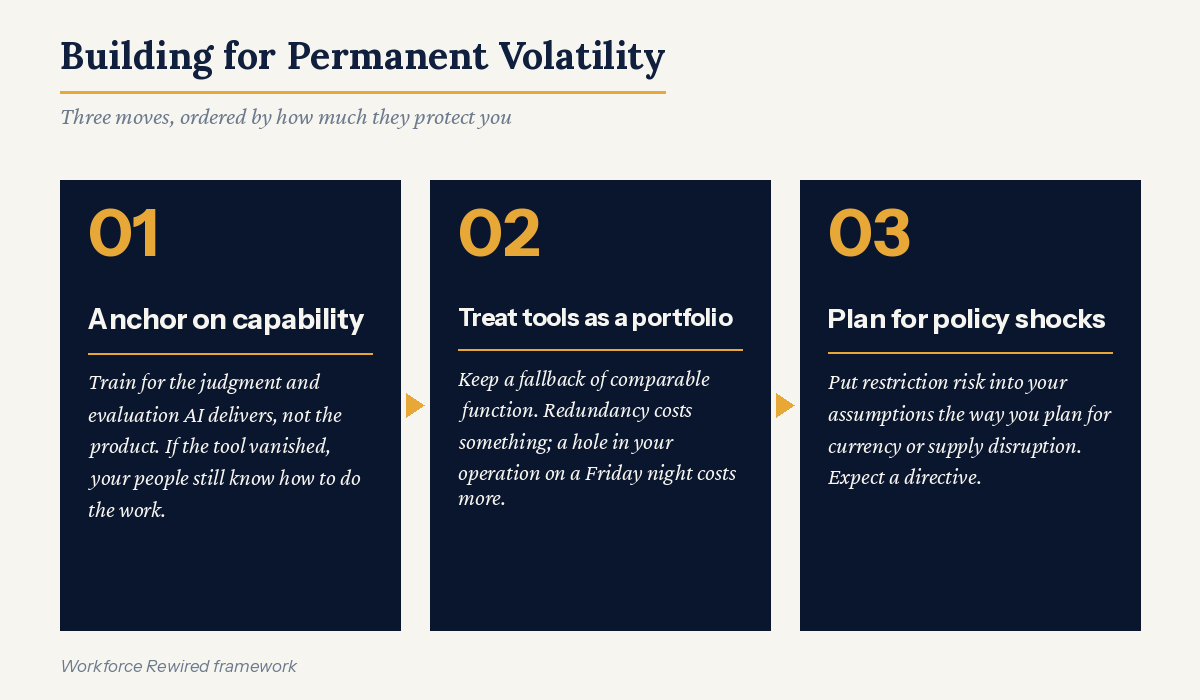
First, design human work around capabilities, not products. Ask of every AI investment: if this specific tool disappeared tomorrow, what would my people still know how to do? If the honest answer is “very little,” you have built dependency, not capability. Train for the judgment, the evaluation, the direction of AI output. Those skills move with your people across whatever tool survives the next directive.
Second, treat tool adoption like a portfolio, not a marriage. Avoid letting a single model become load-bearing in a critical workflow without a fallback of comparable function. The team that lost Fable 5 on Friday is in a different position than the team that could route the same work to a second capability with a day of reconfiguration. Redundancy costs something. So does a hole in your operation on a Friday night.
Third, put policy volatility into your planning assumptions explicitly, the way you already plan for currency risk or supply disruption. Your 2027 plan should name which capabilities you will build on, which of them could be restricted, where that restriction could land, and what your operation does the day it happens. You cannot predict the next directive. You can refuse to be surprised that one is coming.
The tool that vanished this week will probably come back. The condition it revealed is here to stay. The organizations that come out ahead will be the ones that stopped treating their tools as permanent and started treating the human capability around those tools as the only asset they actually own.
For people who want better questions: the next time a vendor or a consultant tells you a new model will transform your operation, ask them what your operation looks like the morning it gets pulled. If they have not thought about it, you have just found the gap in the plan.
Workforce Rewired publishes weekly at the intersection of AI, organizational design, and the future of work. If this piece made you think, share it with someone navigating the same questions.
The views expressed here are my own and do not represent the position of my employer or any organization I am affiliated with.