


TL;DR: This week I head to Ohio to volunteer on a 328-mile ride for the American Cancer Society, the fifth year I have raised money for a disease that has taken some of the people who raised me. Cancer research is in an extraordinary stretch: AI systems now solve protein structures in weeks that used to take years, and more than 200 AI-designed drugs are in clinical development. That progress runs on a human pipeline that is contracting at the same time. New international graduate enrollment fell sharply this year, federal cancer research funding faces a proposed 37 percent cut, and three quarters of US scientists told Nature they were weighing a move abroad. Tools arrive in quarters. Scientists take a decade. That mismatch is a workforce planning problem, and it is the kind that shows up long after the decision that caused it.
A note before I start. Workforce Rewired is usually an argument about how organizations are designed, and it still is. It also has my family in it. Cancer research is the one subject where I cannot separate the two, and this week I did not try.
Tomorrow I drive to Ohio.
For the third year, I will spend four days with a team called Agents of Hope on the Pan Ohio Hope Ride, 328 miles of road from Cleveland down to Cincinnati. I rode it the last two years. This year vertigo has me off the bike, so I will work the route instead, running support stops and the unglamorous logistics that let all of our riders keep moving. The ride still starts in Cleveland, which is where my dad was born and where he died.
His name was Mark Lexa. Leukemia took him at 33. I was five.

That is the first entry on a list I keep. My grandmother Jeanne, who I called Memaw, raised me like a second mother and died of colon cancer. My Uncle Buddy, the closest thing I had to a father after mine, died of pancreatic cancer. In 2019, my friend Chris Connelly, married to my longtime friend Kristen, died of brain cancer in his thirties. In the spring of 2022, within a few months of each other, I lost Lauren Kelly, a close friend and peer, to breast cancer, and Naomi Stutzman, a woman I had hired myself, to pancreatic cancer. Both were in their thirties.
Chris left a toddler named Jack. Lauren left two boys, her Jack and her Gabe, the younger barely two. Naomi left a five-year-old named Liam.
I was five. I know what those boys are walking into. Five years of these rides has raised close to $100,000 for the American Cancer Society, which is the most useful thing I have figured out how to do about any of it.
So I follow cancer research the way some people follow a sports team. And the last eighteen months have given me more to be excited about than the previous ten years combined, alongside a set of numbers that I cannot stop reading as a workforce problem, because that is the job I do for a living.
The good part is very good
Let’s start with what is going right.
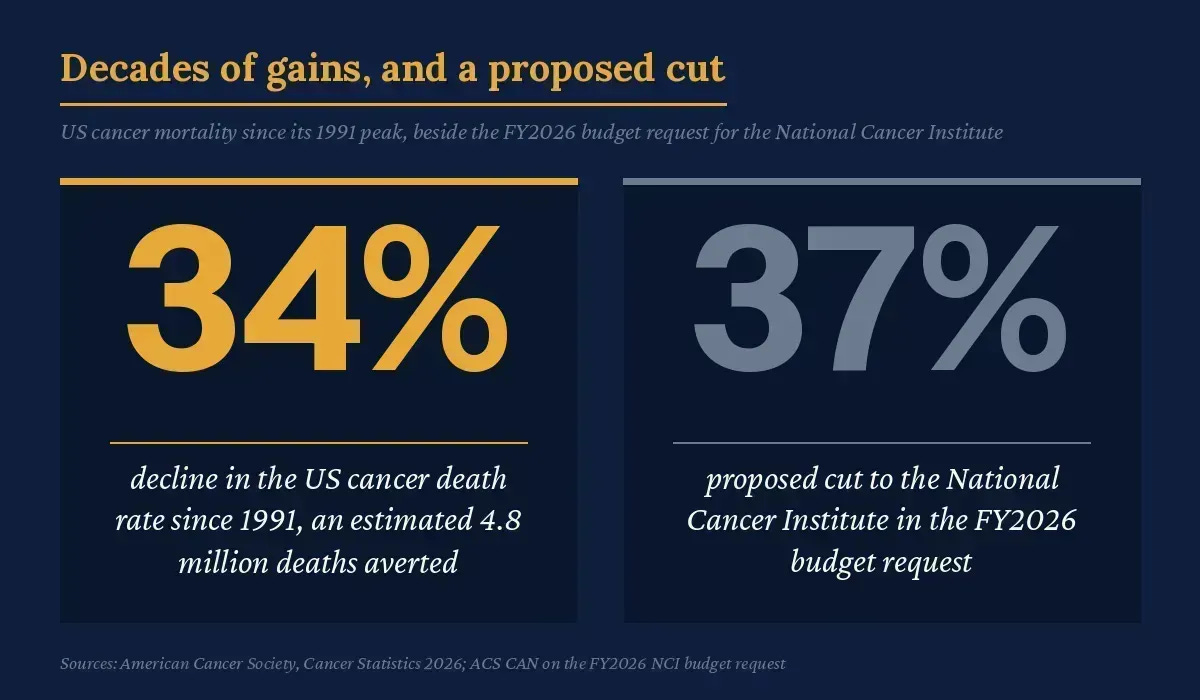
The American Cancer Society’s 2026 statistics report put the US cancer death rate down 34 percent from its 1991 peak, an estimated 4.8 million deaths averted. Five-year relative survival crossed 70 percent for the first time. Myeloma survival went from 32 percent to 62 percent. Liver cancer went from 7 to 22. Lung cancer, the one that used to be a near guaranteed death sentence, went from 15 to 28.
Those gains came from decades of slow, expensive, federally backed science. What is happening now is that the slowest step in that science is getting dramatically faster.
Protein structure prediction is the clearest example. Figuring out the three-dimensional shape of a protein used to take a lab years and sometimes never worked at all, and you cannot design a drug against a target whose shape you cannot see. Google DeepMind’s AlphaFold changed that. In the first oncology application of the tool, researchers worked out the structure of CDK20, a target implicated in liver cancer, and had a small-molecule inhibitor in 30 days. Thirty days, against a problem that used to take careers.
That compression is showing up downstream. As of January 2026 there were more than 200 AI-designed drugs in clinical development, 94 in Phase I, 56 in Phase II, 15 in Phase III. Isomorphic Labs, the drug discovery company spun out of Google DeepMind, expects its first AlphaFold-designed oncology candidates to reach human trials by the end of this year. AI is also reading pathology slides, matching patients to trials, and cutting trial documentation from months to days.
If you have lost people to this disease, this is the best news you have heard in a long time. The tools are real and the acceleration is real.
What the tools do not do
Here is where my day job starts arguing with my optimism.
AlphaFold predicted a structure. It did not decide that CDK20 was worth chasing. A human being with fifteen years of liver cancer biology in their head made that call. The model did not design the trial, recruit the patients, notice in month nine that the results looked too good because the treatment group skewed healthier, or sit with a family in a consult room and explain what a response rate means. It did not write the grant that funded any of it.
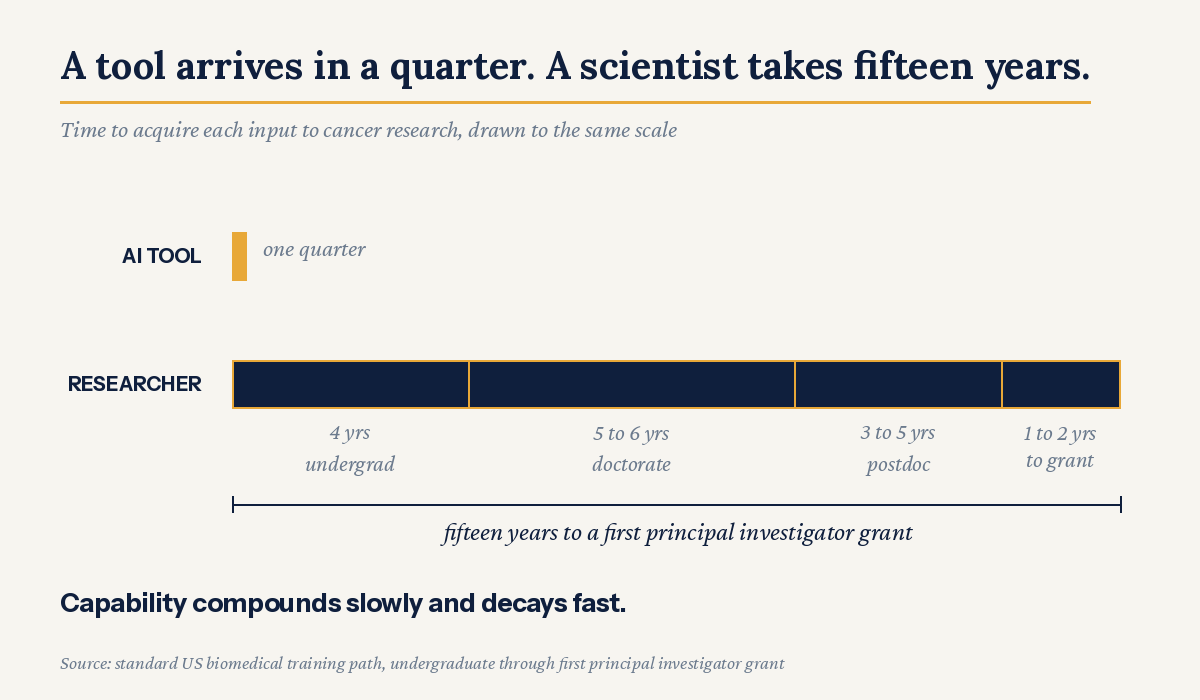
Every one of those steps needs a person, and that person spent years training for it. The median biomedical researcher running a lab today is looking at four years of undergraduate work, five or six for a doctorate, three to five as a postdoc, and then the slow climb to independent funding. Call it fifteen years from freshman orientation to first principal investigator grant.
You cannot replace that quickly. There is no vendor, no contract, no acquisition that produces a mid-career oncology researcher in a quarter. This is the longest lead-time role in the American economy, and lead time is the thing workforce planners worry about when everyone else is watching the tool demo.
The pipeline is contracting from three directions
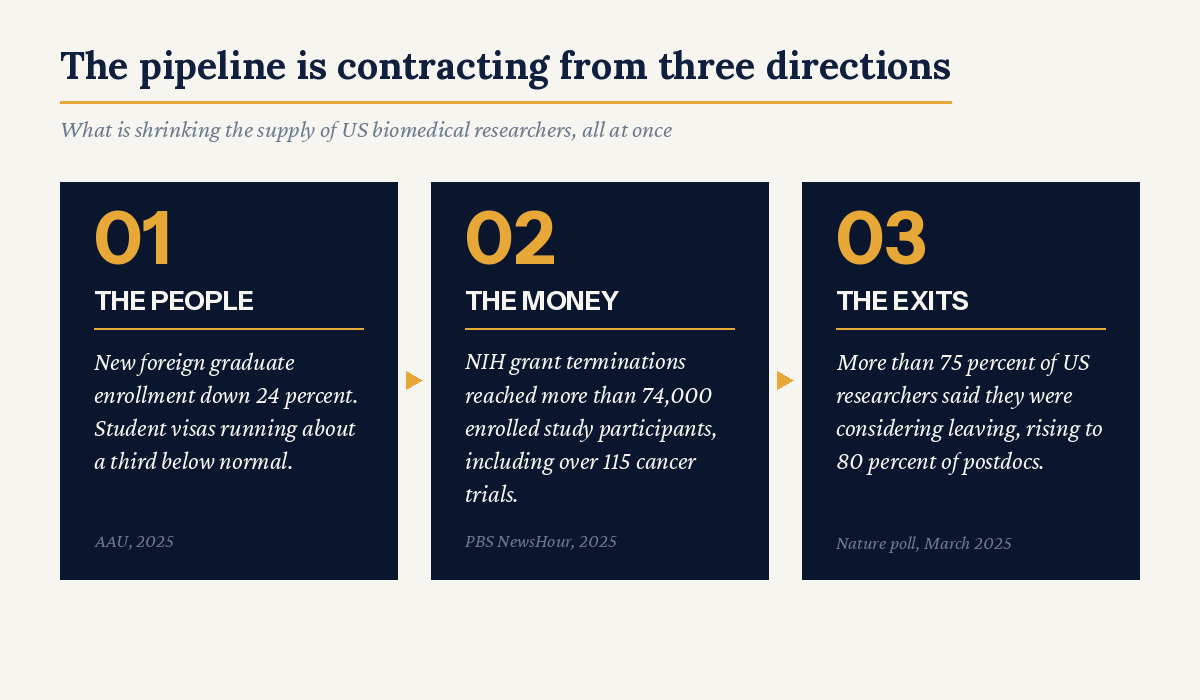
The people. Foreign-born scientists make up the majority of American biomedical research. Roughly 52 percent of US biomedical scientists are foreign-born, and at the doctoral level the share runs higher still. That system depends on a steady inflow of graduate students, and this year the inflow dropped. New international student enrollment fell 17 percent, the steepest decline since the pandemic, with new foreign graduate enrollment down an average of 24 percent and student visa issuance running about a third below normal. The Peterson Institute modeled the consequence: a sustained one-third reduction in foreign STEM graduates would shrink the US high-skill STEM workforce by 6.2 percent overall and 11.5 percent at the PhD level, costing $240 billion to $481 billion in annual GDP within a decade.
The money. The proposed FY2026 budget sets the National Cancer Institute at $4.531 billion, a cut of roughly $2.7 billion, or 37 percent. The damage has already started. NIH grant terminations affected more than 74,000 people enrolled in studies, including over 115 cancer trials. Federally funded trials cover the ground pharmaceutical companies will not fund on their own, including early-phase work, rare cancers, and pediatric cancers.
The exits. In a March 2025 Nature poll of about 1,600 researchers, more than 75 percent said they were considering leaving the United States, rising to 80 percent among postdocs. Other countries noticed. Applications to the European Research Council’s early-career grants from US-based researchers went from 60 for the 2024 call to 116 for 2025 to 169 for 2026. France opened a program to recruit them by name. China launched a K visa for international science graduates and has recruited at least 85 scientists away from US institutions since 2024.
The part that is a workforce problem
I want to be careful here, because it would be easy to turn this into a political column, and that is not what I have to offer.
What I have is twenty years of watching organizations make staffing decisions whose consequences arrive on a delay. That pattern is consistent enough to be a rule. When a company freezes campus hiring in a downturn, the P&L improves that quarter and the leadership bench is thin eight years later, long after the executive who made the call has moved on. The savings are attributable. The shortage is not. Nobody gets a memo in 2034 that says the missing director was the analyst you did not hire in 2026.
Research pipelines work the same way, on a longer timeline and with higher stakes. A grant not funded this year is a lab that does not staff up, a postdoc who takes a position in Munich, a graduate student who never applies. None of that shows up as a headline. It shows up as a treatment that arrives in 2041 instead of 2036, and no one can point to the specific decision that cost those five years.
Capability compounds slowly and decays fast. A tool can be bought in a quarter. A researcher takes fifteen years, and the fifteen years start before anyone knows which disease they will end up chasing.
The AI acceleration makes that asymmetry sharper rather than softer. Every hour AlphaFold saves is an hour returned to a scientist who then has to know what to do with it. The scarce input has always been judgment: which target matters, which anomaly is real, which patient population to design for. Cut the supply of people who hold that judgment while simultaneously handing the researchers who stay better tools, and you have built a beautifully equipped lab with nobody qualified to decide what to run in it.
I would rather we not run that experiment. The 4.8 million people who did not die of cancer since 1991 are the return on a bet this country made decades ago, funded patiently, staffed with the best people from everywhere.
Here’s How You Take Action
If you set workforce strategy anywhere: Find the roles in your organization with the longest build time, the ones that take eight or more years to grow internally, and check whether anything in your current plan quietly shrinks that pipeline. Long-lead roles never announce their own shortage. You have to go looking.
If you lead a team using AI to speed something up: Ask what the new bottleneck is. When a tool removes the slow step, the constraint moves to the human judgment that decides what the tool should work on. Staff for that, or the speed gain disappears into a pile of unreviewed output.
If you hire technical talent: Know your actual exposure to the international pipeline before it becomes a surprise. If a meaningful share of your PhD-level hiring comes from US graduate programs, read the enrollment numbers above as your five-year hiring forecast.
If you care about cancer specifically: Fund it directly. The American Cancer Society funds early-career researchers who are precisely the people the federal cuts hit first, and private money moves faster than a budget cycle. My Pan Ohio Hope Ride page is open through August, and I will take any amount. Then call your representatives. Research budgets and the visa rules that decide where trained scientists end up living are both set by people who count the calls they get. Ask them to protect NIH and NCI funding, and to back the programs that keep the scientists we train working here.
For everyone: The next time someone tells you AI is going to cure cancer, agree with them, then ask the follow-up question. Who is going to be standing there to use it, and where are we getting them?
Christina Lexa writes Workforce Rewired, on the intersection of workforce transformation, AI, and global talent. She volunteers with Agents of Hope on the Pan Ohio Hope Ride, July 23 to 26, for her dad, Memaw, Uncle Buddy, Chris, Lauren, and Naomi and many others fighting or who have fought cancer.
The views expressed here are my own and do not represent the position of my employer or any organization I am affiliated with.