


TL;DR: When Moderna folded IT under its HR chief in 2025, the expert read was that it was a one-off. Fourteen months later Atlassian made the same move from the opposite situation: no crisis, no vacancy, a healthy company. Same structural answer, arrived at twice, which is both a real signal and a trap. Both moves worked because one unusually technical HR leader happened to exist, and an org model that depends on a person that rare is a bet on scarce supply. For almost everyone, the durable answer is a partnership between the People side and the Technology side, held together by shared metrics. Here is how to tell which one your company needs.
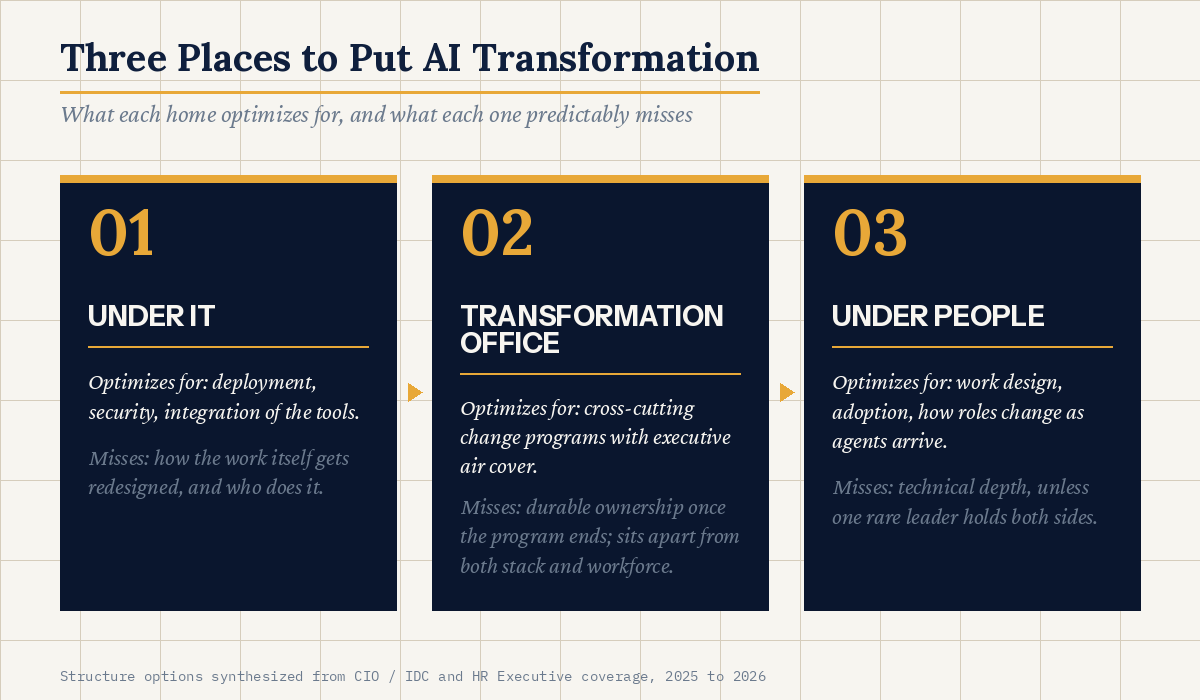
Every org chart is an argument. It looks like a diagram of who reports to whom, but read it closely and it tells you what a company believes its hardest problem is. Put your AI transformation under IT and you have argued the problem is deployment: pick the tools, wire them in, keep them secure. Put it under People and you have argued the problem is the work itself, how it gets designed and who does it. In the last year, two companies made the second claim loudly enough to notice.
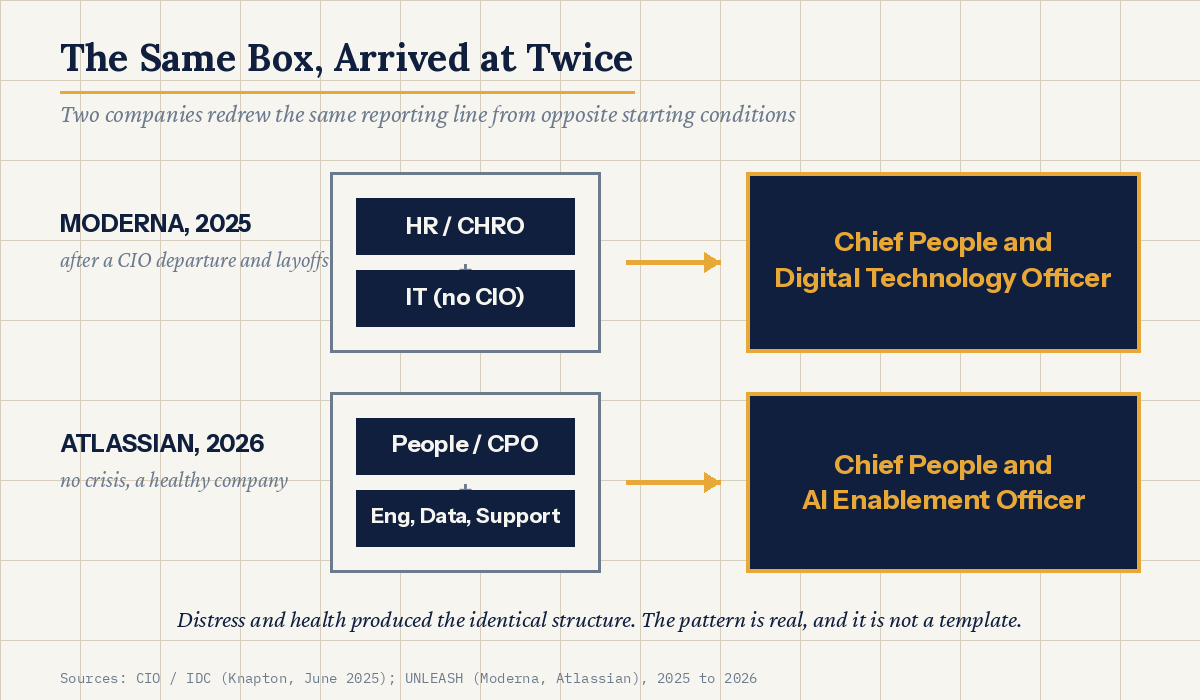
In May 2025, Moderna folded its IT department under its chief human resources officer, Tracey Franklin, and gave her a new title: Chief People and Digital Technology Officer. The move raised eyebrows across the industry, and the sober read at the time was that it was situational. IDC’s Ken Knapton, writing in CIO, called it “deeply situational and very unique,” a “singular experiment, not a template,” and argued the CIO and CHRO “are still best kept in separate seats at the table.” That was a reasonable call. Moderna’s merger followed a CIO departure and a round of layoffs, and it rested on one leader with an unusual command of both domains.
The same box, arrived at twice
In spring 2026, Atlassian expanded the remit of its chief people officer, Avani Prabhakar, into a new role: Chief People and AI Enablement Officer. Her organization grew from a 700-person HR team to roughly 3,500 people spanning engineering, data science, customer tech support, and internal operations, serving a company of about 14,000. Nothing about Atlassian’s situation matched Moderna’s: no CIO had walked out the door, no layoffs forced a reshuffle. This was a healthy software company choosing the structure on purpose.
Opposite conditions producing the same box points to something structural, a force pulling the People function and the Technology function toward each other.
Why the pull is real
Jensen Huang put the logic in one sentence that Knapton quoted:
“In a lot of ways, the IT department of every company is going to be the HR department of AI agents in the future.”
As agents take on real work, someone has to decide what they are allowed to do, how their output gets reviewed, and how human roles reshape around them. That is a workforce design question. It falls in the space between the two functions, and companies that keep People and Technology far apart on the chart leave it unowned.
Franklin describes her job as “architecting the flow of work,” and has been candid that the merger is “still very much a work in progress.” Both companies are pointing at the same gap: the tools arrive faster than the work is redesigned to use them, and the redesign is nobody’s clear job. The question is whether merging the boxes fixes that, or just hides it inside a single title.
The uncomfortable part
Both stories quietly depend on the same thing: a person who can actually do both jobs. Knapton was blunt about it.
“This type of executive is rare. Most CHROs, while highly skilled in people strategy and organizational design, do not possess the technical depth required to lead IT. Conversely, most CIOs are not equipped to take on employee experience or talent development at scale.”
Franklin could hold Moderna’s merged role because she had spent years close to the company’s AI strategy. Prabhakar brought two decades across tech and operations. Remove that rare leader and the elegant org chart becomes a job description no one on LinkedIn can fill.
I set workforce strategy for a technology organization, so I understand this intersection more than most. And I can say with certainty that I would be wholly unqualified to lead a technology organization as a talent strategist. You can copy Moderna’s boxes onto your chart in an afternoon. You cannot copy Tracey Franklin.
That is why I do not think the merger is the right default, even though I understand the decision in both cases. Tech-stack transformation and workforce transformation are two different jobs. One owns architecture, security, and integration. The other owns how work is designed, how people develop, and how roles change as the machines take on more. Both are full-time, senior, and hard. Collapsing them into one seat does not shrink the work. It hands one person more than most can carry, and bets that whoever holds the title is a specialist in both.
What usually breaks
When you do put both under one leader, the predictable failure is that one voice swallows the other. Neil Morrison of Staffbase named it in HR Executive: “one voice will likely overpower the other if both perspectives are housed in one unit, or under one C-suite leader. That can lead to decisions that are too tech-led, or technology that never fully gets used.” HR brings culture, ethics, and human judgment. Technology brings systems, data, and scale. AI needs both, and a single leader under pressure tends to favor the domain they came up in. The other domain becomes an afterthought with a seat that exists only on paper.
Morrison’s alternative is the one I would put money on for most organizations. Shared goals, shared metrics, and mutual respect, “not shared titles.” Build a real partnership between the Technology leader and the People leader, with cross-functional teams, shared governance, and incentives measured by employee adoption and measurable productivity gains rather than rollout speed. His phrase for the target state is “separate, but tightly aligned.” That takes more deliberate structure than merging does, because merging just takes a memo. Even Knapton, arguing against the merger, lands in the same place: the CIO and CHRO “will be powerful allies in the age of AI.” Allies in distinct seats.
The question you should be asking
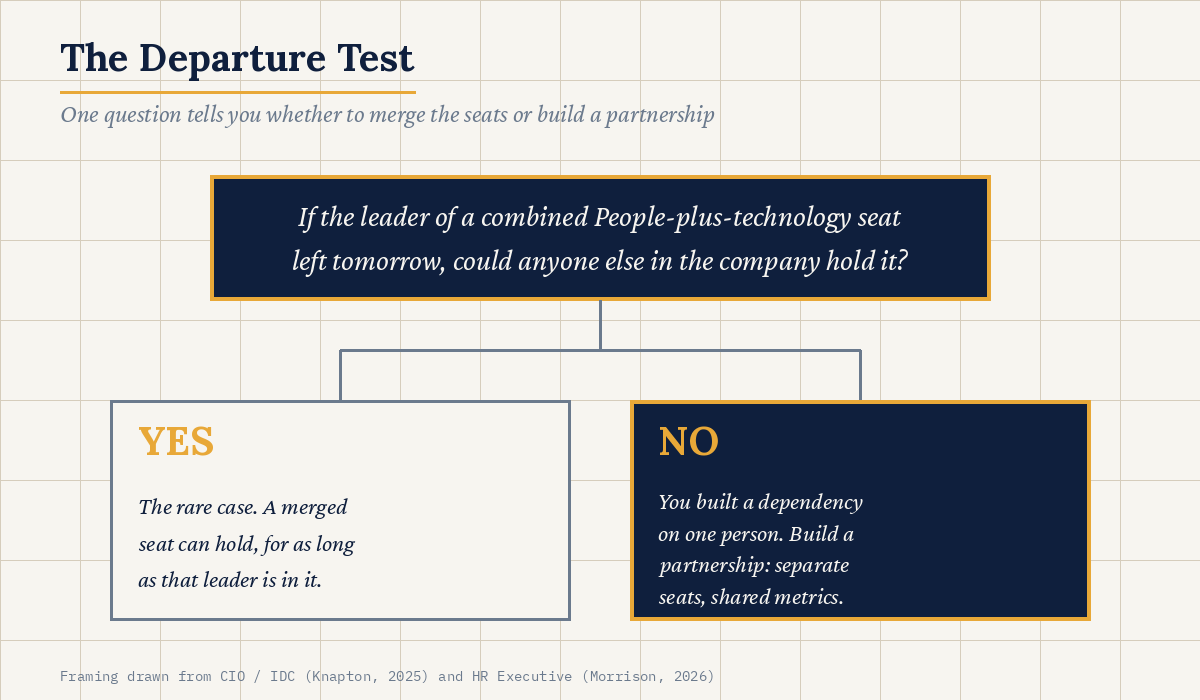
One test separates the rare company where a single leader can genuinely hold both from the many where partnership is the honest answer. Ask whether the leader you would put in that combined seat could be replaced if they left tomorrow. If the honest answer is no, you do not have a durable structure. You have a dependency on one person, and you are one resignation away from an org chart that describes a role nobody can fill.
The headline cases are worth watching. Moderna’s structure survived a year that cut roughly ten percent of its workforce, which tells you the model is more than a press release. Atlassian’s version is young. But the seam between People and Technology is now load-bearing, and every company has to decide who owns it. A rare few will have a leader who can own both. Everyone else should resist the urge to solve an organizational problem with a title.
Here’s How You Take Action
If you are a CEO or on the executive team: Before you combine the People and Technology functions under one leader, run the departure test. If only one specific person could hold the merged seat, you have built a dependency on that person, and a structure has to outlast whoever sits in it. Name the gap you are trying to own, then decide whether one leader or a governed partnership owns it better.
If you lead HR or Technology: Do not wait for a reorg to close the gap. Build the partnership now. Agree on shared metrics with your counterpart, measured by whether the workforce actually adopts and benefits from the tools. Shared goals beat shared titles.
If you set workforce strategy: Treat AI-agent governance as the specific work that lives between the two functions. Who approves what an agent can do, who reviews its output, who redesigns the human roles around it. Assign those explicitly, to named people on both sides, before an incident assigns them for you.
For everyone watching the headlines: When a company announces it has merged HR and IT, ask who is filling the seat and whether the model survives that person leaving. That answer tells you more than the boxes on the chart, because it reveals whether the company built a role or bet on a unicorn.
Christina Lexa writes Workforce Rewired, on the intersection of workforce transformation, AI, and global talent.
The views expressed here are my own and do not represent the position of my employer or any organization I am affiliated with.