


TL;DR: I draft with AI and I am not embarrassed to say so. What I am embarrassed by is the first draft, which arrives reeking of robot: em dashes everywhere, every paragraph resolving into a tidy little bow, the phrase “it’s not just X, it’s Y” three times in nine hundred words. So I wrote my own anti-AI style guide, and the audit against it now runs as a step inside my writing workflow, not as me alone with a red pen. I direct it, I read what comes back, and I make the final calls. Here is the whole checklist, free to steal.
The confession
I write a newsletter about AI. I use AI to help write it. The people who find this scandalous are usually the same people whose “human-written” LinkedIn posts open with “In a world where...” and close with “The future is now.” So I will not be lectured.
What I will admit is that the raw output is bad in a very particular way. Not wrong. Bad. It reads like every other piece of AI prose on the internet, which is to say competent, smooth, and instantly forgettable (except you hear echos of it everywhere in the structure and language). The ideas can be mine. The sentences are nobody’s.
The first time I noticed this, I had drafted a section on entry-level hiring, read it back, and felt nothing. Every sentence was fine. The whole thing had the texture of a hotel lobby. Pleasant, anonymous, and impossible to remember once you have left.
The people who find this scandalous are usually the same people whose “human-written” LinkedIn posts open with “In a world where...” and close with “The future is now.”
So I started keeping a list of the specific things that made it sound like that. The list became a document, then a real style guide: every pattern to exclude, limit, or keep, with the reason for each. That guide is now a standing instruction the AI reads before it drafts a single sentence for me. It writes against my rules, runs the audit against my rules, and hands me the result. I read what comes back, catch what it missed, and make the calls it cannot. Nothing publishes until it survives that loop.
Why a banned-word search is not enough
The obvious move is to search for the famous AI words and delete them. “Delve.” “Tapestry.” “Leverage.” Fine. Do that. It takes thirty seconds and it is the easiest win available.
It is also nowhere near sufficient, because the strongest tells are not words. It’s the syntax. A reader who has seen a thousand AI posts does not consciously think “ah, the word delve.” They feel a wrongness in the rhythm, the way every paragraph builds the same way, the little rhetorical question that sets up its own answer. You can pass a banned-word search clean and still sound exactly like a machine.
The research backs this up. The most reliably identified AI tell is not vocabulary at all. It is a sentence structure: negative parallelism. “It’s not about the technology, it’s about the people.” “The question isn’t whether AI will change work. The question is how.” Once you see it you cannot unsee it, and AI produces it constantly, because it is a cheap way to manufacture the feeling of insight without any actual contrast underneath.
So my guide hunts syntax, not just words. Here is what it tells the AI to look for, and what I check behind it.
The audit, in full
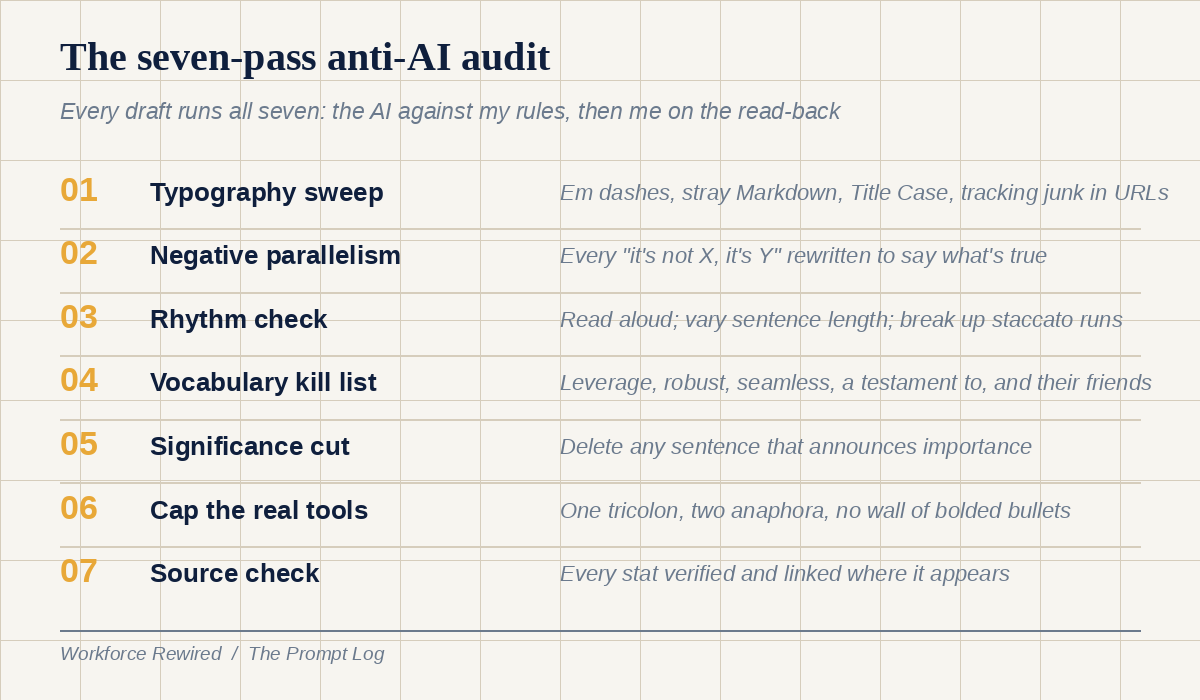
The guide runs these as ordered passes. Each one is a sweep through the whole draft looking for one specific thing. Boring, mechanical, and it works. I do the same passes on the way back, because the AI applying my rules and me confirming them are two different safeguards, and I want both.
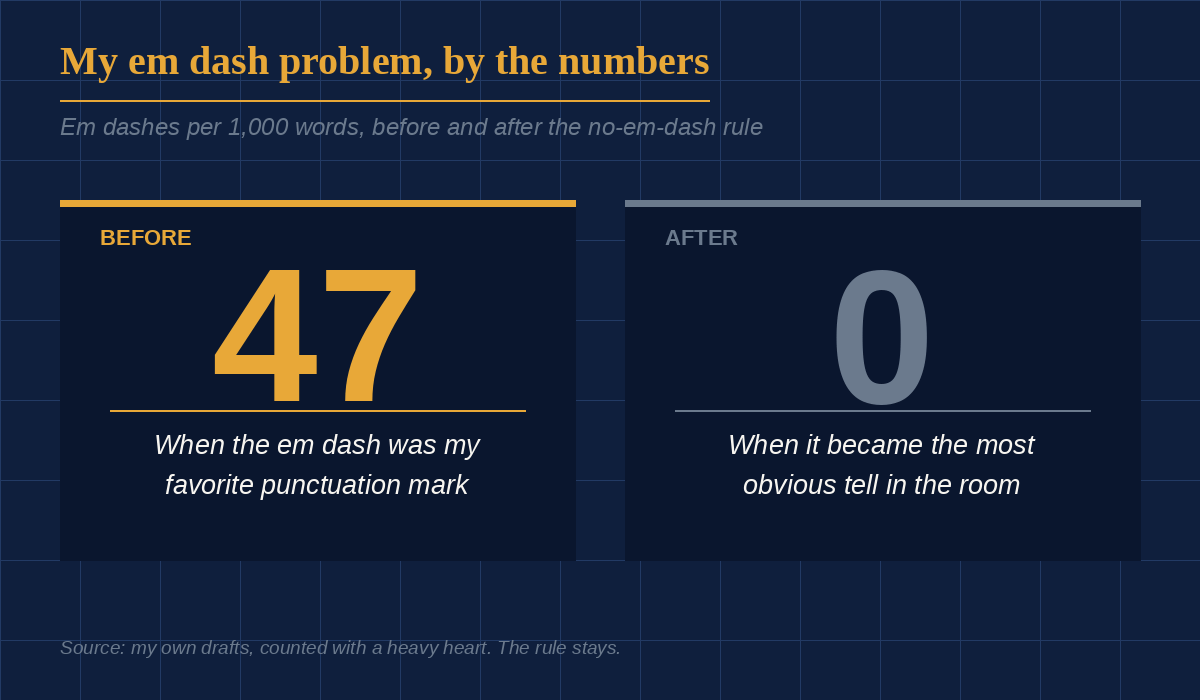
1. The typography sweep. This is the highest-value five minutes and almost nobody does it. Em dashes: zero, always, no exceptions, rewrite the sentence. I should confess that this rule costs me personally. I loved the em dash. For twenty years it was my favorite piece of punctuation, the elegant little bridge I dropped into a sentence whenever a comma felt too weak and a period felt too final. Then the machines learned to love it too, and now it is a tell, and I have had to give it up like a perfectly good habit that turned out to be a crime. I still reach for it. I still grieve. I use a comma and move on. Stray Markdown that survived the copy-paste: literal asterisks where bold should be, a hash mark in front of a header, bracket-paren link syntax sitting in the body. Headers in sentence case, not Title Case That Capitalizes Everything. URLs stripped of tracking junk, because a live link in your published post carrying utm_source=chatgpt.com is the most literal confession available to a writer. Then paste the whole thing through a plain-text editor once to kill the invisible Unicode characters AI sometimes smuggles in. You will not see them. They are there.
2. The negative parallelism hunt. Every “it’s not X, it’s Y” and its whole family. I rewrite each one affirmatively. “This is a management problem” says everything “It’s not a technology problem, it’s a management problem” says, in half the words, with more authority, and without the fingerprint. This single pass does more for the human-ness of a draft than any other.
3. The rhythm check. I read it aloud. If every sentence is the same length, something is wrong, because AI tends toward uniformity and humans do not. A short sentence lands hard after a long one. I also look for clusters of single-sentence paragraphs stacked for fake drama, and I consolidate them. One lone sentence can hit. Five in a row is a robot doing an impression of Hemingway.
4. The vocabulary kill list. Now the words. “Leverage” as a verb, “robust,” “seamless,” “unlock,” “streamline,” “underscore.” Plus the sneakier inflation cluster the 2026 frequency data flagged: “pivotal,” “showcase,” “foster,” “garner,” “a testament to,” “stands as a reminder of.” The pattern under all of them is the same. The word inflates a significance the writer has not earned with a fact. Replace it with the fact.
5. The significance-inflation cut. Any sentence that tells the reader something is important gets deleted. Not softened. Deleted. If a development matters, the specifics show it. “This represents a broader shift in how organizations think about talent” is a sentence that has decided to skip the part where it proves anything. The fact carries the weight, or there is no weight.
6. The caps on the real tools. Some AI patterns are also legitimate rhetorical moves, so I ration them instead of banning them. One tricolon per piece, the rule of three, because AI uses it to fake comprehensiveness. Anaphora twice, maximum. Not every bullet starting with a bolded phrase and a colon. These are tools. The tell is the overuse.
7. The source check. Every statistic verified and hyperlinked at the exact point it appears, not in a cleanup pass later. “Experts argue” and “research suggests” are not citations. They are the absence of one wearing a tie.
That is the whole audit. Seven passes. The AI runs them as it drafts because the rules live in its instructions, and my read-back on a long piece takes maybe twenty minutes, less once the patterns are in your own head and you start catching them on sight.
The part where I tell on myself
The honest thing to report is that the loop still fails, on both ends, constantly.
I drafted this very piece with AI help, ran the typography sweep on the way back, and found two em dashes. Neither came from the machine. I had typed them myself, by hand, in the lines I revised. Eighteen years of writing habits do not evaporate because I wrote a rule against them, and the guide I built to catch the AI ended up catching me.
The AI misses things too. It left a “the question isn’t whether, it’s how” sitting in an early paragraph, which is a special kind of irony given that the paragraph was about negative parallelism. My read-back caught it. I rewrote it. That is the entire point of running the audit twice, once by the AI against my rules and once by me: neither pass is clean on its own, and the version of me that is confident at nine at night is not a safeguard I trust.
So I will be precise about who does what. I wrote the rules. The AI applies them while it drafts and flags what it can. I read every line, catch what slipped through on both sides, and decide what is actually mine. The machine just makes sure the rules get run every single time, which is more than I managed when the only auditor was me at the end of a long day.
Here’s how you take action
If you write anything with AI in the loop, build your own version of this. It does not have to be elaborate. Start here.
Write the rules down where the AI can read them. Open a note and list the five things that most make AI writing sound like AI to you: em dashes, the “it’s not X, it’s Y” shape, headers in Title Case, the significance-announcing sentence, the bolded-colon bullet. Then paste that list into your system prompt or project instructions so the model applies it as it drafts, instead of you cleaning up the same mistakes by hand every time. Mine grew from six items to dozens, but it began that small.
Separate the word passes from the syntax passes. Search-and-delete handles the vocabulary. Only reading aloud catches the rhythm and the structure. Do both, and do them as separate steps, because your brain cannot hunt words and syntax at the same time.
Always run the typography sweep on the final paste. Em dashes, stray Markdown, Title-case headers, and tracking junk in URLs are the four tells that survive the move from your draft into Substack or LinkedIn. Strip them in the published version, not just the draft.
Verify every number where it sits. When you cite a statistic, link the primary source in the same sentence, immediately. Do not promise yourself you will go back. You will not go back.
Audit both ends. The AI will miss things even with your rules in front of it, and you will introduce your own tells in the lines you revise. It will still use words that make you go, huh? Read every draft yourself, no matter how clean the model claims it is. The point is a reliable way to catch the imperfect draft, whoever made it imperfect. That habit is cheaper than the trust you lose when a reader’s gut tells them a machine did all your thinking for you.
The machine drafts fast and now runs my rules while it does it. The taste, the direction, and the final call stay with me, and that is the part nobody can automate. The guide just makes sure the rules get run every time, which is the part I could never be trusted (or find the time) to do alone.
The Prompt Log is a recurring feature of Workforce Rewired. Published when there's something honest to say about the process. If you're building your own version of this, I'd like to hear what's on your list: christina@workforcerewired.co.
Very interesting!! You're a genius!