


TL;DR: Companies are eliminating middle management at historic speed, framing it as efficiency and AI enablement. The real cost is not the salary savings. It is the systematic destruction of the organizational layer that develops judgment, enforces ethical guardrails, and produces the next generation of senior leaders. The bill comes due around 2028. No one is prepared to pay it.
Imagine you are building a house. The foundation looks solid. The roof is ambitious. And someone has just told you that the load-bearing walls in the middle are redundant weight, expensive to maintain, and frankly, a little old-fashioned. A smarter structure would just carry more load at the top and bottom, with the middle opened up for flow. So you start removing walls.
This is, more or less, what corporate America has been doing to management structure for the past three years. And the engineers (which, in my observation, might be the ones calling the shots) who approved those blueprints should know better.
The Numbers Are Not Subtle
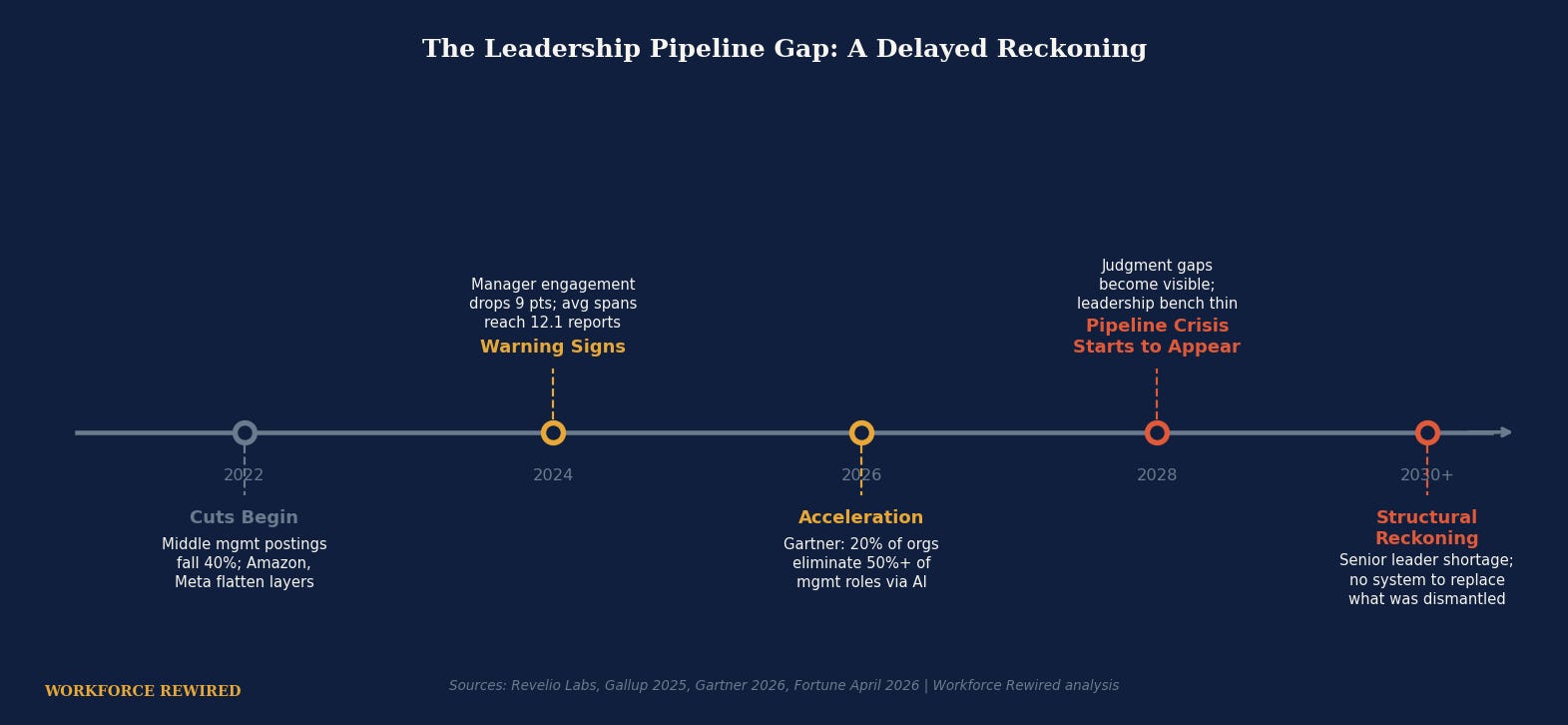
Revelio Labs has been tracking management job postings since 2022. Middle-management postings dropped 40% over that period. Not trimmed. Not reduced. Nearly halved.
Gartner predicted that by the end of 2026, 20% of organizations will have used AI to eliminate more than half their current middle management positions. Managers constituted one-third of all layoffs in 2023. By 2025, 41% of employees reported that their companies had trimmed management layers in the prior year.
The individual company cases are even more instructive than the aggregate numbers. Amazon, in late 2025, removed roughly 14,000 corporate roles and reduced its manager-to-individual-contributor ratio by 15%. CEO Andy Jassy positioned the move as removing bureaucratic friction and increasing decision speed. Meta deployed a 50-to-1 engineer-to-manager ratio in its applied AI division. A ratio that would have been considered organizationally reckless five years ago is now presented as a model worth studying. Span of control is the latest hot topic in the corporate ever-growing quest for “efficiency”.
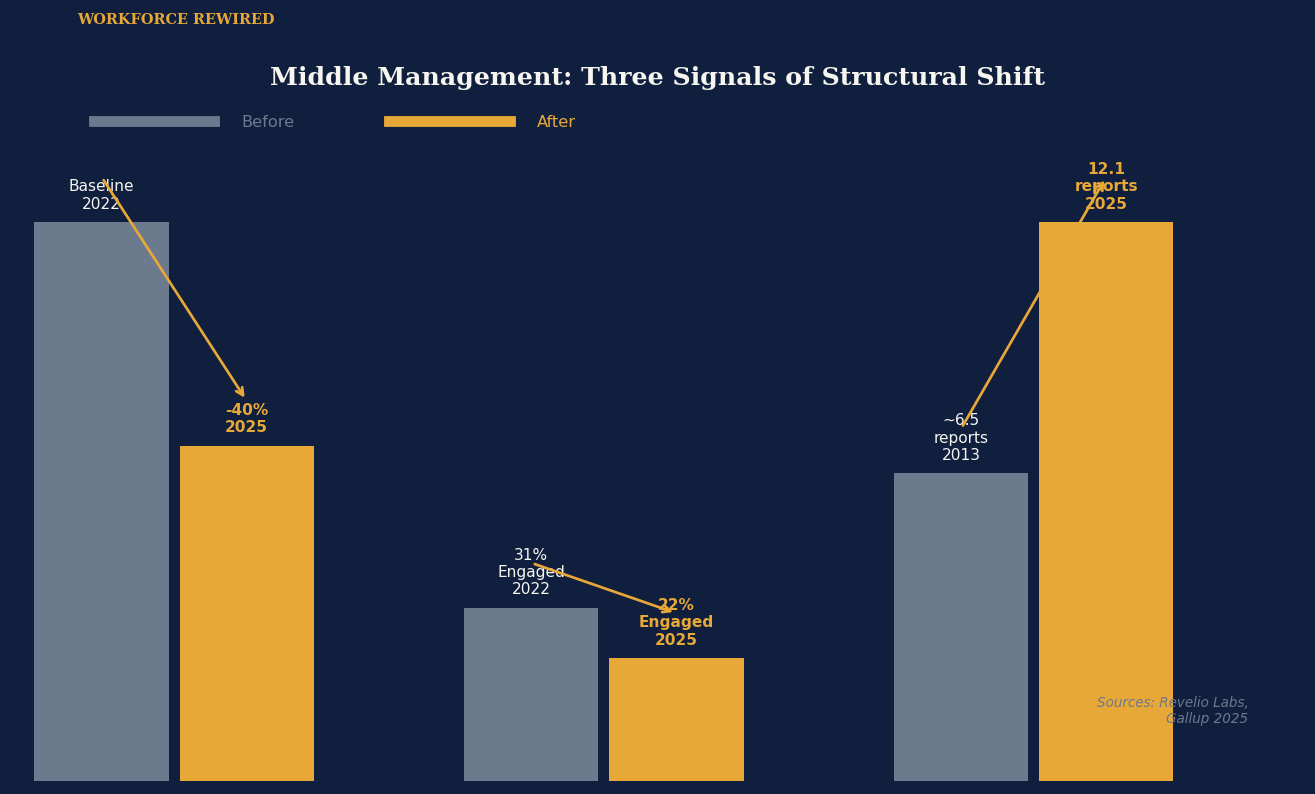
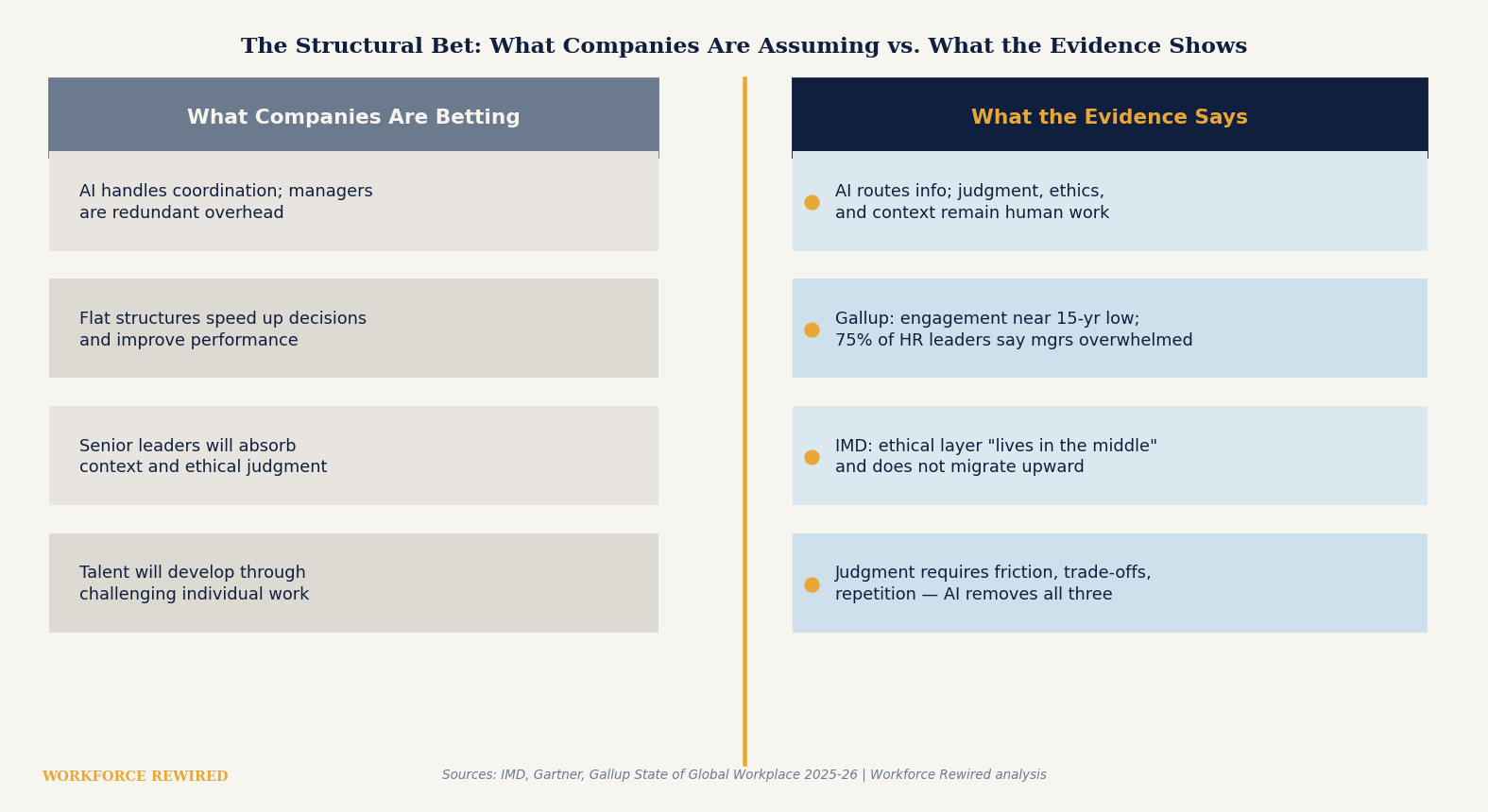
And the managers who survive these cuts? Gallup tracked the average number of direct reports per manager from 2013 through 2025. That number has nearly doubled. In practical terms: from 2024 to 2025 alone, the average manager went from supervising 10.9 people to 12.1. In tech specifically, average spans of control grew 16.6% between September 2023 and April 2025. The math is not sustainable, and the data confirm it: 75% of HR leaders, per Gartner, believe managers are already overwhelmed by their expanding responsibilities before AI integration has fully landed.
What AI Actually Replaced
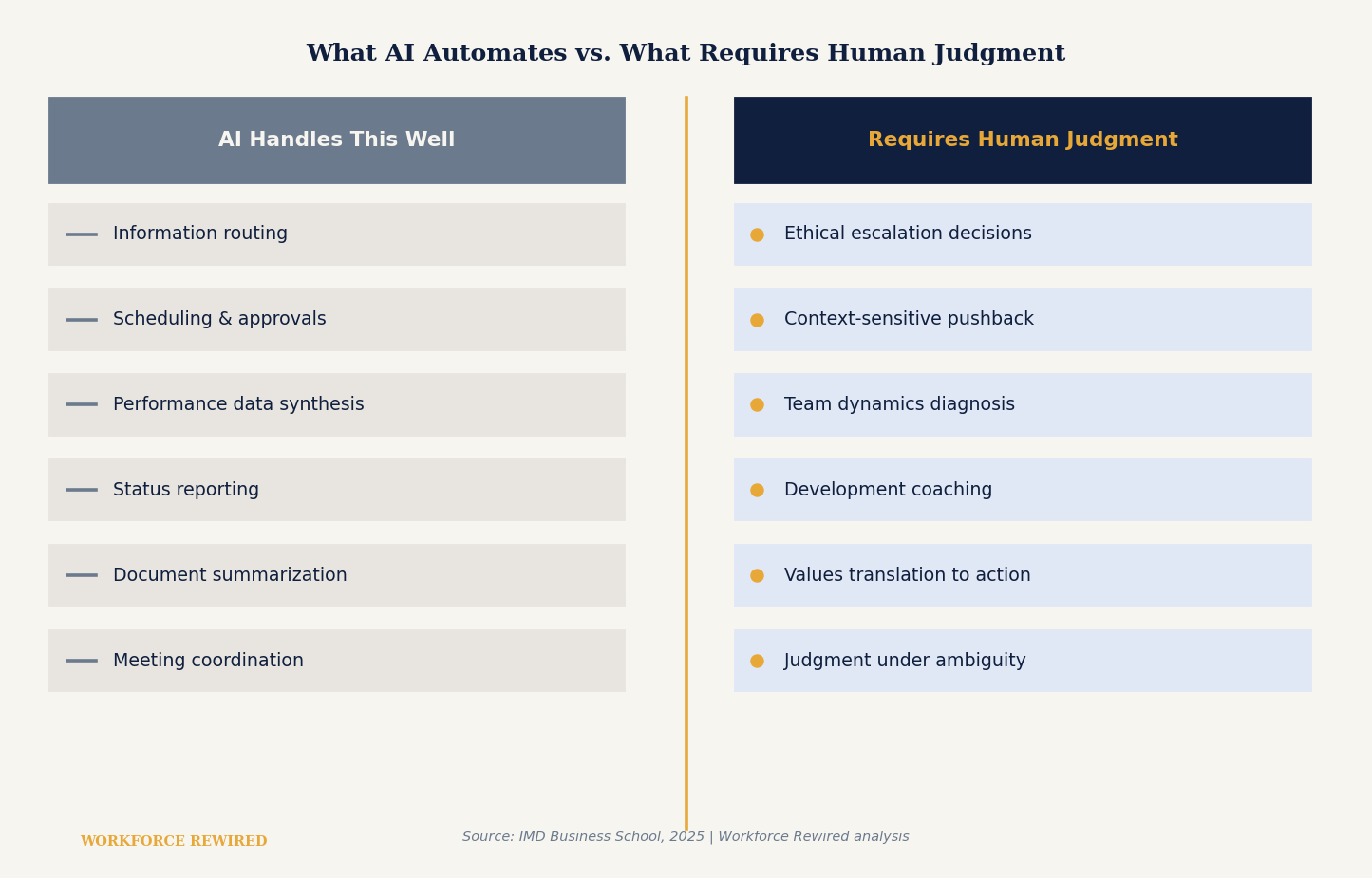
The argument for eliminating middle management is, on its surface, coherent. Much of what middle managers did was information routing. They took data from above, translated it, distributed it, collected status updates from below, synthesized them, and passed them back up. They scheduled. They approved. They tracked. They sat in the meetings that made sure the left hand knew what the right hand was doing.
AI is very good at that. Coordination tools, AI-enabled project management systems, real-time dashboards, and large language models that can synthesize reports have made the information-routing function of management genuinely automatable. If that were all middle managers did, the case for eliminating them would be closed.
But that is not all they did.
Middle managers were also the layer where abstract organizational strategy became concrete human decision. They were the ones who looked at a performance problem and decided whether it was a skills gap, a motivation issue, a process failure, or a management failure. They were the ones who pushed back when an executive directive was going to produce an outcome nobody upstairs had modeled. They were the ones who knew, from accumulated experience and daily human contact, that the policy looked clean on paper and was going to land badly in practice.
IMD captured this precisely in research published in 2025: middle management is where abstract principles become concrete action, and where the organization’s conscience resides. Ethical risk management, practical judgment, and the translation of values into behavior at scale are not functions that sit at the C-suite. They live in the middle. When the middle disappears, those functions do not get absorbed upward or downward. They just disappear.
The Judgment Gap Is Real
There is a concept circulating in leadership development research that I think names the problem precisely: the judgment gap. It goes like this.
Leaders develop judgment by making decisions, seeing the consequences, and making better decisions the next time. Judgment accrues through repetition, friction, and exposure to trade-offs that do not have clean answers. A manager who has to decide how to handle a team member who is struggling, whether to escalate a risk or absorb it, when to push back on an unrealistic deadline, and how to tell someone their work is not meeting the bar is building something that cannot be downloaded or modeled. They are building the capacity to navigate novel situations with incomplete information.
AI is compressing the learning curve for technical execution. The side effect is that it is also eliminating much of the friction that produced that learning. Work moves faster. Decisions get automated. Ambiguity gets resolved by a system rather than a person wrestling with it. Emerging leaders are being shielded from the trade-offs, the consequence management, and the repetition of judgment that turns a high-performing individual contributor into someone who can actually lead.
Then companies flatten the management layer that would have given those emerging leaders the next stage of development.
Fortune put the consequence plainly in April 2026: the middle manager cuts saving companies millions today will cost them everything in 2028. That framing is right, but the timeline may even be optimistic. Leadership pipelines do not fail visibly in year one. They fail when the organization reaches a moment of genuine complexity, with no one below the senior leadership team who has developed the judgment to handle it.
The Engagement Signal Nobody Is Listening To
Gallup’s State of the Global Workplace 2026 report contains a data point that should alarm every senior leader reading it.
Manager engagement fell from 31% in 2022 to 22% in 2025. That nine-point drop is the steepest decline of any cohort Gallup tracks. Global employee engagement sits at 20%, near its lowest level since 2020, and the estimated cost to the global economy is $10 trillion in lost productivity annually. Managers used to enjoy an engagement premium over the workers they supervised. That premium has evaporated. The people most responsible for maintaining team performance are running on fumes.
Gallup’s research has consistently found that 70% of the variance in team engagement traces directly to the manager. That figure is not new. What is new is that the managers who produce that variance are being asked to span twice as many people, absorb functions previously handled by the layers beneath them, and do all of this while watching their own peers get eliminated in waves. The psychological toll is already showing up in the data. Organizational performance is next.
The Argument Worth Making
I have spent nearly twenty years building and transforming workforces, including the years I spent at Deloitte helping stand up talent strategy, org design, and workforce planning from scratch for a 12,000-person global organization. I have seen what happens when companies treat structure as purely a cost variable. The savings show up in the next quarter’s earnings call. The consequences show up in the years that follow, in the form of initiatives that stall out, cultures that cannot hold, and leadership benches that are too thin to carry the organization through a hard moment.
The conversation about AI and middle management has been captured by two narratives. The first: flatten, speed up, remove bureaucracy, let AI handle coordination. The second: middle managers are doomed, their jobs are going away. Both are partially right and almost entirely beside the point.
The real question is not whether organizations should reduce management layers. Some should. Many have structural inefficiency in their architecture, and AI genuinely handles coordination work that once required human intermediaries. The real question is what gets lost when the reduction goes past the fat and into the connective tissue. What gets lost is the organizational capacity for judgment, ethical action, and leadership pipeline development. Those are not recoverable in the short term once they are gone.
Companies that are treating middle management as a pure cost optimization are making a structural bet: that the judgment, context, and development function can be redistributed, automated, or foregone. That bet has not been tested at scale. The test is running right now. Results post around 2028.
What Thoughtful Organizations Are Actually Doing
The answer is not to preserve every management role for its own sake. Bureaucracy is real, and some organizations built management structures that were more about internal politics than organizational effectiveness.
The organizations that are navigating this well are distinguishing between two types of middle management work: the work that is genuinely automatable and the work that requires human judgment, contextual knowledge, and ethical responsibility. They are reducing the former deliberately and protecting the latter deliberately. They are also asking a harder question about their leadership pipeline: if we flatten this structure, where exactly do senior leaders come from, and what experiences will we provide instead of the management layer we are removing?
That question does not have a comfortable answer yet. The organizations that start asking it now are years ahead of the ones that wait until the pipeline runs dry.
The middle was never just bureaucratic friction. It was the layer where organizations converted abstract intent into concrete action. It was where people learned what it actually meant to be responsible for other people. It was where values either held or broke. Stripping it for short-term efficiency is not a new idea. But the speed and scale at which it is happening now, with AI as both the justification and the accelerant, is producing a structural bet that most organizations have not consciously chosen to make.
They should choose. Because the house without load-bearing walls stands right up until it doesn’t.
What is your organization doing to protect leadership development (the real, on-the-job learning - not the comes in a classroom box one) as management layers thin? I’d like to know what you’re seeing from the inside. Email me at christina@workforcerewired.co.
Christina Lexa leads workforce strategy for Technology at Capital One. She writes Workforce Rewired at the intersection of AI, org design, and the future of work. Subscribe for free at workforcerewired.co.
That's very interesting!