


TL;DR: Amazon, Google, and a growing list of Big Tech companies are widening spans of control and stripping out management layers, often citing AI. The first-order effect everyone names is manager overload. The second and third-order effects are the ones that decide whether this works: the manager’s old work doesn’t disappear when you raise the ratio, it gets redistributed, and the development pipeline thins out three years before anyone notices. Flatter can be the right move. It only pays off if you redesign what a manager does before you double the number of people reporting to them.
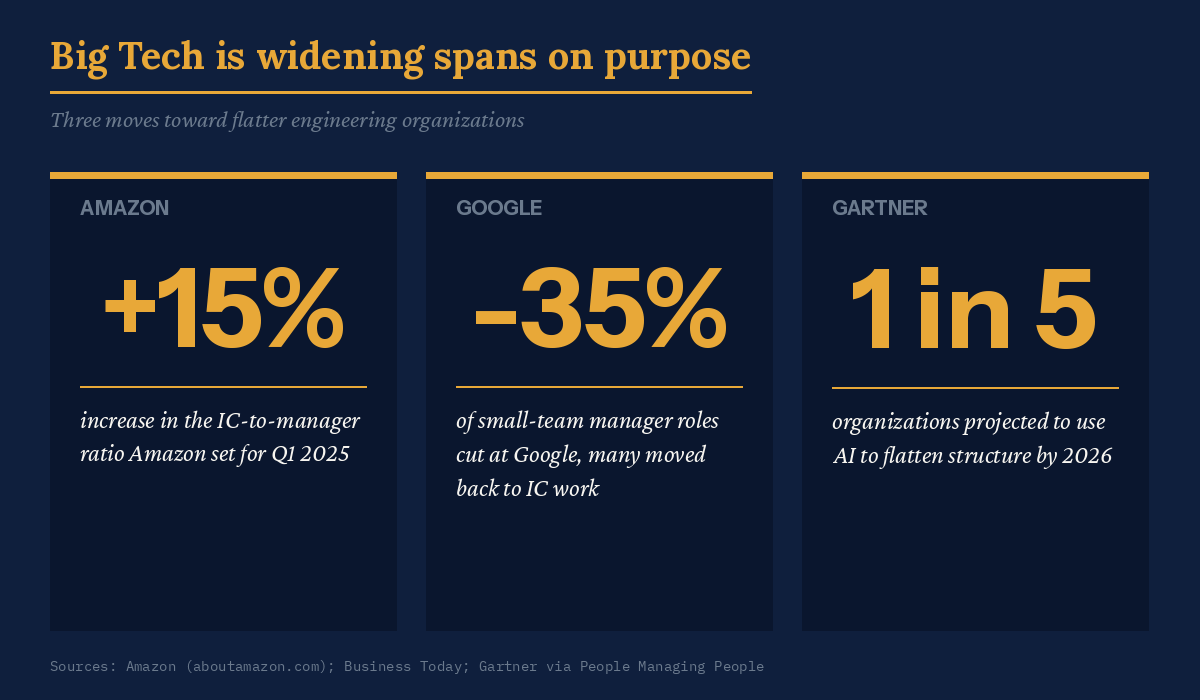
Andy Jassy told Amazon in September 2024 to increase the ratio of individual contributors to managers by at least 15 percent by the end of the first quarter of 2025. The company hit the target without mass layoffs: it paused manager hiring, asked existing managers to take more direct reports, and moved some managers back into individual contributor roles. Jassy’s framing was about speed, not cost. He wants Amazon to “operate like the world’s largest startup,” fast and flat, with fewer layers between a decision and the person making it. He said the quiet part out loud: at Amazon, the path to promotion is no longer taking charge of a massive team.
Google did a sharper version of the same thing. The company cut roughly 35 percent of its small-team manager roles, with the heaviest impact on managers responsible for fewer than three people. Many of them moved back to individual contributor work. Sundar Pichai’s line to staff was a sentence every workforce planner should sit with: “We need to be more efficient as we grow, so we don’t just throw more people at every problem.”
Gartner projected that through 2026, one in five organizations would use AI to flatten their structure, eliminating more than half of current middle management positions. The direction is set. The interesting question is no longer whether companies will widen spans. It is whether they understand the knock-on effects of doing it.
The number the spreadsheet loves and the research doesn’t
Span of control is one of the few org-design levers that looks like an easy target on a spreadsheet. Raise the average number of reports per manager from eight to twelve, and you need a third fewer managers to run the same headcount. The savings (and hopefully productivity gains from repurposing managers to individual contributors) are immediate and tangible. That is exactly why this metric gets implemented first.
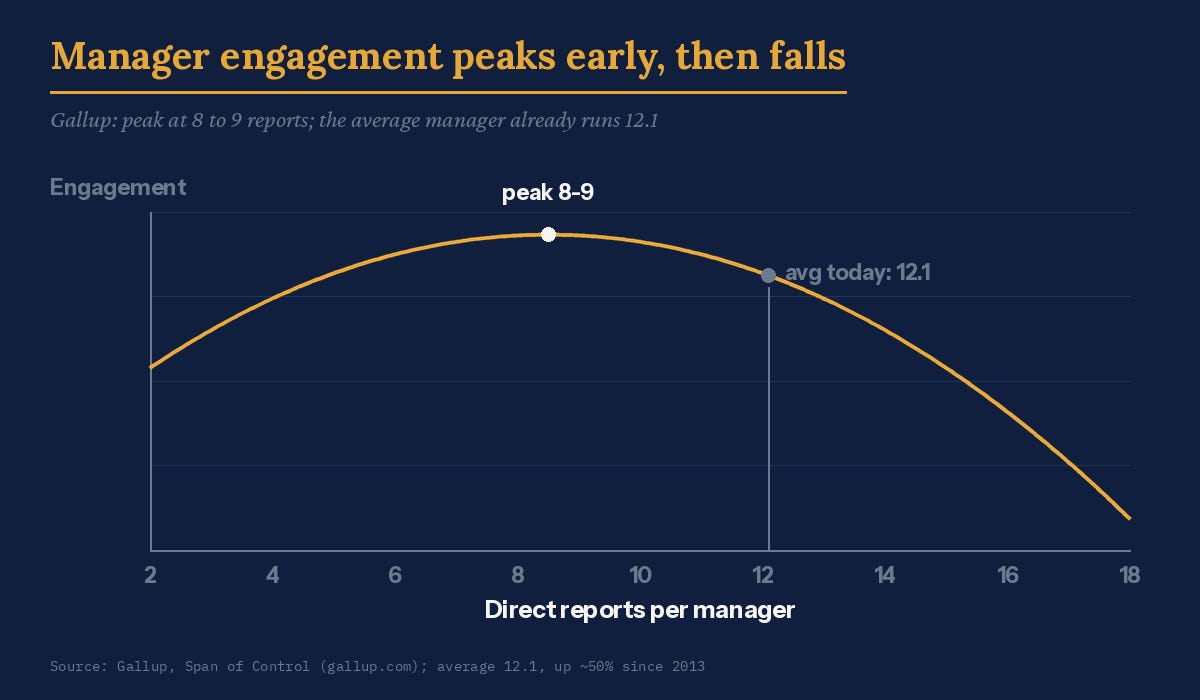
The research on what happens next is less convenient. Gallup found that manager engagement peaks at around eight to nine direct reports and declines past that point. Teams led by managers with more than ten reports show measurably lower engagement than teams of five to eight, and the quality of one-on-one relationships drops as the number climbs. Meanwhile the average manager already oversees 12.1 people, up nearly 50 percent since 2013. So the starting point for most “let’s widen spans” conversations is already past the line where the research says relationships fray.
I lead Tech Workforce Strategy and Architecture at Capital One, where I spend a lot of my time on exactly this question: what is the right mix and shape of teams inside an engineering organization. The temptation is to treat span of control as a single dial. It is not. A span of twelve junior engineers shipping similar work is a different animal from a span of twelve senior engineers each owning a distinct system. The first is supervisable. The second is a portfolio of twelve relationships, twelve career arcs, twelve sets of context, run by one person who also has a day job. The dial and the work behind it are not the same thing.
Where the manager’s work actually goes
Here is the part the ratio math skips. When you remove a layer of managers, their work does not evaporate. It moves. The only question is where, and most companies never make an active decision about it.
A middle manager does a bundle of jobs that rarely appear in a single job description. They triage priorities and absorb ambiguity so the team can keep moving. Coaching is in there. So is running the performance and promotion process, translating strategy down, surfacing reality up, and noticing the quiet problem before it becomes a loud one. Strip the layer out and each of those jobs reappears somewhere: pushed up to an already-stretched senior leader, pushed down onto individual contributors who now coordinate themselves, or simply dropped.
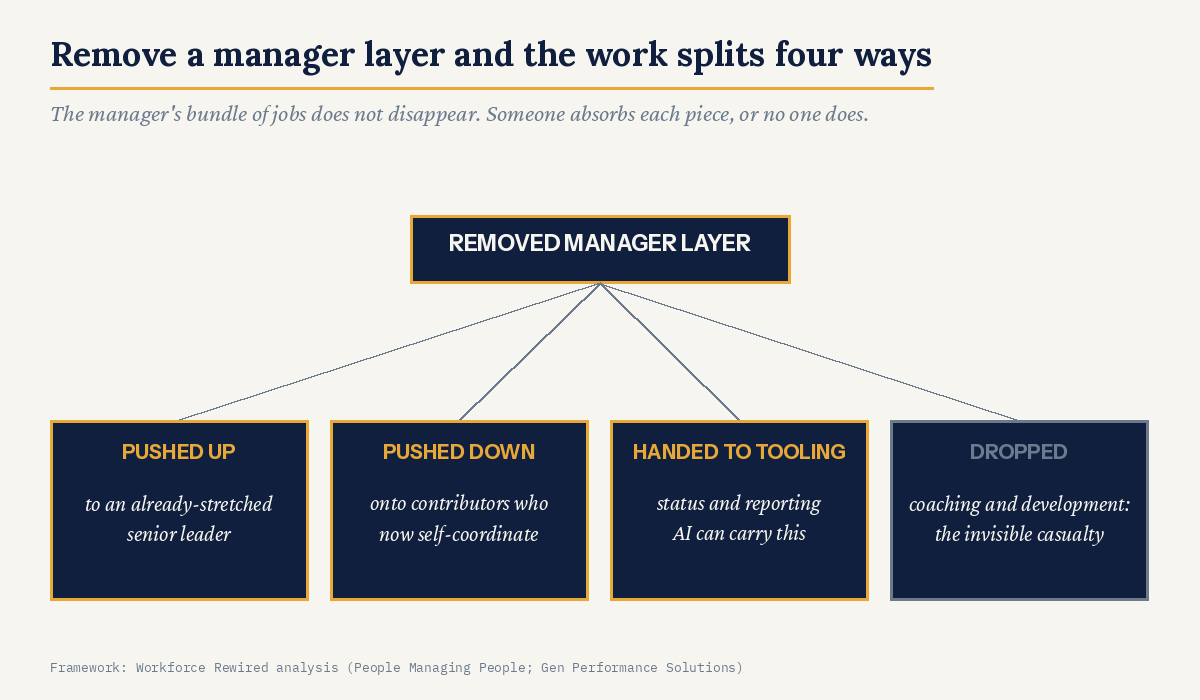
Dropped is the dangerous one, because it is invisible for a while. Coaching is the first thing to go when a manager’s span doubles, and the cost shows up much later, in a promotion case that never got built and a mid-level engineer who quietly stopped growing. Reporting on the flattening trend keeps landing on the same finding: when layers come out, junior employees lose the people closest to them in the hierarchy, the ones who used to provide feedback and access. The org chart gets cleaner. The development system gets thinner.
AI is genuinely part of the answer here, which is why the flattening story and the AI story are tangled together. A manager who once spent a third of the week assembling status reports, reconciling dashboards, and chasing updates can hand a real share of that to tooling. That redesign is what makes a wider span survivable, because it frees the manager’s hours for the work only a human can do. The courage to assign more people was never the hard part. The companies treating AI as a reason to cut managers are doing the easy half. The companies using AI to change what a manager spends time on are doing the half that actually makes twelve reports work.
The third-order effect loops back to the pipeline
Push the timeline out and the consequence stops being about any individual manager. It becomes structural. If coaching erodes and the rungs between individual contributor and senior leader get pulled out, you have quietly stopped manufacturing your future leaders. The leadership pipeline gap is a named risk of the flattening trend, and it is the same shape as the entry-level collapse I wrote about in The Inverted Pyramid. An organization that stops developing people in the middle today is writing a senior-talent shortage for itself in 2030. The senior engineering leader of 2031 is the person getting coached, or not, in the wider span you build this year.
Flatter organizations also change how careers work, and most have not updated the story they tell their people. When the title ladder gets shorter, “get promoted into management” stops being the default path for a strong individual contributor. That can be healthy. Forcing every excellent engineer into management to earn more was always a way to lose a great engineer and gain a mediocre manager. A flatter structure only works if there is a real, well-paid technical track that runs parallel to the management track, with its own levels and its own status. Without it, flattening just means fewer places to go and more people competing for them.
There is a harder question hiding underneath the technical track, and it is about how you attract and retain managers. If you widen a manager’s span, hand them more performance conversations and more career arcs to tend, and pull them further from the technical work that built their reputation and career, you have made the job bigger and less rewarding at the same time. A strong engineer can now earn well without ever managing anyone, which removes the old, lazy incentive that pushed people into management to grow their compensation. Strip that out and the question of who volunteers for the harder, less technical job gets real. Companies that want a real management pipeline will have to pay for it directly, pricing the management premium against an IC track that has become genuinely lucrative, and treating the willingness to develop other people as a scarce skill worth compensating, not a rung everyone climbs by default. The alternative is a slow shortage of people willing to manage, discovered the year you need them most.
What it takes to make wide spans actually work
Span of control is downstream of work design. You cannot decide the right number of reports until you have decided what the manager is for. A few things separate the organizations that make this work from the ones that just announce a ratio:
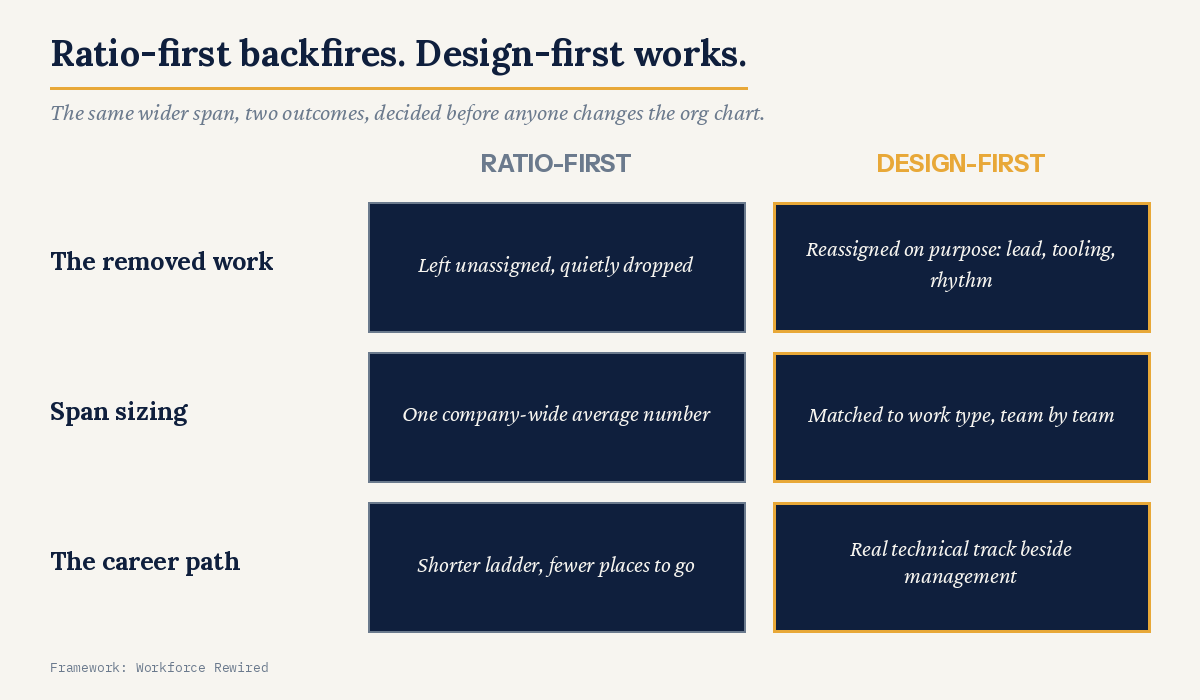
Decide where the removed work lands before you remove the layer. Name it. Coaching to a technical lead, status reporting to tooling, prioritization to a clearer operating rhythm. Unassigned work is dropped work.
Match span to work type, not a company-wide average. A team of senior engineers on distinct systems needs a smaller span than a team doing convergent work. One number across an org is the tell that nobody modeled it.
Protect coaching explicitly, because it is the first casualty and the last to show damage. If the wider span eats one-on-ones, the cost is a development hole you will feel in three years.
Build the technical track before you shorten the management ladder. Flattening without a parallel path for individual contributors is a retention problem dressed as an efficiency win.
Use AI to change what a manager spends time on. Hand the status reports and reconciliation to tooling so the freed hours go to coaching and judgment. That redesign is what makes a span of twelve humane. Cutting managers and calling AI the reason, with the job unchanged, is how a span of twelve becomes a slow-motion attrition event.
Flatter and faster is a defensible bet. Capital One went all-in on the public cloud years ago and rebuilt itself as a technology company, a much larger structural move, and the lesson from that kind of decision is that structure works when it follows a clear-eyed view of the work. Widening spans can do the same thing for an engineering organization: push decisions closer to the people doing the work, strip out coordination that AI can now carry, and give strong individual contributors room to lead without a title change. The redesign has to come first for any of that to hold. When the ratio comes first and the redesign never arrives, the organization spends the savings now and pays for them later.
The companies announcing flatter structures this year are running an experiment whether they admit it or not. The ones who treated span of control as a math problem will spend 2028 wondering where their bench went. The ones who treated it as a work-design problem will have built something faster that still develops people. The arithmetic of flat is easy. The org design underneath it is the actual work.
Here’s How You Take Action
If you lead an engineering organization: Before you set a span-of-control target, write down where each piece of the removed manager’s work will go. If “coaching” and “performance development” don’t have a clear new owner, you have deferred a problem and called it a design.
If you set workforce strategy: Pull your actual span distribution, not the average. Find the managers already past twelve reports and look at their teams’ engagement and attrition. The damage from over-widening is usually already in your data before you formalize the policy.
If you manage a large team and feel it: Name the specific job that fell off when your span grew. Take it to your leadership as a design question, not a personal failing. “My span doubled and coaching is the thing I can no longer do well” is a sentence that changes how the org should be built.
If you’re an individual contributor watching the layers come out: Ask your leadership what the technical track looks like, with real levels and real pay. If the answer is vague, that is useful information about whether this flatter org was designed or just announced.
For everyone: In your next reorg conversation, ask the question that separates design from arithmetic: when we widen this span, what work are we deciding to stop doing? If no one can answer, the spreadsheet is driving, and the spreadsheet does not coach anyone.
Christina Lexa writes Workforce Rewired, on the intersection of workforce transformation, AI, and global talent.
The views expressed here are my own and do not represent the position of my employer or any organization I am affiliated with.