


TL;DR: A major drugmaker’s AI talent platform flagged me, a workforce strategist with two decades in org design and zero background in pharmaceuticals, as a strong match for a global marketing leadership role for one of its oncology drugs, paying up to $320,000. When I asked the recruiter whether a person or the software picked me, she told me plainly that the AI did. I happen to have evaluated that same class of tool for enterprise use, so I know exactly what went wrong and why almost no one catches it. AI belongs in this work. The argument here is narrow: there is one seat in the hiring process where the machine should never sit alone.
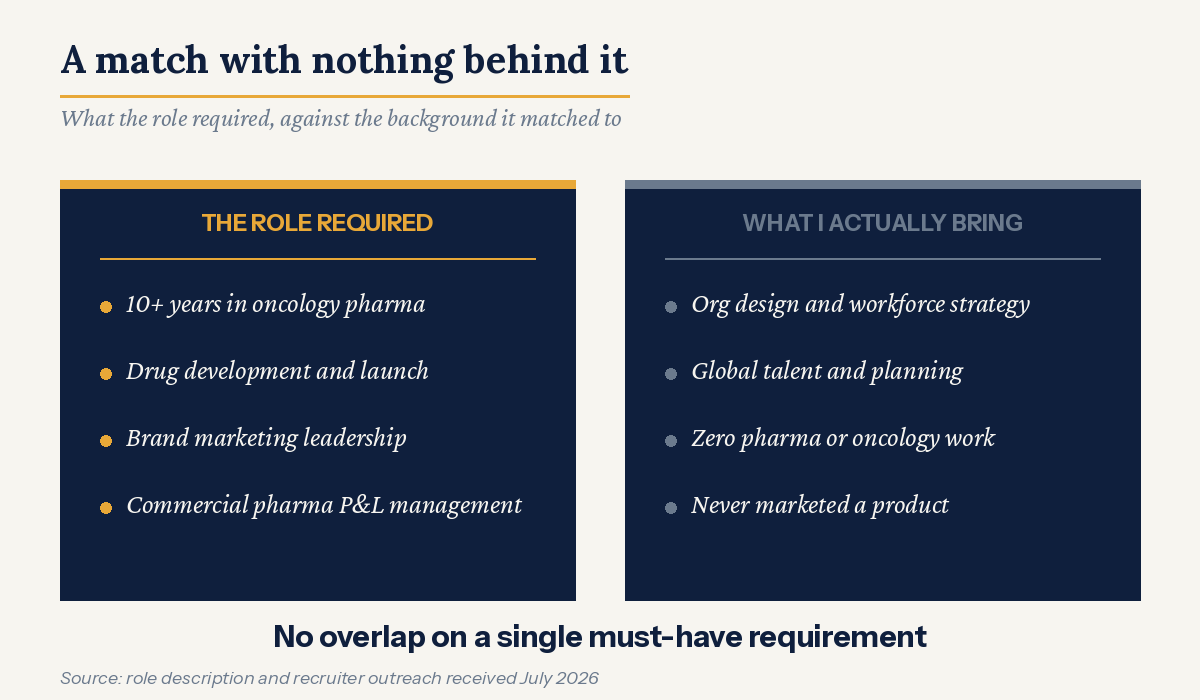
The email landed on a Tuesday, addressed to me by name, warm and specific. A global pharmaceutical company wanted me to consider a global marketing leadership role for one of its oncology drugs. Base salary $260,000 to $320,000. The first line of the job description asked for ten or more years in oncology pharmaceutical development and commercialization.
I have none of that. I have never worked in pharma. I have never marketed a drug, launched a therapy, or sat in a commercial meeting about a cancer treatment. My career is org design, workforce strategy, and global talent. The gap between me and this role is not a stretch a hiring manager might take a chance on. It is a different profession.
So I wrote back and asked the question I could not resist asking: did a person choose me for this, or did a machine? The recruiter answered without hesitation, and she framed it as a selling point.
“It was indeed our AI system that highlighted you.”
I have spent a good part of the last two years helping decide which of these systems a large technology organization should trust. I have sat in the vendor demos and read the model documentation. I recognized the tool behind that email, because I had personally put it through its paces for possible use at my own company. Watching it get me this wrong, from the other side of the table, taught me more in one exchange than the demos ever did.
What the machine actually saw
The best of these platforms market themselves on looking past keywords. They promise to read skills and potential, to understand meaning rather than surface words, to see that a machine learning engineer at a fintech and a data scientist at an insurer share underlying capability even when the titles differ. Some are trained on well over a billion career profiles. The pitch is that they transcend the crude keyword matching of the old applicant tracking systems.
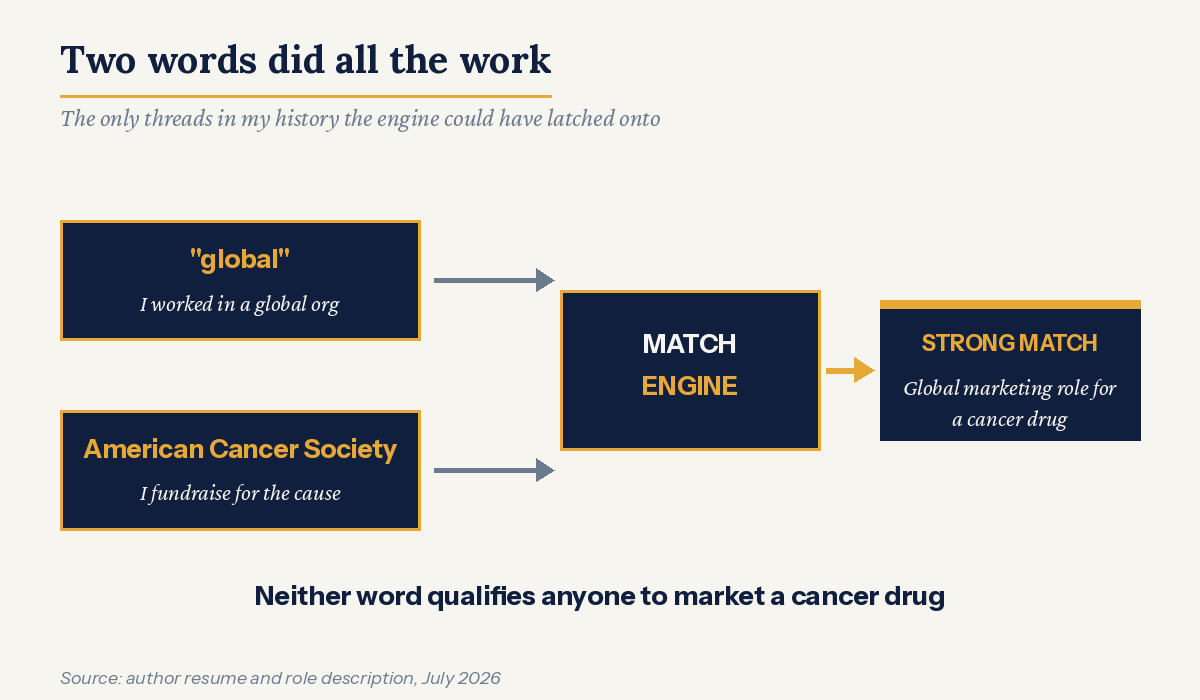
And yet the match it made for me looks exactly like crude keyword matching wearing a nicer coat. I can reconstruct the logic, because there are only two threads in my history that touch this job at all.
The first is the word global. I have spent years working globally, with workforce experience that spans continents. My most hands-on work has been with teams in markets like India, Mexico, Canada, and the UK, and the reach has always extended well beyond them. The role was global in scope. The token matched. The meaning did not, because my global experience has nothing to do with commercializing a cancer drug across markets.
The second is cancer, and this one stings a little. I raise money for the American Cancer Society every year. I have ridden hundreds of miles and buried too many people to count that cause as anything less than central to my life. It sits on my resume and my public profile because it matters to me. To a model scanning for oncology relevance, my fundraising for a cancer charity apparently read as adjacency to oncology drug development. Passion for a cause is not qualification for a profession. The machine could not tell the difference.
That is the tell. A system sold as understanding capability had, in my case, retrieved two decontextualized signals and produced a confident recommendation on top of them. The confidence is the dangerous part. A keyword match at least announces itself as dumb. A talent intelligence score arrives dressed as judgment, and the human on the other end is told to trust it.
The candidate side: this is how trust leaves the building
Start with what this feels like from a job seeker’s chair, because the workforce implications begin there.
Most candidates never learn that a machine picked them, or passed over them. I only know because I asked, and because the recruiter was honest. The average applicant experiences these systems as silence or as a strangely off-target message, and draws their own conclusions about the company that sent it.
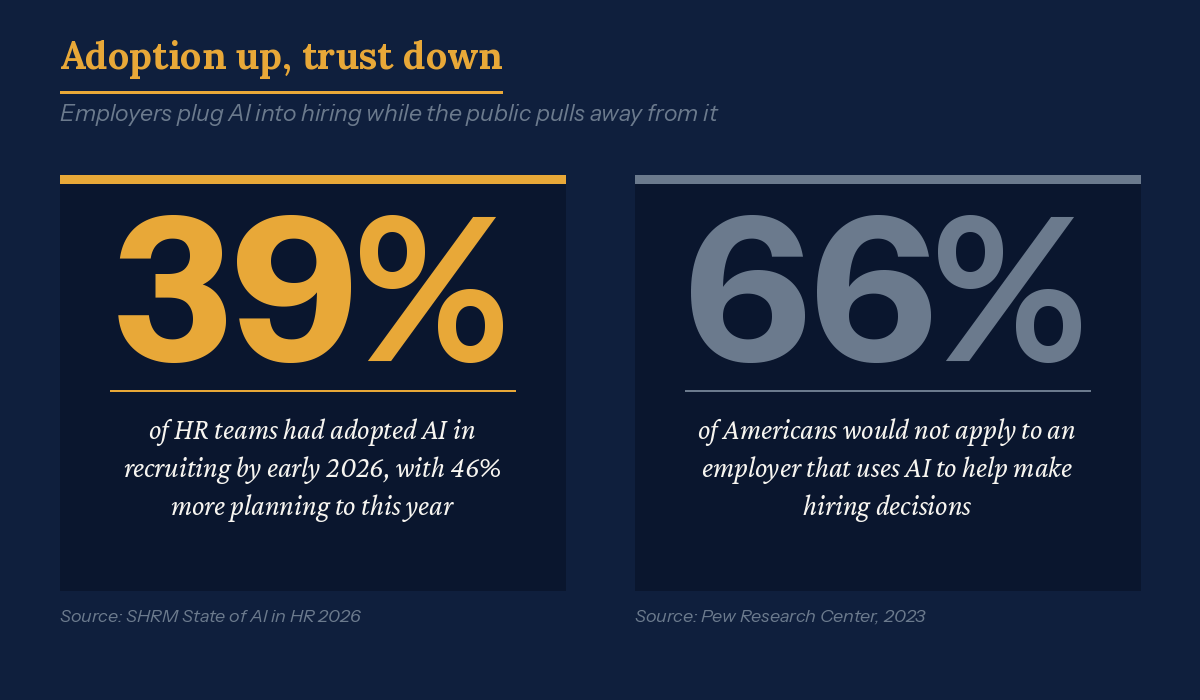
The public already distrusts this. Pew Research found that 66 percent of Americans would not want to apply for a job with an employer that uses AI to help make hiring decisions, and 71 percent oppose letting AI make a final hiring call. The most common reason people give is that these systems miss the human side of evaluating a person. My mismatch is a small, almost comic proof of exactly that fear.
Volume makes it worse. Passive candidates in high-demand fields now field between 10 and 30 recruiting messages a week, and generic automated outreach draws response rates under one percent, which is to say it performs like spam. When companies point AI at the top of the funnel and measure only reply rates, they miss the slower cost: every wildly wrong message teaches a strong candidate to stop reading. Jobvite’s 2026 Job Seeker Nation report found that 46 percent of workers report a gap between what the hiring process promised and what the job turned out to be, up ten points in a year. The trust problem is not coming. It is here, and automation at the sourcing stage is pouring fuel on it.
The architect side: the human gate got hollowed out
Now flip to the seat I actually occupy. I help design and buy this tooling. From here the problem sits in one place: the workflow, at the point where companies put the human. Models retrieve and rank, and sometimes they rank badly. That much is expected. The outcome turns on the human step downstream, which most companies have placed where it cannot catch a miss.
Adoption is racing ahead. SHRM’s State of AI in HR 2026 report found that 39 percent of HR teams had adopted AI in recruiting by early 2026, with another 46 percent planning to before year end. Recruiting is the single most common place organizations plug AI in first. The tools are landing in the funnel faster than anyone is redesigning the judgment around them.
The seductive pitch is that these platforms free recruiters from the grunt work of screening so they can spend their time on human connection. In practice, the recruiter who emailed me had a match score in front of her and, I would guess, a quota of candidates to reach. The system said I fit. She trusted the system. The human confirmation step existed on paper and added nothing, because a person under volume pressure defers to a confident number rather than second-guessing it. That is not a rogue recruiter. That is the predictable result of putting a person downstream of a tool and telling them to move fast.
And the liability does not move with the convenience. The EEOC has been explicit that an employer using AI in hiring remains responsible for the outcome and cannot outsource that responsibility to the vendor. New York City’s Local Law 144 already requires bias audits of automated hiring tools. The EU AI Act classifies hiring systems as high risk. Colorado’s AI Act extends similar duties. The regulatory direction is clear: the company that deploys the tool owns what it does, whether a human looked closely or not.
The uncomfortable truth
When you remove the human judgment step from sourcing and call the model’s output a match, you have not automated judgment. You have automated the appearance of it. The score looks like a decision a thoughtful person made. It is a retrieval, ranked by proxies, and the proxies can be as thin as one word and one charity.
There is a brand cost that no dashboard prices. My view of that pharmaceutical company dropped after this. A wrong match on its own is forgivable. What actually lowered my opinion is that they let a machine send a serious, named, six-figure solicitation with no human check, when three seconds of human reading would have caught an error this large. My view of the AI vendor dropped too. I once considered bringing its technology inside my own walls, and it read a straightforward summary of my experience with total confidence and got it badly wrong. Both downgrades happened in a single email. Multiply that by every mis-sent message going out at machine scale, and the reputational bill compounds quietly while the efficiency metrics look great.
What good looks like
None of this argues for ripping AI out of recruiting. The volume problem is real and models genuinely help sort it. The argument is narrower and, I think, harder to wriggle out of: the machine can widen the top of the funnel, and a human has to own the match before it reaches a candidate’s email.
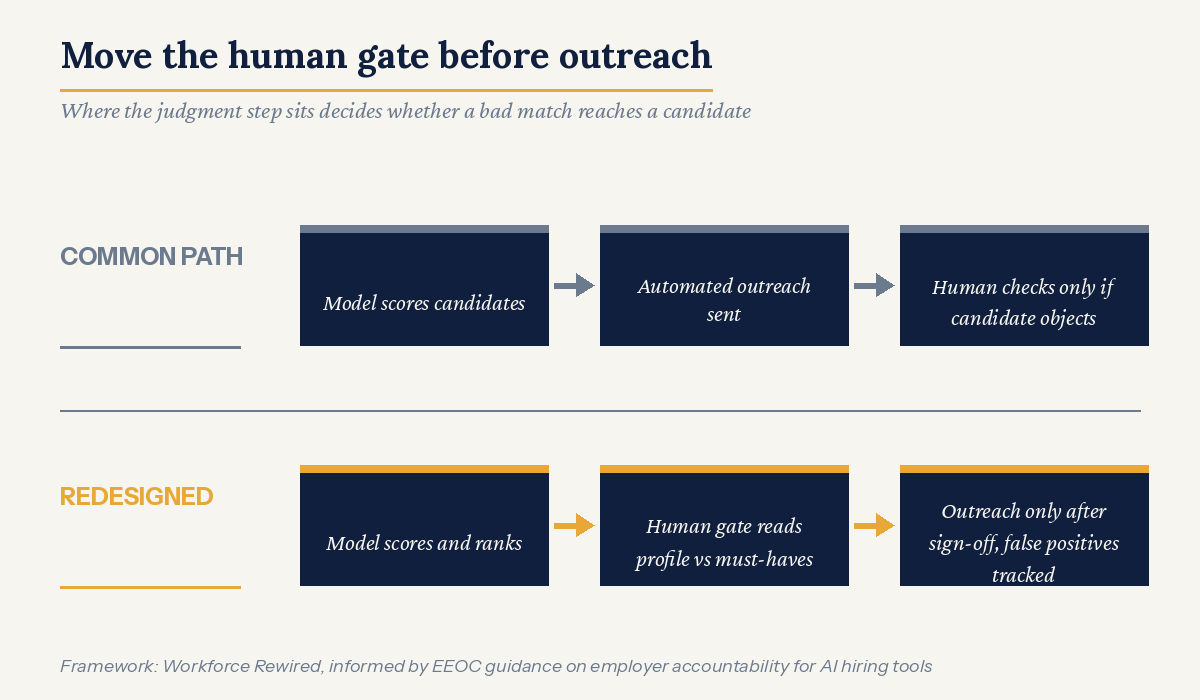
Concretely, that means designing the workflow so the judgment gate sits ahead of outreach, where a person can stop a bad match before it is sent. The model surfaces and ranks. A recruiter reads the actual profile against the actual must-have requirements and confirms the fit, with authority and time to reject a high score that does not survive thirty seconds of human reading. The fit score feeds that person’s decision and stays subordinate to it. And someone owns the false-positive rate as a real metric, because a mismatch sent is a small withdrawal from the company’s reputation, and those withdrawals add up.
Here’s How You Take Action
If you lead talent acquisition or own the tools, do three things this quarter. Move the human judgment gate to before outreach, and give recruiters explicit permission and time to overrule a high match score. Start tracking your false-positive rate, the share of AI-surfaced candidates who are plainly wrong for the role, and put that number in front of leadership as the brand risk it is. Ask any vendor one direct question before you buy: show me the mismatches, not the wins, and tell me who is accountable when the system sends a bad one.
If you are a candidate on the receiving end of a strange match, ask the question I asked. A person or a machine? You are entitled to know, and in more places every year you are legally entitled to know. The answer tells you a great deal about how the company on the other end actually operates.
The machine thought I was perfect for a job I could never do. That is funny once. It stops being funny when you realize how many of these are going out every day, each one confident, each one unread by a human, each one teaching someone that the company behind it was not paying attention.
Christina Lexa writes Workforce Rewired, on workforce transformation, AI, and global talent.
The views expressed here are my own and do not represent the position of my employer or any organization I am affiliated with.