


TL;DR: Hiring a Director of workforce planning took me more than six months, in the largest labor market on earth. The work is its own craft, distinct from people analytics and from the headcount budgeting American companies filed it under, and it takes four capabilities that rarely land in one person. AI made the gap expensive, because (as I’ve argued here a couple of times) tools arrive in quarters and capability takes years. The fix: organization design and workforce planning on one roadmap, led by HR, co-authored with Technology, Finance, and business leaders who each own a piece.
It took me more than six months to hire one person.
The role was a Director to lead workforce planning for Technology at Capital One. Funded, senior, pointed at the most interesting problem in the function. Applications were never the constraint. I read resumes from talented people who had run headcount budgets, built dashboards, and led HR business partner teams. Few had done the actual work: taking a business strategy, translating it into the skills and capacity to deliver it, then defending that translation to executives who had already decided what the number should be.
Half a year and then some, for one hire.
The demand side is not subtle
Gartner named “shape work in the human-machine era” one of four priorities for CHROs in 2026, and called it a “now-next” talent strategy: what you get from people in the next twelve months, and what you set in motion for the one to three years after. Two horizons at once, held by someone who can show their math.
Mercer’s Global Talent Trends 2026, drawn from nearly 12,000 executives, HR leaders, investors, and employees, sizes it: 98% of executives are planning organizational design changes within two years, and 65% expect 11% to 30% of their workforce redeployed or reskilled because of AI in that window. Redeploying a third of a workforce is not a budgeting exercise.
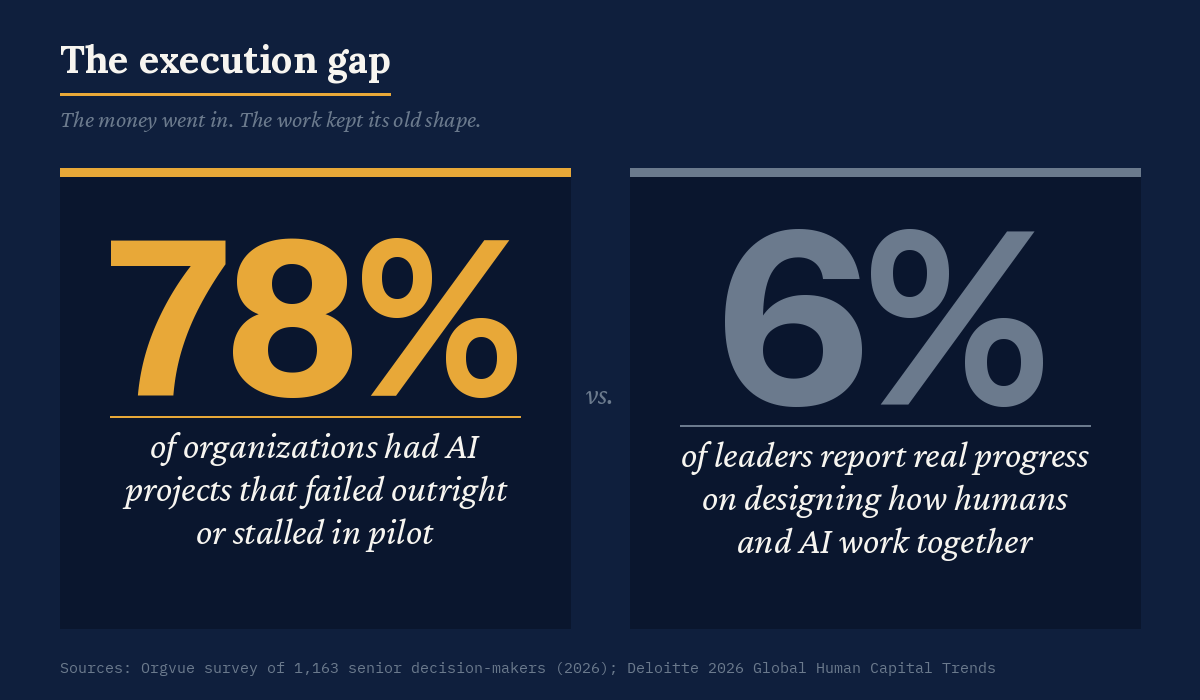
The demand shows up as failure before it shows up as hiring. Orgvue surveyed 1,163 senior decision-makers across the US, Canada, the UK, and Ireland: 78% had AI projects that failed outright or stalled in pilot, and 52% ran restructures costing a combined $49.4 billion in severance. Deloitte’s 2026 Global Human Capital Trends found the mechanism: only 6% of leaders report real progress on designing how humans and AI work together.
Companies are buying tools faster than they redesign the work those tools are meant to do. Somebody has to sit between the technology roadmap and the org chart and answer what changes, for whom, by when, at what cost. American companies mostly never filled that seat.
The supply side has an accent
When I built the talent strategy, organization design, and workforce planning function at Deloitte Global, I hired across the US, Canada, and the UK. My workforce planning lead, who taught me most of what I know about strategic workforce planning, sat in the UK. So did the depth of the market. Search for someone who had run this work before and the resumes came back British far more often than the relative size of the two labor markets would predict.
Britain built the profession on purpose. The CIPD lists workforce planning as specialist knowledge in its Profession Map, publishes the guidance practitioners work from, and runs an accredited program. A defined route in, a body of practice, a credential at the end. The Workforce Planning Institute certifies practitioners and holds annual gatherings in Chicago, London, and Sydney.
In most US companies the work landed inside Finance as headcount budgeting: a number per quarter, a hiring plan, a variance report, an argument every October. Useful, and a different craft from forecasting which capabilities a business will need in three years and what they cost to build.
Employment law widened the gap. A UK employer proposing 20 or more redundancies in 90 days must consult employee representatives for at least 30 days before the first dismissal, 45 days at 100 or more, with the penalty doubled to 180 days’ pay per employee in April 2026. A British company has to explain and negotiate its workforce plan before acting on it. The US federal WARN Act asks for 60 days of notice and stops there. Notification is a letter. Consultation is an argument, and an argument requires evidence, modeling, and someone who can stand behind the assumptions when a works council pushes back. Do that for twenty years and you produce practitioners. Skip it and you produce spreadsheets.
What the British bench proves
My hypothesis needed correcting. I assumed the UK was simply better at this.
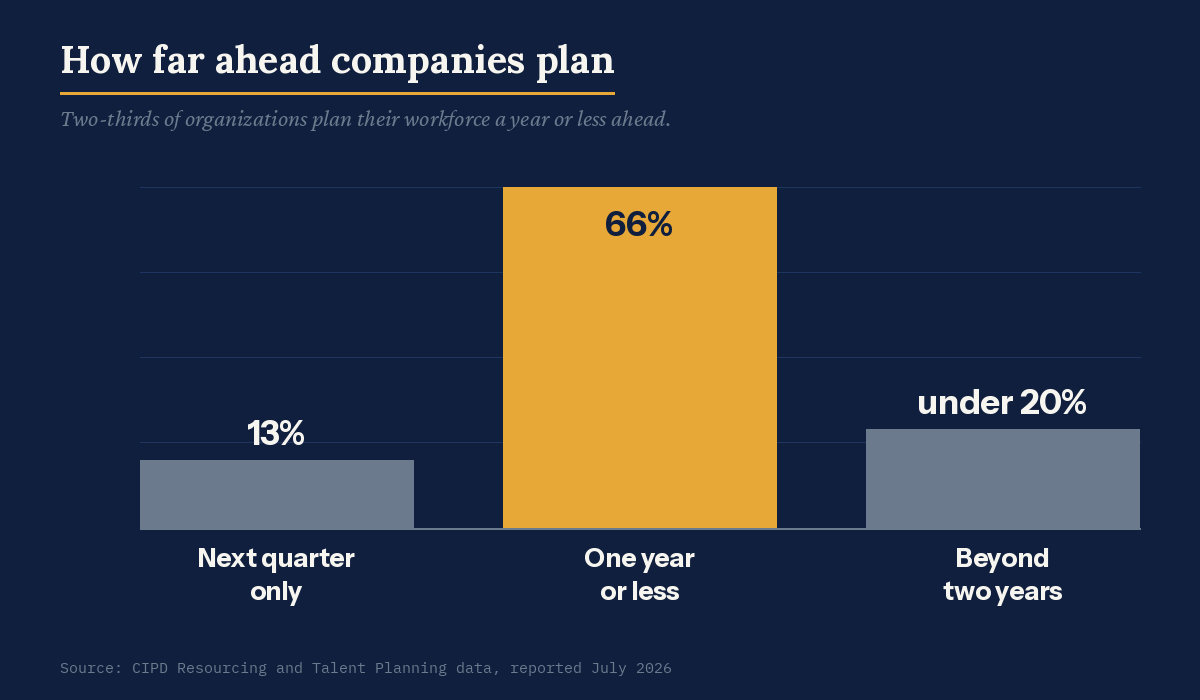
CIPD data reported in its July 2026 analysis shows two-thirds of organizations plan a year or less ahead, 13% only to the next quarter, and fewer than a fifth beyond two years. Only 38% collect data on their own skills gaps. That is the country with the credential, the Profession Map, and the consultation law.
Britain built a career path. Mastery is scarce on both sides of the Atlantic. A British CHRO can hire someone who spent a decade doing this work under a title that says so. An American CHRO is looking for someone who assembled the same skill set by accident, from adjacent jobs, without anyone naming it. The route that would produce them in numbers, and label them so a hiring manager can find them, has never been built.
Organization design and workforce planning are one job
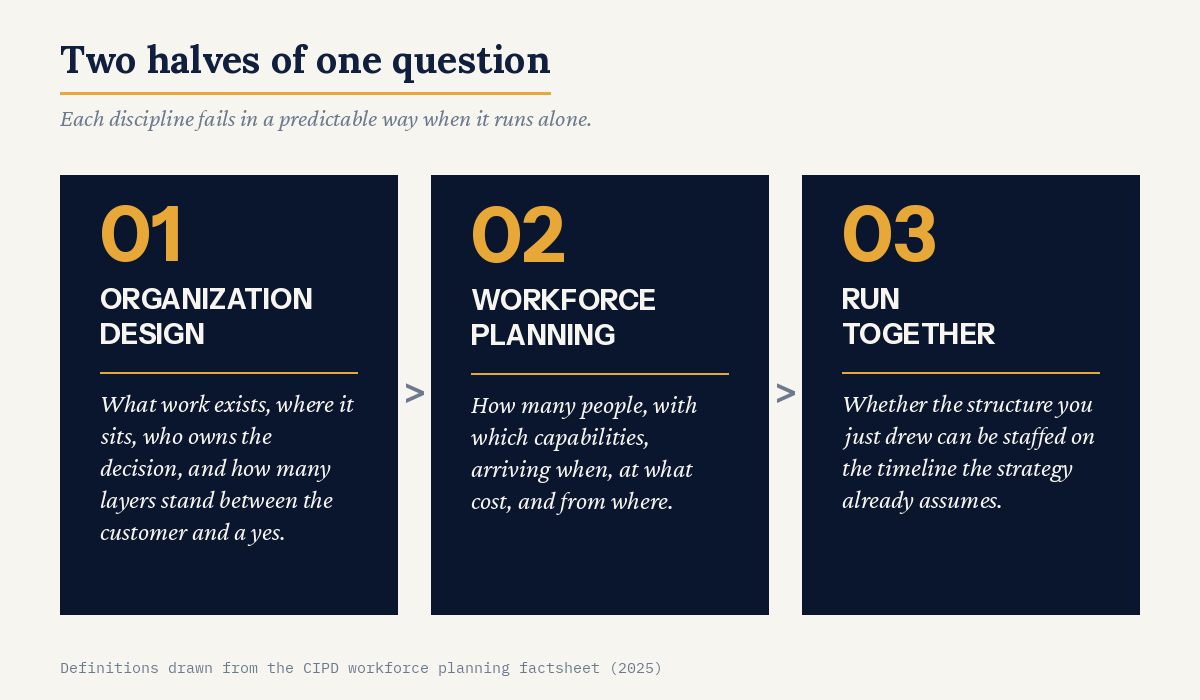
The two disciplines answer different halves of the same question, and each fails alone.
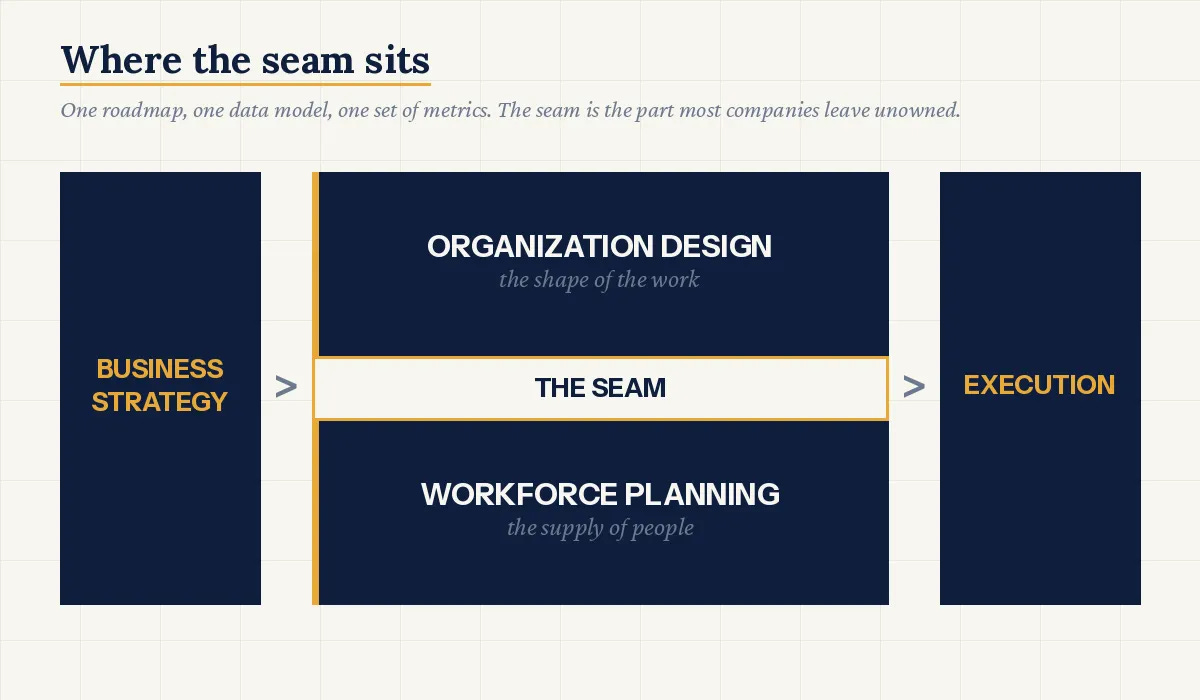
Organization design decides what work exists, where it sits, who owns the decision, and how many layers stand between the customer and someone who can say yes. Workforce planning decides how many people, with which capabilities, arriving when, at what cost, from where. Run design without planning and you get an elegant operating model that assumes people who do not exist and cannot be hired on the timeline it requires. Run planning without design and you produce a precise forecast for an organization being taken apart around you.
I put both under one roadmap at Deloitte Global, and run them that way now at Capital One, because the alternative kept producing that second failure. A workforce plan built against last year’s structure ages the moment the structure changes, and the structure keeps changing.
AI raises the cost of the separation, because it changes work at the task level before it changes anything at the role level. Orgvue puts roughly 66% of jobs in AI’s path while only about a quarter of the tasks inside them can currently be automated. Roles are being hollowed out and refilled from the inside. What work belongs to this job now, and what skills we need to staff it, are one question arriving from two directions. Companies keep sending it to two leaders who meet quarterly.
I wrote in July about companies merging the People and Technology seats to close a similar gap. This one is easier. Both disciplines already report to the same executive in most companies. They just do not share a roadmap or a set of metrics.
HR holds the pen
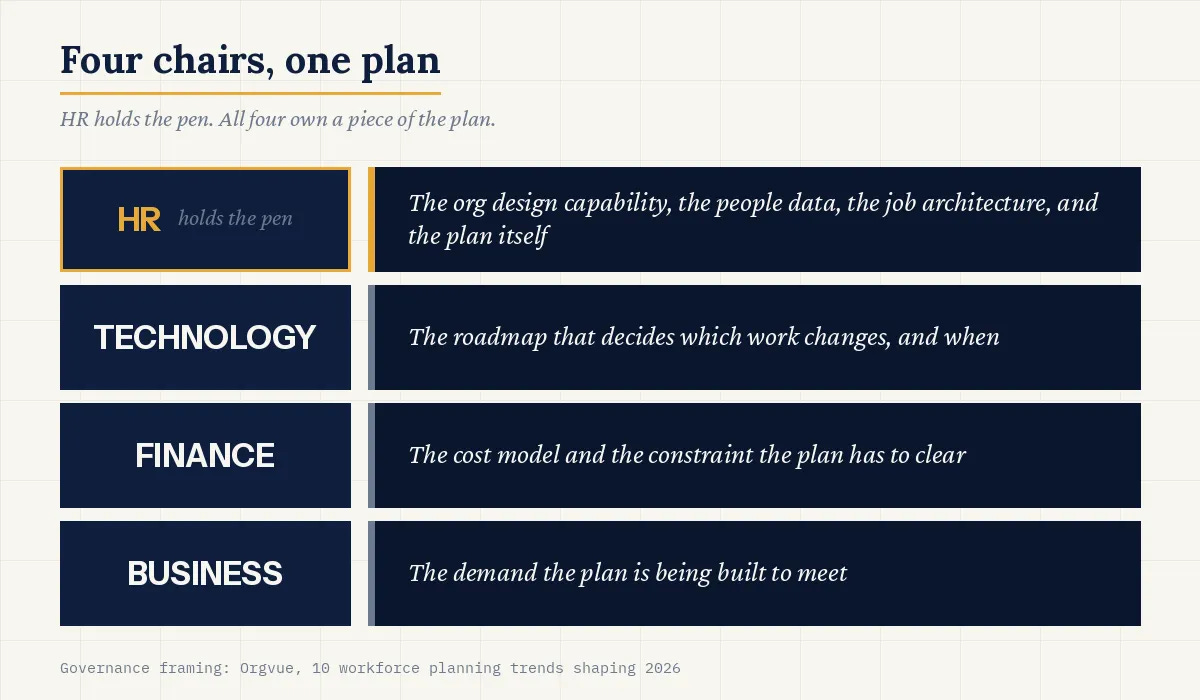
The function belongs in HR. HR owns the org design capability, the people data, the job architecture, and the leveling logic. Put workforce planning anywhere else and it drifts toward the owner’s instincts. Inside Finance it becomes a cost exercise. Inside a technology organization it becomes a tools roadmap with a headcount appendix. A business unit produces a hiring wish list with a good story attached.
Holding the pen is different from writing alone. The plan is co-authored, and three other leaders own pieces HR cannot supply. Technology owns the delivery roadmap that decides which work changes and when, and knows which capabilities the platform will need before HR does. Finance owns the cost model and the constraint the plan has to clear, which separates a workforce plan from a list of hopes. Business leaders own the demand, and the revenue plan is what makes capability forecasting better than extrapolation.
Deloitte’s workforce planning practice describes the same shift and is blunt about where the work used to sit: a small team of specialists with finance holding the loudest voice in the room, which made sense while the exercise was cost and headcount plugged into a model. Deloitte now places workforce planning at the intersection of finance, technology, human capital, and business strategy. Most companies have not moved. The American Productivity and Quality Center found 49% of strategic workforce plans are top-down or not integrated across divisions, and a Bersin survey found only 32% of talent acquisition professionals involved in planning at all.
The companies that do move can show what it buys. Network Rail, which runs Britain’s rail infrastructure, was taking twelve months to recruit and train signalers and losing them fast enough to open real gaps. A team spanning HR, operations, finance, training, and the trade unions cut that end-to-end time by half, with roughly £1.2 million in expected savings over three years from premium hours it no longer had to pay. A biotech company cutting general and administrative costs after the pandemic ran the same play and saved about $94 million.
A disclosure: I am not a neutral reader of Deloitte’s research. I spent nearly a decade at Deloitte Global and have spent time with several of the people behind this work, including Russell Klosk, who leads their workforce planning practice, and Kyle Forrest. Russ signed my copy of his book, Talent Prophecy, at the Eightfold conference in May.
What the job actually requires
Three adjacent disciplines get mistaken for this one, which is much of why the searches stall. People analytics describes what already happened: attrition by team, time to fill, the cost of a bad quarter. Headcount budgeting prices the workforce that was approved and tracks variance against it. Recruiting planning turns an approved number into requisitions and sourcing channels. All three are real crafts, every company needs them, and a strong practitioner in any of them can be hired this quarter.
Workforce planning starts where those stop. It makes a claim about a workforce that does not exist yet, inside a strategy still being argued over, and attaches numbers, dates, and costs to that claim in a document leaders will be held to.
Doing it well takes four capabilities at once. The quantitative half is visible: supply and demand modeling, scenario testing, skills taxonomies, and enough statistical judgment to know which assumption the model turns on. Underneath sits organizational knowledge no onboarding deck transfers: how the company actually decides, where the constraints sit, whose plan has moved three times this year, which capability takes eighteen months to build because you watched it take eighteen months. Then the relational part. A plan gets adopted when a CFO, a CIO, and a business unit head who each walked in with a different number sign the same one, and that runs on trust built long before the meeting. Tool fluency finishes it: knowing the platform and the labor market data underneath well enough to catch the tool when its answer is wrong.
The Director I hired had all four. She could read a strategy and name the capabilities it implied, build the model, and explain it to a CFO without hiding behind it. Put her in an organization design session and she could say what a leader’s whiteboard redraw would cost in hiring time and capability eighteen months out.
The gap is measurable. BCG and the World Federation of People Management Associations surveyed more than 7,000 HR and business leaders across 115 markets and ranked 28 people-management topics by future importance against current capability. Strategic workforce planning came out as a universal anchor, a priority in every region. In the same study, 11% of companies have a skills taxonomy embedded across the enterprise.
Each of those four capabilities is common on its own. The combination is rare and takes extensive time to develop. Recruiting calls about these roles are on the rise, and the searches they describe have usually been open for months.
Here’s how you take action
Give the seam an owner, and put that owner in HR. Name one leader accountable for both the shape of the organization and the supply of people to fill it, then name three counterparts: the technology leader who owns the delivery roadmap, the finance leader who owns the cost model, the business leader who owns the demand. Those four set the assumptions together at the start of the cycle. Four functions comparing notes quarterly is a coordination problem that becomes an execution problem later.
Screen for the combination. Platform mechanics are teachable in a month. Modeling judgment, organizational knowledge, and the standing to hold a room of executives who disagree take years, and a candidate with three of the four will struggle. Ask for a forecast they got wrong and what they changed after, then ask how they got a finance leader to sign something the finance leader did not like.
Shorten the cadence. Annual workforce plans made sense when the work changed annually. Deloitte’s 6% is what an annual cycle looks like against a quarterly tool release schedule. Start with skills-gap data on the roles carrying the most business risk, since fewer than four in ten organizations collect it at all.
Build the bench, because you cannot buy it. Rotate people in from financial planning, organization design, and analytics, and give them a real assignment with executive exposure. Companies that build a pipeline over the next three years will stop competing for the same forty people.
Workforce planning is a quantitative, high-judgment discipline most American companies have never named or staffed. AI just made it urgent. If you run a Technology, HR, or Finance organization, ask who in your building can translate next year’s strategy into next year’s capability requirement. If the answer takes more than a moment, you have found the work.
Christina Lexa writes Workforce Rewired, on the intersection of workforce transformation, AI, and global talent.
The views expressed here are my own and do not represent the position of my employer or any organization I am affiliated with.