


TL;DR: AI agents are no longer tools your people use. They are components of your workforce: completing tasks, running processes, making decisions. McKinsey has 20,000 of them. By the end of 2026, Gartner expects 40% of enterprise applications to embed task-specific agents. And 84% of companies have done nothing to redesign the jobs, the management structure, or the governance systems that running a hybrid human-AI workforce actually requires. The question is no longer whether your organization will have a digital workforce. It’s whether you’ll manage it or just let it happen to you.
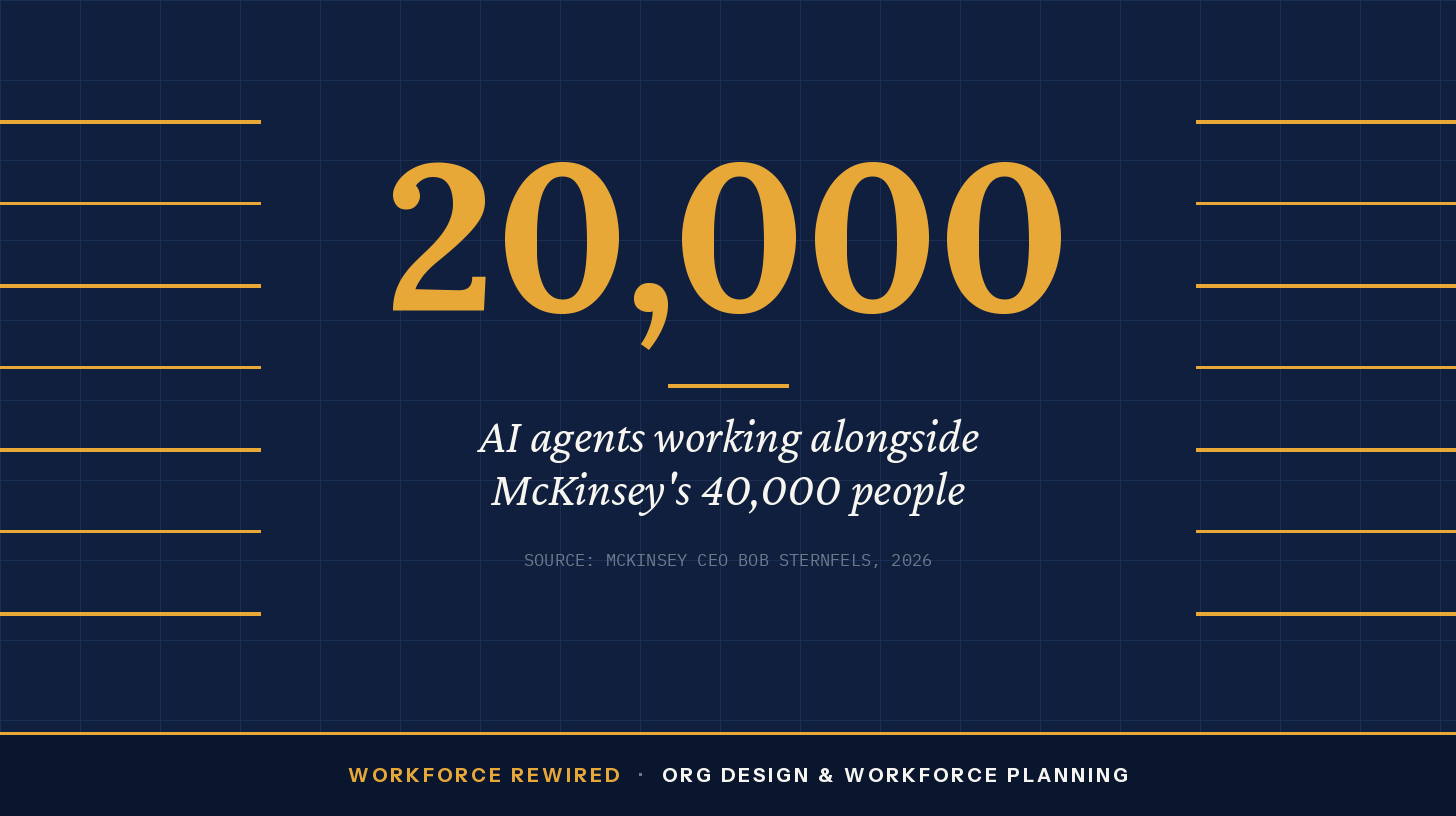
Sometime in early 2026, McKinsey CEO Bob Sternfels started answering a question differently. When people asked how many people McKinsey employs, he stopped saying 40,000. His answer became 60,000: 40,000 humans and 20,000 AI agents.
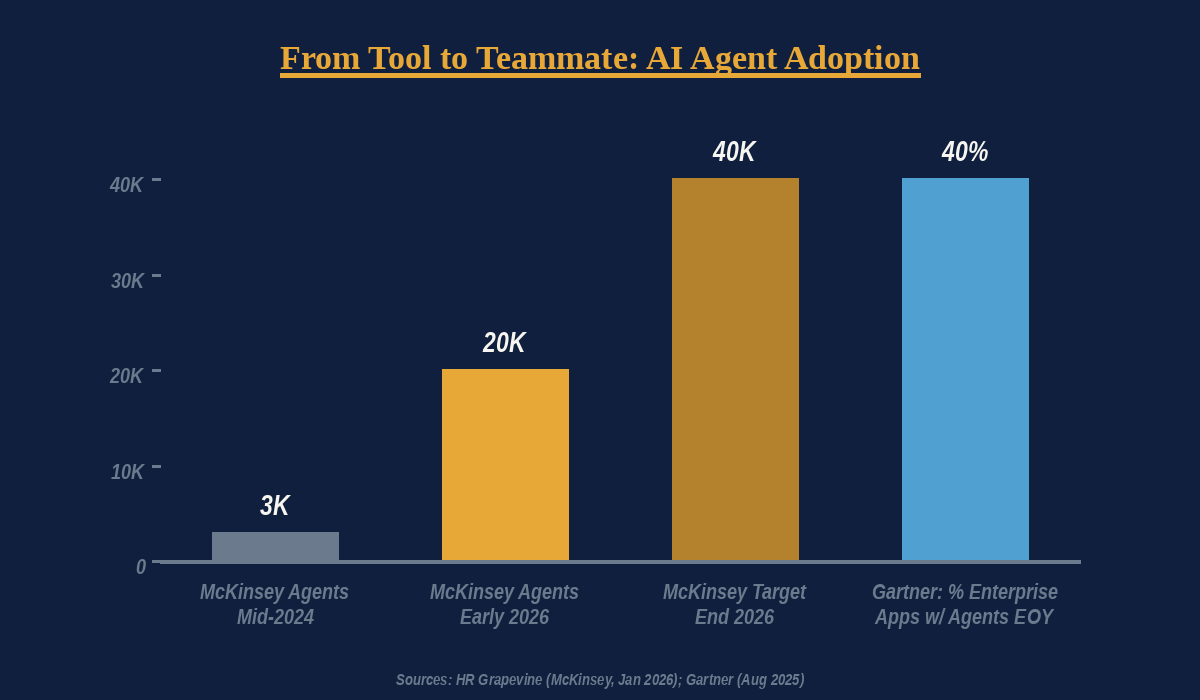
Eighteen months before that answer, McKinsey had 3,000 agents. The goal is to reach parity: one agent for every human by the end of this year.
This is not a technology announcement. It is an organizational one. And most organizations are not ready for what it means.
The Workforce Has Already Changed Shape
Here is the state of play as of mid-2026: Gartner predicts that 40% of enterprise applications will embed task-specific AI agents by year’s end, up from less than 5% in 2025. More than half of enterprises are already running agents in production. Deloitte’s State of AI in the Enterprise 2026, a survey of more than 3,200 business and IT leaders across 24 countries, found that 82% of companies expect at least 10% of their jobs to be fully automated within three years.
Those are technology statistics. What they describe is a workforce transformation.
AI agents are not assistants. They are not co-pilots. They do not wait for a human to prompt them before doing something. The current generation of agentic AI is self-directed and goal-oriented: it researches, plans, executes, adapts, and delivers complete workflows with minimal human oversight. Deloitte describes this as a “silicon-based workforce”: software workers that run continuously in the background, completing tasks, routing decisions, flagging exceptions.
The distinction matters because it changes the question. The question is no longer “how should our people use AI?” It is “how do you run an organization where a portion of your workforce isn’t human?”
Almost no one has an answer to that second question. And that is not a small gap.
The 84% Problem
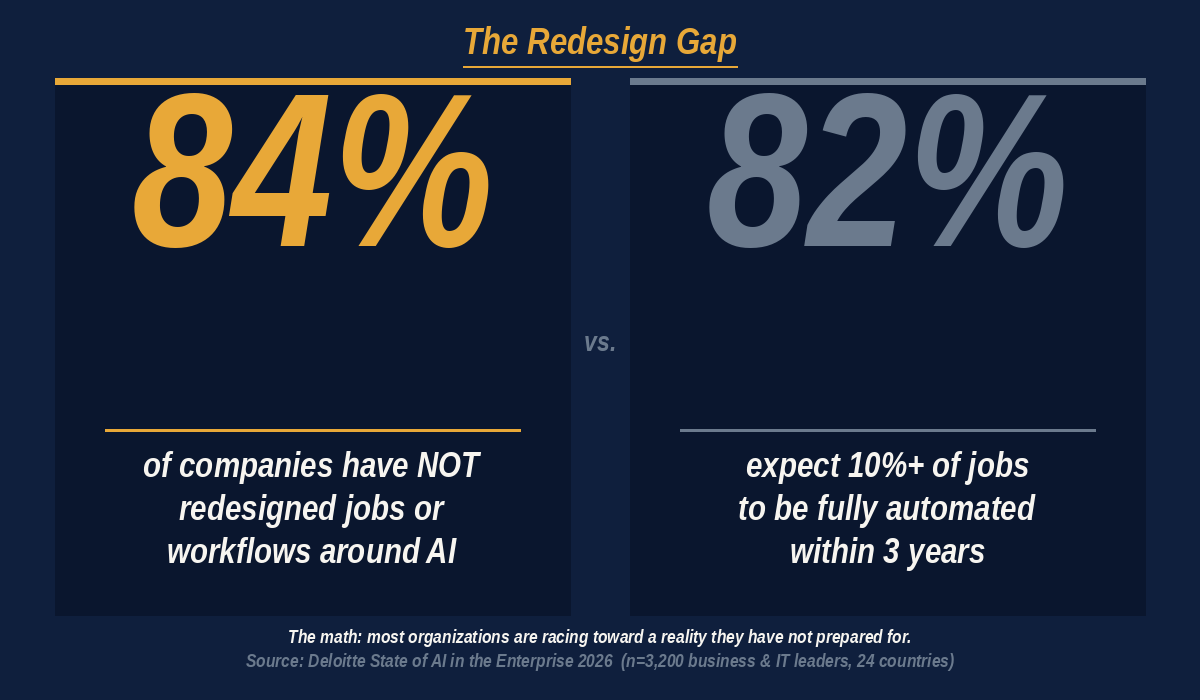
Deloitte’s survey found that 84% of companies have not redesigned jobs or workflows around AI capabilities. Eighty-four percent. In the same survey, 82% expect significant automation of their workforce within three years. The math is brutal: most organizations are racing toward a structural reality they have not prepared for at all.
This is not a technology readiness gap. The tools exist. The agents work. The gap is organizational: the management systems, the governance frameworks, the job architectures, and the cultural expectations that a hybrid human-AI workforce requires do not exist at most companies. They are still running an operating model designed for a fully human workforce, layering agents on top of it rather than rethinking the model itself.
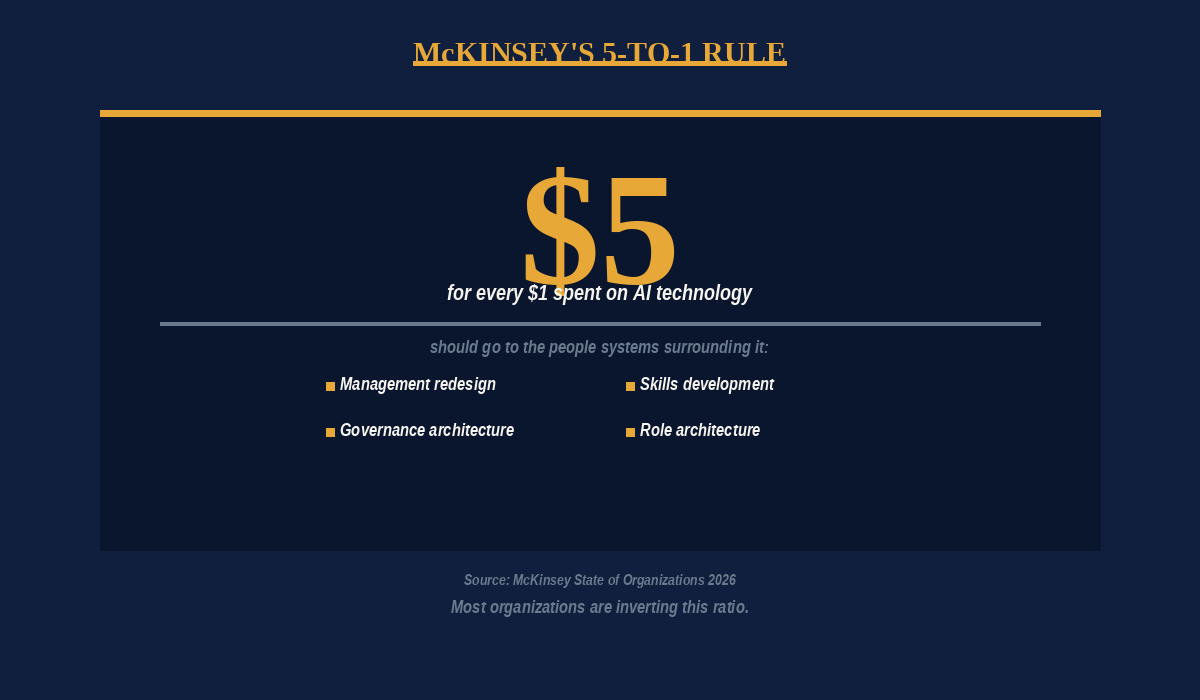
McKinsey’s State of Organizations 2026 report makes this point sharply: organizations must move from fragmented AI use cases to full operating-model redesign, with agentic AI embedded end-to-end across functions. The report estimates that for every dollar invested in AI technology, organizations should invest five dollars in the people, management, and organizational systems surrounding it. Most organizations are inverting that ratio.
The pattern is familiar. Companies buy the technology, deploy the technology, measure the technology, and declare the transformation underway. The organizational redesign, the harder, slower, less visible work of figuring out what it actually means to manage a workforce that now includes non-human workers, gets deferred. That deferral is not free. It is a compounding liability.
What Managing Agents Actually Requires
The practical management challenge of a hybrid workforce is more specific than most discussions acknowledge.
The first challenge is oversight at scale. McKinsey’s research shows that a human team of two to five people can currently supervise an “agent factory” of 50 to 100 specialized agents running end-to-end processes. That ratio is extraordinary. But it requires a specific skill set that almost no manager currently has: the ability to define clear goals and constraints for autonomous systems, to spot when an agent is producing outputs that are technically correct but contextually wrong, and to intervene effectively without slowing the entire system to human speed.
This is a new kind of management competency. It is not the management of tasks or the management of people. It is the management of outcomes produced by systems operating faster and at higher volume than any individual human can directly observe.
The second challenge is governance. Who is accountable when an AI agent makes a consequential decision and no human reviewed it? The answer at most organizations right now is: unclear. Deloitte’s guidance on redesigning operating models for human-agent work argues that governance must become everyone’s role, embedded in performance expectations rather than concentrated in a compliance function reviewing outputs after the fact. That requires a complete redesign of how accountability is structured.
The third challenge is the question of what experienced human workers are actually for, once agents handle execution. Research from the Dallas Federal Reserve has found that AI is simultaneously replacing workers whose tasks are codifiable and raising the wages of workers whose value comes from tacit knowledge: the accumulated judgment that develops through years of working in context, making mistakes, reading situations that don’t fit the standard model, and building the pattern recognition that no training dataset fully captures.
This finding has profound implications for org design. If AI absorbs execution and codified analysis, the humans in an organization need to be positioned where their tacit knowledge actually creates value: in the edge cases, the exceptions, the high-stakes decisions, the relationships, and the situations where being wrong matters in a way that requires a human to own it.
Most organizations have not thought through what that positioning looks like in practice. They have reduced headcount and expanded spans of control. They have not rebuilt the organizational architecture that would let their human workforce operate at the level the moment requires.
The Shape of the Organization Is Changing
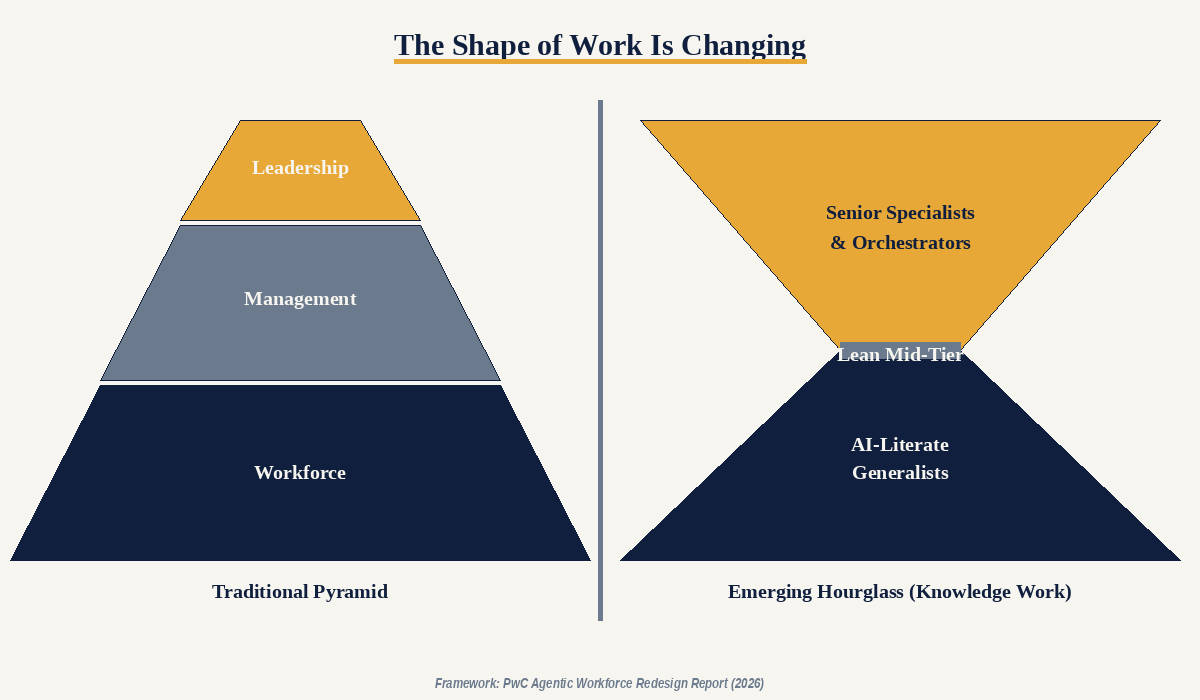
PwC’s research on workforce redesign for the agentic era describes two different shapes emerging, depending on the type of work.
In knowledge-intensive functions (strategy, law, consulting, finance), the workforce is trending toward an hourglass: a broader base of AI-literate generalists who ramp quickly and contribute at a high level early in their careers, a leaner middle tier as agents absorb coordination and routine analysis, and a concentrated top of senior specialists whose value comes precisely from what agents cannot replicate. The senior layer expands its reach by directing agents, not by managing humans.
In operational functions where front-line execution still requires human presence, the shape trends toward a diamond: AI absorbs entry-level task work, more mid-level workers are needed to orchestrate and manage agents, and a thinner senior layer sets direction and handles exceptions.
Both shapes require something organizations are only beginning to build: a management layer that knows how to run a blended team. Not just a team that uses AI tools, but a team where agents are actual members of the workflow, with assigned responsibilities, performance expectations, and handoff protocols.
New roles are emerging in the space between: agent orchestrators who design and supervise agent workflows, hybrid managers who lead blended human-agent teams, AI coaches who help employees integrate agents into their daily work. These roles are appearing at companies moving fastest on agentic deployment. They don’t yet exist on most org charts.
The Employer Brand Dimension No One Is Talking About
There is a dimension to this shift that workforce practitioners need to start thinking about now: what deploying a digital workforce says to your human one.
The companies moving fastest to build out agentic capacity are making an implicit statement about what they value in their human workers. McKinsey, notably, has started interviewing candidates with AI tools and shifting its hiring toward candidates with liberal arts backgrounds and strong judgment over those with narrow technical credentials. The logic is coherent: if agents handle analysis and execution at scale, the humans you want are the ones who can think across domains, communicate across functions, and make sound decisions in ambiguous situations.
That is a different hiring profile than the one most organizations have optimized for over the last decade. It implies a different career architecture, a different approach to early career development, and a different definition of what good talent looks like.
Companies that do not make these choices deliberately will have them made by default. The agents will proliferate. The human workforce will adapt without direction. And the gap between the organizational capability companies think they have and the one they actually have will widen until it becomes a crisis.
What to Do With This
I want to be specific, because the advice in this space tends toward the generic.
The first thing to do is count. Map what agents are actually doing in your organization right now. Not what you’ve licensed. What’s running in production. Most senior leaders don’t have a clear picture of this, because agent deployment has often happened at the team or function level without central visibility. You cannot manage a workforce you cannot see.
The second is to design the oversight model before the gap becomes a governance problem. Who is responsible for the quality and accuracy of agent outputs in each function? What is the exception-handling protocol? What decisions require human review, and at what threshold? These are management architecture questions, not technology questions. They belong on someone’s desk. In most organizations, they’re not on anyone’s desk.
The third is to look honestly at your human workforce’s positioning. Are the people in your organization concentrated in the work that agents will absorb over the next three years: the codifiable, the repetitive, the execution-heavy? Or are they positioned in the work where human judgment creates value that silicon cannot replicate? If the former, the time to start repositioning is now, not after the agents are fully deployed.
The era of AI as assistant is over. The era of AI as workforce member is here. Bob Sternfels is counting his. The question is whether you’re counting yours, or waiting until the org chart tells you something you should have seen coming.
Is AI gaining a spot on your org chart? I’d like to know what you’re seeing from the inside. Email me at christina@workforcerewired.co.
Christina Lexa leads workforce strategy for Technology at Capital One. She writes Workforce Rewired at the intersection of AI, org design, and the future of work. Subscribe for free at workforcerewired.co.