


TL;DR: AI is creating two classes of workers inside the same organization: power users who have already compounded their advantage, and everyone else who is falling behind while believing they are keeping up. The divide is not primarily about access. It is about time, management, and structural permission. Companies that do nothing are not staying neutral. They are choosing a side.
Two people joined your finance team two years ago. Same onboarding, same tech stack, same laptop. Today, one of them uses AI tools for seven or more distinct tasks each week: drafting financial models, summarizing board decks, writing variance commentary, running scenario analyses, debugging spreadsheet formulas. She saves more than ten hours a week. She has, functionally, become a different kind of analyst than she was in 2024.
The other one uses AI occasionally to clean up email drafts.
Same tools. Same company. The productivity gap between them is roughly sixfold.
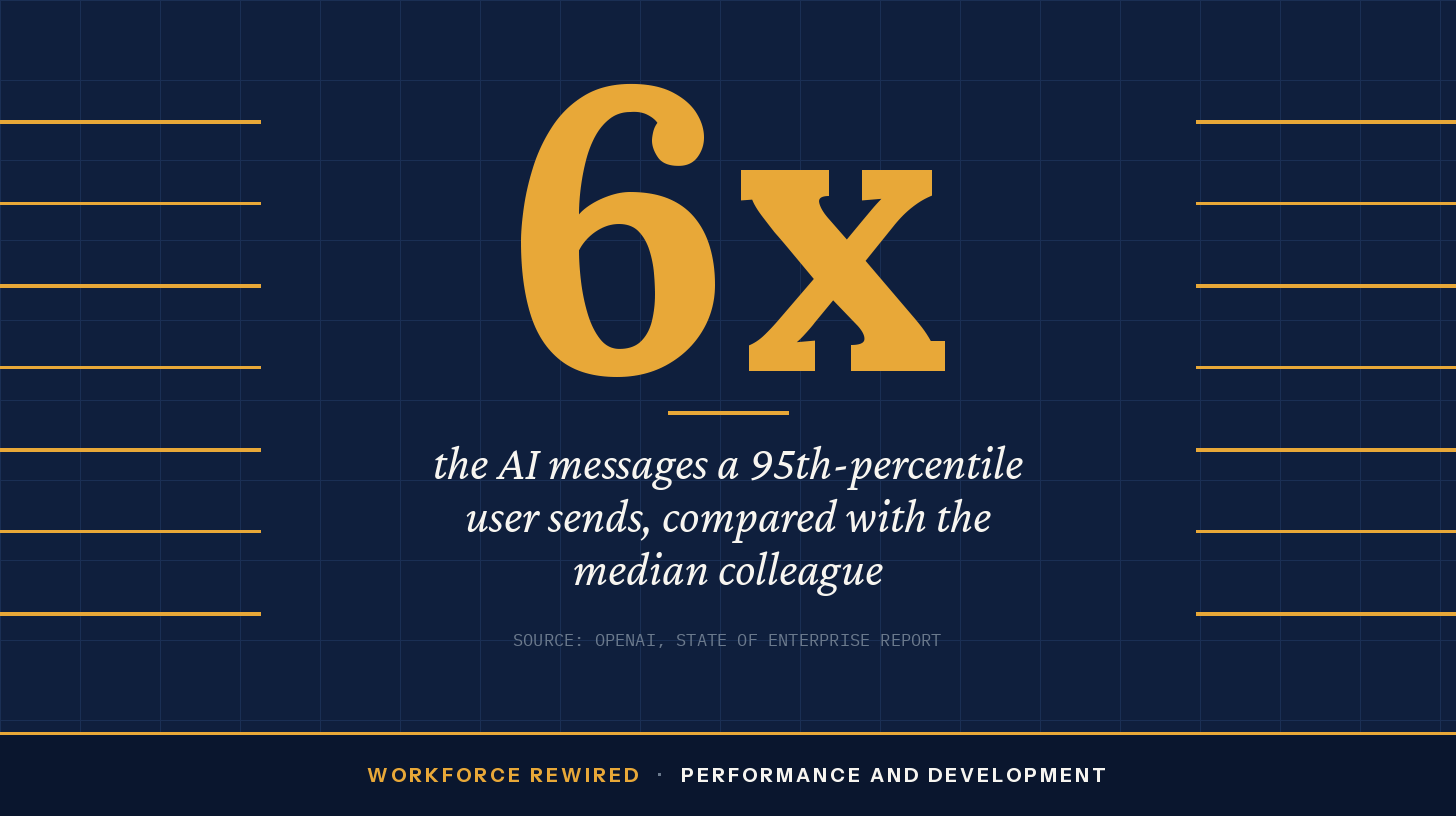
That number is not rhetorical. OpenAI’s State of Enterprise report, published December 2025, found that workers at the 95th percentile of AI adoption are sending six times as many messages to ChatGPT as the median employee at the same companies. Among data analysts specifically, the heaviest users engage with AI tools 16 times more than their typical peers. For coding, the gap is 17-to-one.
Six times the output. Same salary. Same title. Same employer.
If you run a workforce, that number should stop you cold. And it should force you to ask a question most organizations are not asking: who is getting left behind inside your own walls, and what are you doing about it?
The Divide Is Not About Access
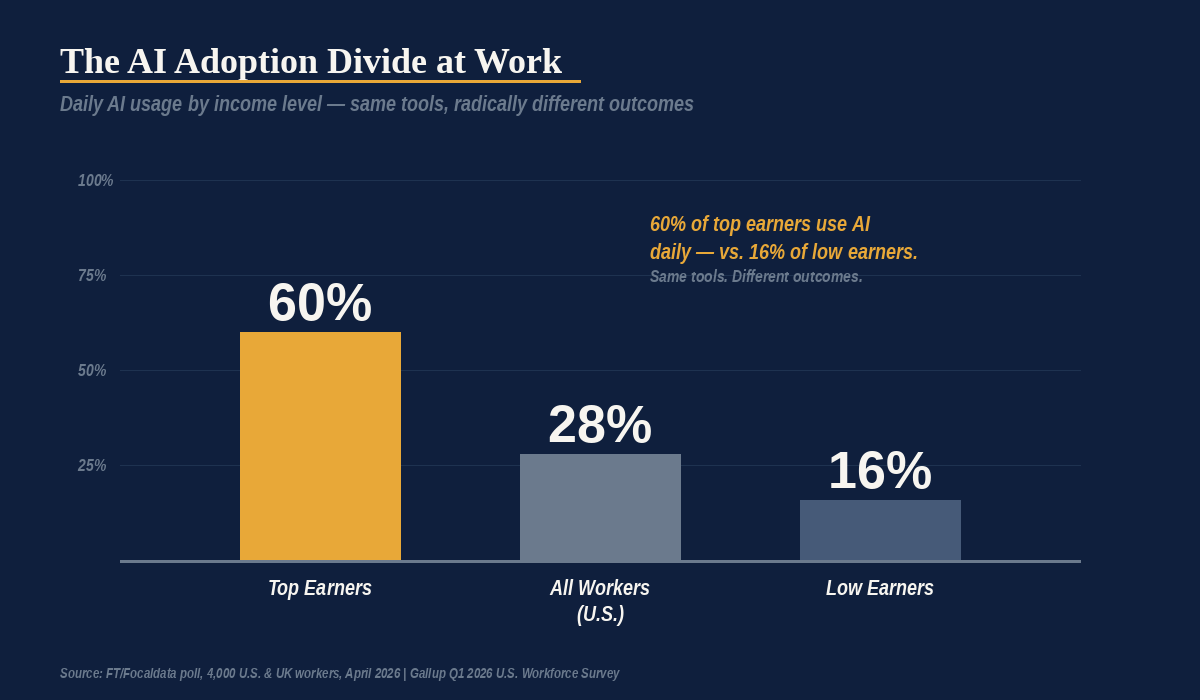
The most important thing to understand about the AI productivity divide is that it is not primarily a technology access problem. The FT and Focaldata surveyed 4,000 US and UK workers in April 2026 and found that 60% of top earners use AI tools daily at work, compared to just 16% of low earners. But in the majority of the organizations these workers come from, the tools are available to everyone.
The workers pulling ahead are not doing so because they have access their colleagues lack. According to OpenAI’s analysis, they are pulling ahead because they decided to use what was already available and kept using it until they figured out what it could actually do. Usage begets capability. Capability begets usage. The gap compounds.
This is both reassuring and alarming. Reassuring because it suggests there is no locked door, no privileged cohort granted special tools. Alarming because it means the divide is forming right now, without malice, in organizations that believe they have handled the AI transition by rolling out a license. They have not.
Who Pulls Ahead and Why
The data on who is winning the AI productivity race is consistent enough to call a pattern.
Gallup’s Q1 2026 workforce survey found that 50% of U.S. employees now use AI as part of their role, up from 21% in mid-2023. That headline sounds like progress. But only 12% use it daily. Daily and weekly combined: 28%. The other 72% are using AI occasionally, if at all. In a moment when competitive advantage accrues to the workers compounding their capability through repeated use, being an occasional user is closer to non-user than to power user.
The workers reaching heavy adoption share recognizable characteristics. They are more likely to be high earners with the autonomy to experiment. They are more likely to have managers who actively model AI use themselves. Gallup found that employees whose managers actively support AI use are 2.1 times more likely to reach weekly usage, making manager behavior the single most significant driver of adoption after tool access itself.
And they are more likely to have time. Not time granted by a formal program. Just the slack in their schedule that makes experimentation feel low-stakes rather than reckless.
The workers not pulling ahead are lower-paid, more likely to be women, and more likely to be early in their careers. The FT data shows a persistent gender gap across industries. And the entry-level workers who most need AI fluency to build career capital are precisely the ones least likely to have the autonomy and management support that drives adoption.
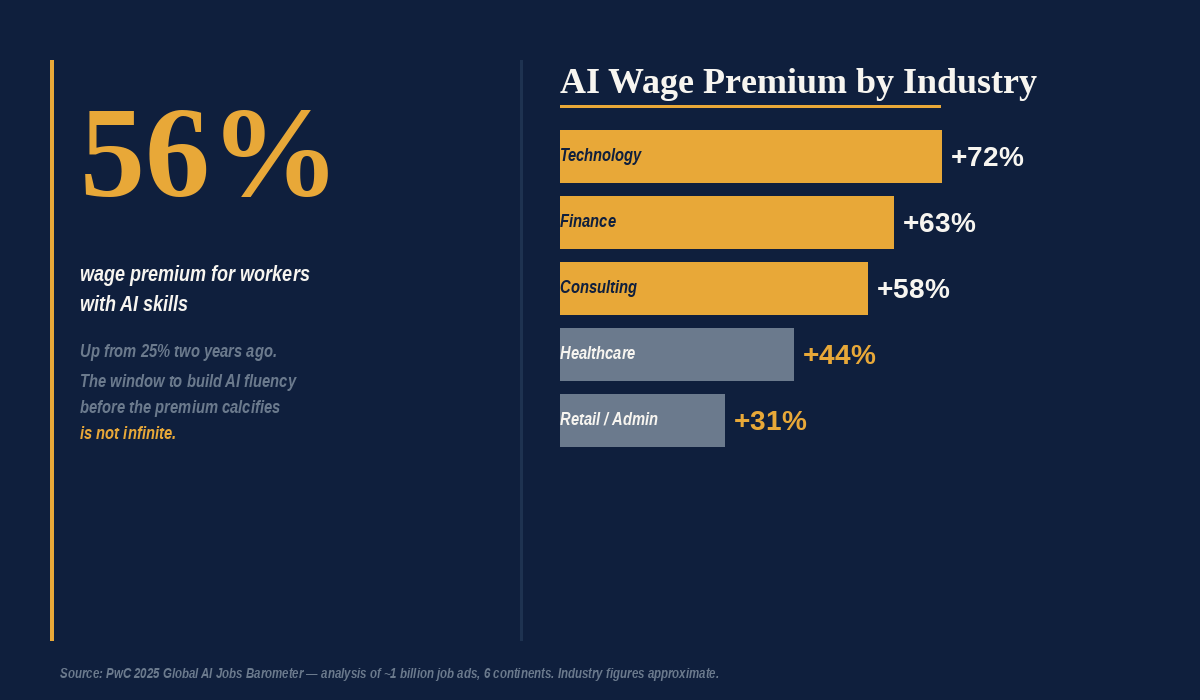
The economic consequences are not hypothetical. PwC’s 2025 Global AI Jobs Barometer, which analyzed close to a billion job ads across six continents, found that jobs requiring AI skills command a 56% wage premium over equivalent roles that do not. Two years ago, that premium was 25%. The gap is accelerating. The window for workers to build AI fluency before the premium calcifies is not infinite.
The Company That Did Nothing Also Made a Choice
Most organizations reading about the AI productivity divide think: this is a training problem. We will run a course. This is not a training problem. Or rather, it is not only a training problem, and treating it as one is how organizations fail.
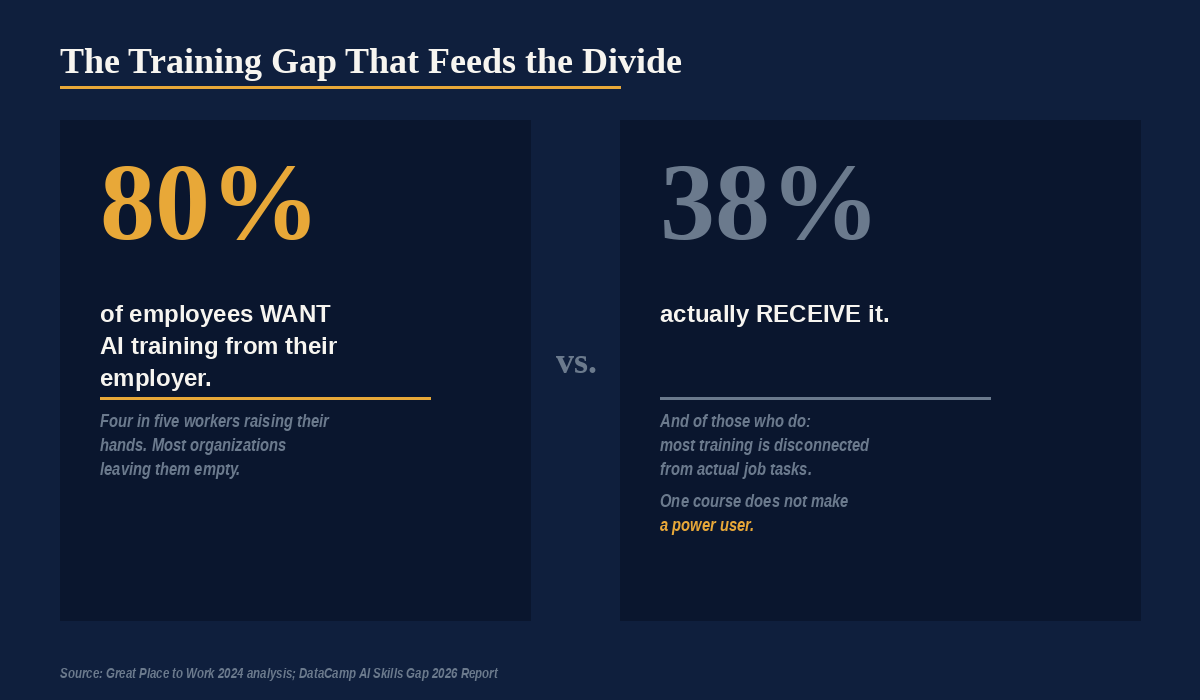
Four in five employees want AI training from their employers, according to Great Place to Work’s 2024 analysis. Only 38% report receiving it. That gap is real and worth closing. But the companies that close only that gap will still find their workforce dividing. Notably, there are myriad free training resources available online - many by the companies creating the products themselves (see: Google, Anthropic, and OpenAI).
Employees who took one AI course and returned to their previous workflows did not become power users. They became people who once watched an AI course.
Real adoption requires three things that training alone cannot provide: repeated practice on actual work, management behavior that makes experimentation feel safe, and enough slack in the day to try something new without it feeling like falling behind on everything else.
The Structural Argument
I want to be specific about something, because this conversation often tilts toward individual responsibility in ways that obscure the structural reality.
Yes, the OpenAI data suggests that some of the productivity gap is explained by individual choice: workers who decided to use the tool and kept using it, versus workers who tried it once and moved on. That is a real factor. Personal initiative matters.
But the conditions that make experimentation possible are not equally distributed. A vice president at a consulting firm has the ability to choose to dedicate time to play with a new tool, the psychological safety to use it imperfectly, and the relationship with her manager that makes saying “I’ve been trying something new” sound ambitious rather than undisciplined. A junior analyst in a high-volume processing role has none of those things. She has a queue, a benchmark, and a manager who tracks output by volume.
When PwC’s research finds that skills sought by employers are changing 66% faster in occupations most exposed to AI, it is describing a target that is moving. Workers who cannot experiment cannot keep up with a moving target. And the workers who cannot experiment are not randomly distributed. They are the ones who were already disadvantaged by the structure of work before AI arrived.
The productivity divide will not sort itself out along lines of individual effort. It will sort itself out along lines of existing advantage, unless organizations deliberately interrupt that sorting.
What the Intervention Actually Looks Like
I am skeptical of the word “program” when applied to organizational change, because programs imply a defined beginning, a defined end, and the ability to declare completion. The AI capability divide is not a problem you close and move on from. It is a condition you either manage or let compound.
What organizations that are actually narrowing the divide seem to do is less glamorous than a program. Gallup’s data points toward manager behavior as the single largest lever. Not a training mandate. Not a license rollout. The actual behavior of individual managers: whether they use AI tools in their own work, whether they talk about it openly, whether they give their people room to try and fail.
This is not a technology intervention. It is a culture one. And culture interventions are slow, specific, and require leaders who understand that their behavior is the signal, not the company memo.
The second intervention is structural: build AI practice into actual work, not into sidecars and optional learning paths. The companies with the narrowest internal divides are not running the most AI workshops. They are redesigning workflows so that AI is embedded in how a role gets done, not offered as an enhancement a motivated person can choose to adopt.
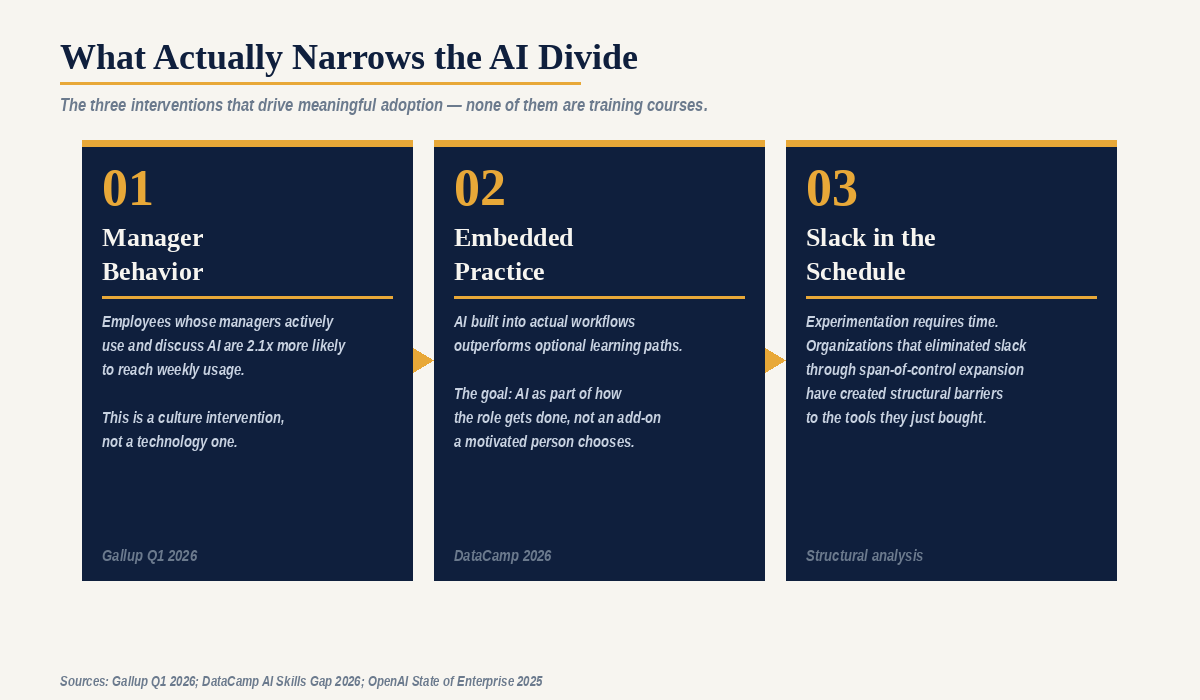
The third is the hardest: time. Organizations that say they want broad AI adoption but have eliminated slack from their workforce through aggressive span-of-control expansion and relentless productivity pressure are describing two incompatible things. Experimentation requires slack. If every hour is already spoken for, the AI tool is one more thing a person cannot fit into the day. The very efficiency drives that prompted the tool purchases are the structural barriers to the tools working.
The Compounding Problem
The reason the AI productivity divide warrants urgent attention is that it does not hold still.
The gap between an AI power user and an occasional user is not a static productivity difference. It is a compounding one. The power user is not just more productive today. She is building intuition about AI capabilities that will make her more effective with every subsequent tool, every model improvement, every new workflow integration. Her colleagues who are not in daily practice are falling further behind each month, not just by the margin of one month’s productivity.
IDC estimates that global skills shortages may cost the economy $5.5 trillion by 2026. Most of that estimate captures the macro-level cost of organizations that cannot hire the talent they need. What it cannot easily quantify is the internal cost: the talent organizations already have that is becoming less competitive by the month, while sitting in the same chair, earning the same salary, believing they are keeping up.
The visible AI talent shortage is the one you recruit for. The invisible one is already on your payroll.
This is the question worth sitting with: not whether your organization bought the tools, but whether the people who needed them most actually learned to use them. The ones who figured it out on their own were probably going to be fine regardless. The ones who needed structure, time, and a manager who made it feel safe -- those are the ones whose trajectory you actually had the ability to change.
The tools are the easy part. The rest is on you.
Christina Lexa leads workforce strategy for Technology at Capital One. She writes Workforce Rewired at the intersection of AI, org design, and the future of work. Subscribe for free at workforcerewired.co.