


TL;DR: Seven months ago I named Meta’s Applied AI division as the most extreme example of the industry’s rush to flatten management: one manager for every fifty employees. This month, that same division started asking individual contributors whether they would like to become managers again. Meta has now reversed a flattening bet twice in three years, and both times the reason was the same. I look at what a company running the same experiment twice tells the rest of us about the difference between cutting a ratio and building the capability underneath it.
In September 2026, Meta started asking engineers inside its Applied AI division a question the company spent three years trying to make unnecessary: would you like to be a manager again. Business Insider reported, and Fortune confirmed, that the ask is voluntary, and that some of the people receiving it had been managers before Meta moved them into individual contributor roles.
This is not a random team. In April, Fortune’s reporting put this exact division at one manager for every fifty employees, roughly double what most organizations have ever treated as the outer edge of a functional team, and I used that number here as the most extreme data point in what Fortune called the “megamanager era”, in Who Wants to Lead People Anymore. Meta built the flattest team in the industry, then spent the following months rebuilding management inside it.
Meta has done this before. In 2023, Mark Zuckerberg told the company that “flatter is faster” and launched what he called the Year of Efficiency, pushing managers and directors into individual contributor jobs or out the door. Three years later the pattern repeated at a smaller scale and higher speed. In March 2026, Fortune reported that analysts expected Zuckerberg to help drive a broader AI-related layoff cascade across the industry. Two months later, Meta cut about 10 percent of its workforce, roughly 8,000 people, disproportionately hitting managers, and scrapped plans to fill 6,000 open roles. Out of that cut came Applied AI, a new engineering division built to bridge Meta’s AI research and its product teams, with roughly 7,000 employees reassigned to it, some of them former managers moved into individual contributor seats for the second time in three years.
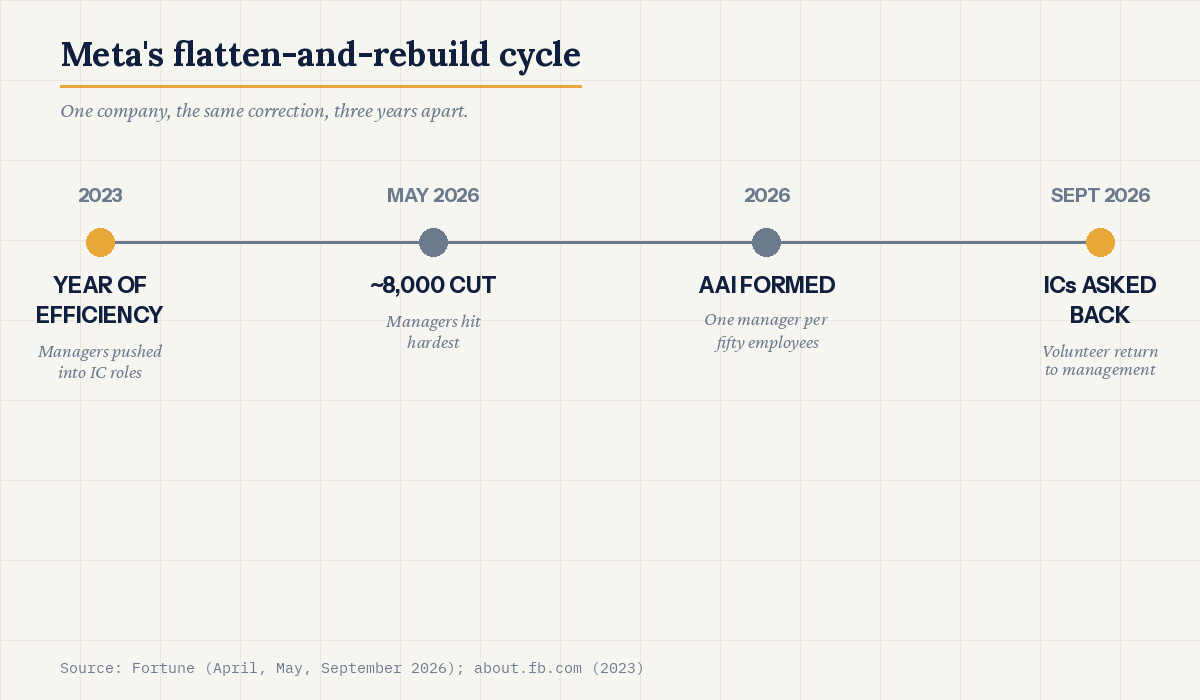
The flattest team Meta ever built did not stay silent about how that felt. Employees inside the roughly 6,500-person Applied AI organization described the work to Wired as a “gulag,” and more than 1,600 of them signed a petition against a company program that tracked clicks and keystrokes on their work devices to generate AI training data. Zuckerberg told the company it had made mistakes in the restructuring, promised no further mass layoffs this year, and named the fix: smaller management structures, more funding for team events, and the return of assigned desks. A company that spent three years arguing management layers were the problem is now funding more of them as the remedy for the team it built without enough.
Meta is not alone in the instinct. Andy Jassy told Amazon to raise its individual-contributor-to-manager ratio by 15 percent, and Amazon hit the target by pausing manager hiring and moving some managers back into individual contributor work. Google cut roughly 35 percent of its small-team manager roles, Sundar Pichai telling staff the company needed to stop throwing people at every problem. Gartner has projected that through 2026, one in five organizations will use AI to flatten their structure entirely, eliminating more than half of current middle management positions. I wrote about the Amazon and Google moves here in The Math of Flat, and the reasoning behind them was not foolish. Bureaucracy really does slow decisions. A manager who spends a day relaying updates between two meetings is not creating much value, and cutting that layer can look, for a quarter or two, exactly like the discipline it claims to be.
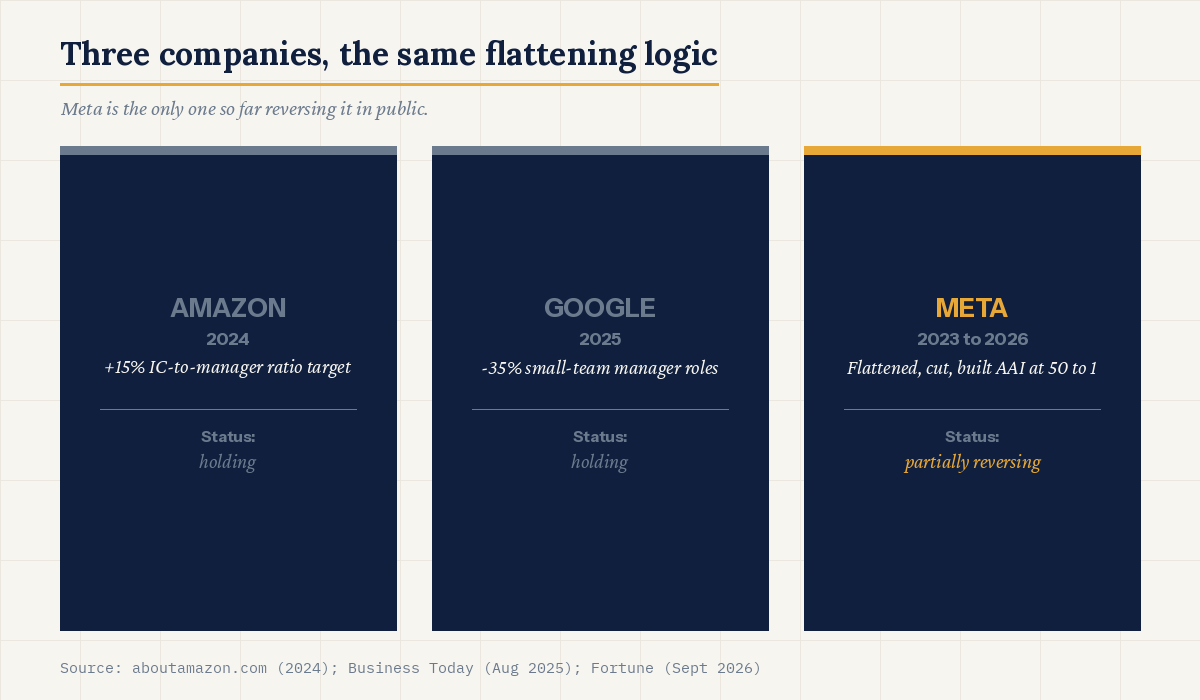
The ratio math missed the same thing twice. A headcount ratio is an arithmetic problem: divide the org by the number of managers you are willing to pay for, and the number gets smaller. Coaching capacity is a different problem entirely, and it does not shrink just because the math says it should. A manager with fifty reports cannot sit with any one of them long enough to catch a bad decision before it ships, correct a wrong technique, or notice that someone is struggling before it shows up in their output. That takes time, and time is the one input a ratio cannot manufacture by removing the people who used to provide it.
AI changed the equation on exactly one side of that math. It let Meta and its peers produce more output with fewer people managing the process, which made the ratio look survivable on paper. It did nothing to change how much attention a person needs to get better at a hard, unfamiliar job, which is the actual capacity a flattened team runs out of first. Gallup’s research points at why that gap matters even for the AI adoption Meta is racing toward: employees whose managers actively support their use of AI are 2.1 times as likely to use it frequently, and 8.8 times as likely to say it gives them more room to do their best work. A manager stretched across fifty people has almost no capacity left to be that kind of support to any one of them. Meta built a team optimized to move fast on AI and, in the same move, removed the exact relationship its own preferred outcome depends on.
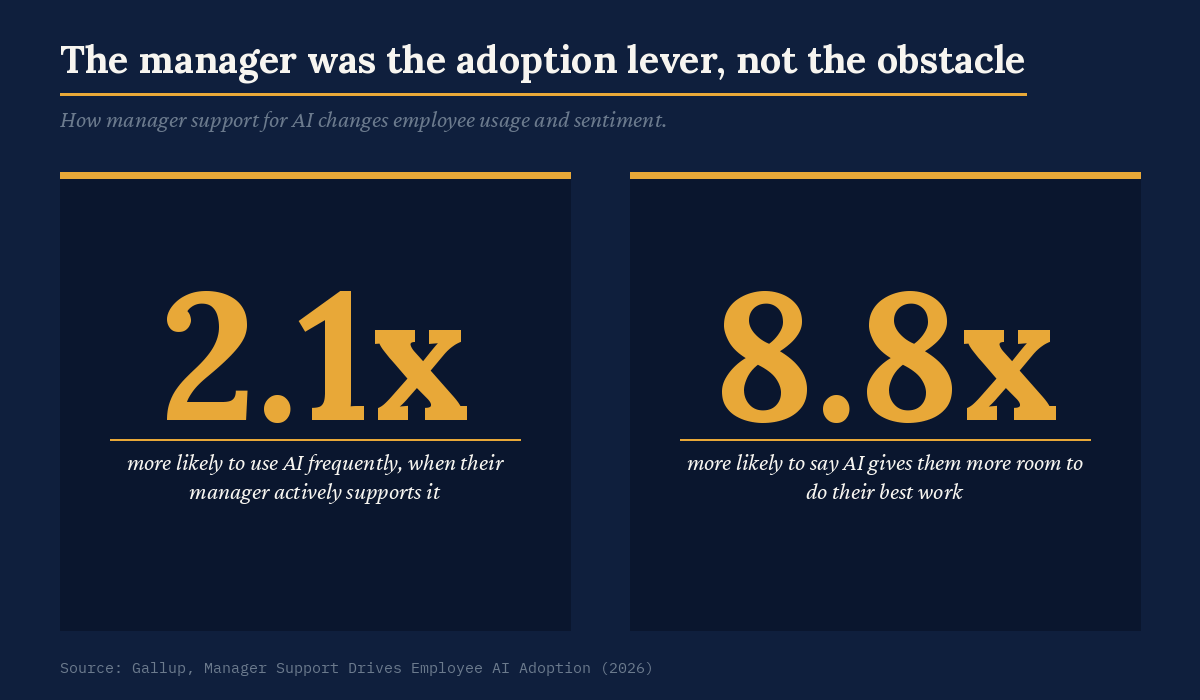
The manager was never the obstacle standing between Meta and faster AI adoption. Assuming otherwise is the mistake the company is now paying to unwind, one voluntary conversation at a time. Unwinding it division by division, without rewriting the underlying assumption, is how a company ends up having this same conversation a third time in 2028, under a different division’s name.
Meta’s own fix, smaller management structures, gets the direction right and leaves the harder question unanswered: smaller than fifty measured against what, exactly. A team that settles at twenty reports per manager still has no coaching cadence if that manager spends the freed hours on performance paperwork and headcount planning instead of the one-on-one correction a hard, unfamiliar AI-native job requires. The ratio matters. It only pays off alongside a real accounting of what a manager’s day is spent on, the same second-order question I raised about Amazon and Google’s cuts in The Math of Flat and never got a straight answer to from any of the three companies.
At Deloitte Global, I led the Org Design function, and we studied the span of control for our divisions for weeks before a choice was made on the outcome. I lead workforce strategy for Technology at Capital One now, and every span-of-control decision we debate runs into the same wall Meta hit: the ratio that looks defensible in a slide is rarely the ratio a real coaching relationship can survive, and the gap between those two numbers does not show up in a headcount report. It shows up eighteen months later, in the manager who cannot name what one of fifty direct reports needs, and in the employee who decides the fastest path to a functioning team is somewhere else.
Here’s how you take action
If your organization has widened a span of control in the past two years, in the name of AI, efficiency, or both, go find the actual coaching cadence underneath the ratio before you defend the number in a leadership meeting. Ask one manager how long it has been since they sat with each direct report long enough to catch something before it became a problem. If the honest answer stretches past a few weeks, the ratio is already costing you the thing it was supposed to protect.
Meta is learning this in public, twice, which is a gift to everyone watching from outside. Set your own ceiling on paper before the math forces the correction. The alternative is Meta’s path: a petition, a livestream outburst, and a quiet form asking your best people if they would like their old job back.
Christina Lexa writes Workforce Rewired, on the intersection of workforce transformation, AI, and global talent.
The views expressed here are my own and do not represent the position of my employer or any organization I am affiliated with.
Span of control is one of those metrics that looks clean in a spreadsheet and much messier in real life. You can automate reporting, status updates and some coordination, but you can’t compress the time required to coach someone, give useful feedback or notice a problem early. AI may reduce the administrative part of management while making the human part more important...