


TL;DR: Frontier AI models have become a commodity that any serious company can rent by the end of the week. What stays scarce is the small population of doctoral-level researchers who can study how those models actually behave and turn that into decisions a business will live with for years. The United States trains most of that talent from abroad, and the two countries that supplied the most of it, India and China, are now giving their scientists reasons to stay home or go somewhere other than here. This is the argument I made two weeks ago about cancer research, arriving in AI itself on a shorter fuse.
Start with the fact that should bother anyone betting a company on AI: the model is the easy part.
A frontier model is now something you rent. The same systems that sit behind the most advanced products in the world are available to any firm with a contract and a budget, and the gap between the best model and the second-best keeps shrinking. If your competitive advantage is which model you licensed, you do not have one. Your rival signed the same order form.
The scarce input is the person who can tell you what the model is doing. Engineers who wire it into a product are hard enough to find. Rarer still is the doctoral-level researcher who studies how these systems behave under pressure, where they fail, when their confidence is misplaced, and how to build the guardrails a regulated business needs before it puts a model in front of millions of customers. That expert takes eight to ten years to grow and cannot be bought in a quarter.
The demand is real
You do not need my internal hiring plans to see this. Look at what Capital One publishes in the open. The company runs a research organization, Capital One Science, that puts papers into ICML and ACL, the same venues where the frontier labs present. It funds named AI fellowships at the University of Illinois and the University of Virginia. Its chief scientist, Prem Natarajan, has said the company is “committed to advancing partnerships between industry, academia, and government to strengthen our national capabilities in AI.”
A bank that funds PhD fellowships at public universities has run the numbers on supply. It compared how many AI researchers exist to how many it needs, and chose to help grow the crop it hires from. Rich Fairbank told investors in 2015 that Capital One would need to “think more like technology companies and maybe a little less like banks.” A decade later he was still describing the same tech transformation, by then more than ten years in with its cloud migration mostly finished in 2020, as “a great long-term story.” AI is the latest tool in that journey, and the university fellowships are what staffing it looks like now. Every serious AI shop, in finance and well beyond it, is competing for the same narrow band of people.
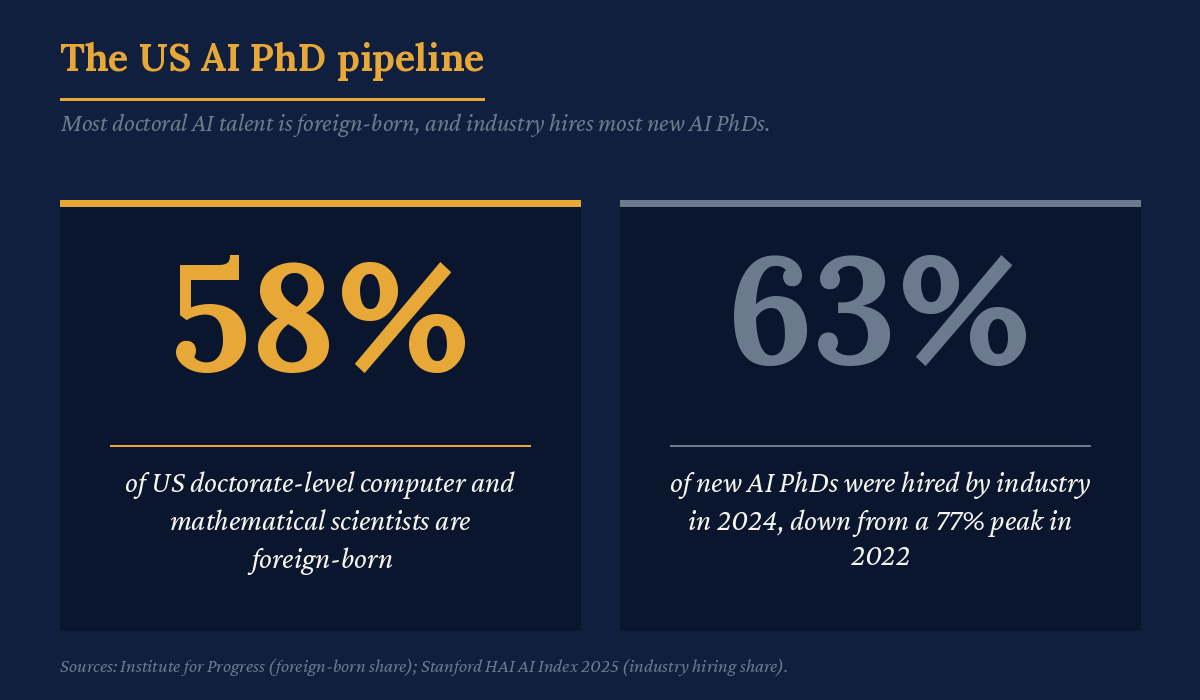
This is where a hiring challenge becomes a workforce problem running head first into geopolitics. Most of that talent is trained from abroad. Around 58 percent of US doctorate-level computer and mathematical scientists are foreign-born, and international students have long made up the majority of new AI PhDs coming out of North American universities. When Stanford’s AI Index reports that the number of new AI PhDs rose 22 percent from 2022 to 2024 and that industry still hires the largest share of them, it is describing a market for people who mostly arrived in the country on a student visa.
India and China are (almost) the whole story
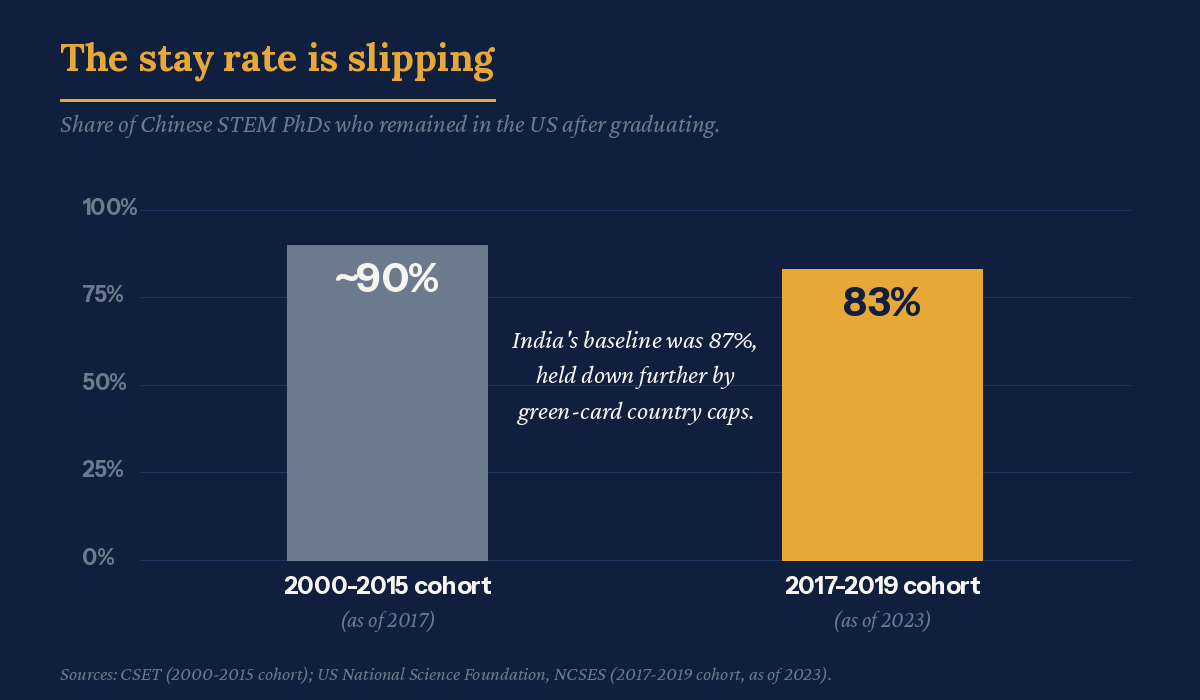
Two countries have supplied more of this talent than anyone else. For the cohort that finished STEM doctorates between 2000 and 2015, roughly 90 percent of Chinese graduates and 87 percent of Indian graduates were still living in the United States years later. That retention has been the engine under American AI. Train them here, and most of them stayed and built here.
That number is falling. National Science Foundation data show that about 83 percent of Chinese science and engineering PhDs from the 2017 to 2019 cohort were still in the country in 2023, down from the earlier peak, and the National Bureau of Economic Research has traced the longer decline to two forces. The first is a green-card queue. Because of per-country caps, Chinese and Indian PhDs wait far longer for permanent residency than anyone else, and the longer the wait, the fewer stay. The second is that their home countries got better at science. When a researcher can do frontier work in Bangalore or Beijing, the pull of Boston weakens. The NBER economists add one more finding: almost everyone who leaves over a visa delay returns home rather than moving to a third country.
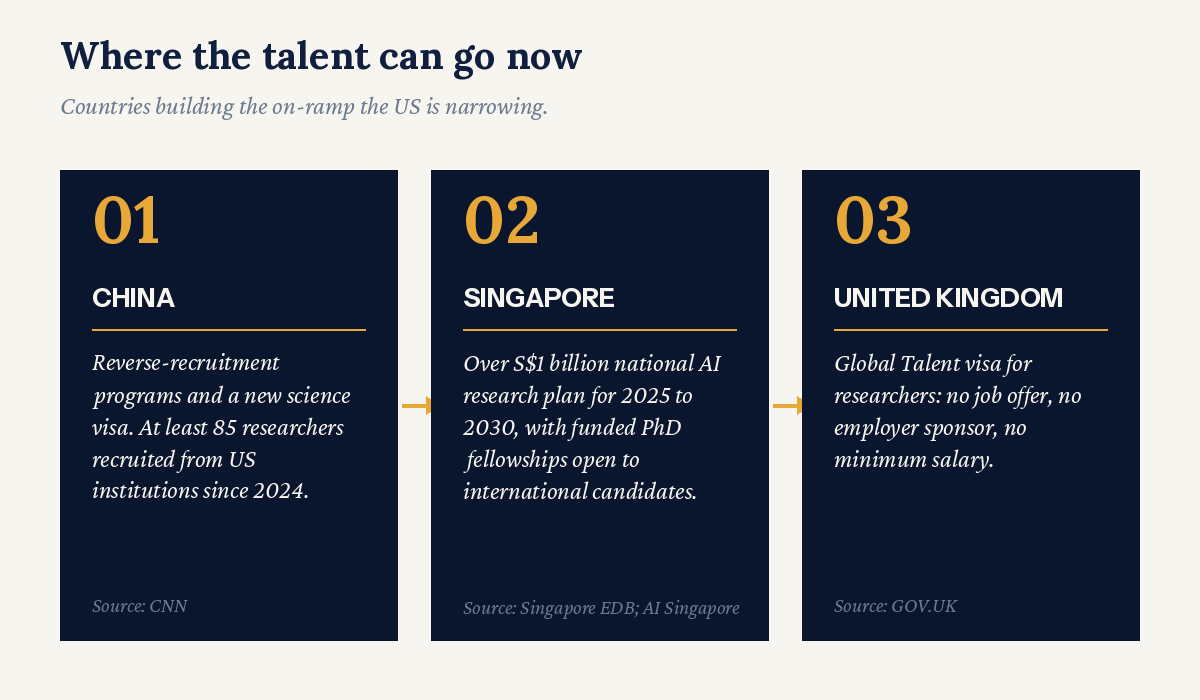
Home is now competing hard. China graduates far more STEM PhDs than the United States, on the order of 77,000 a year against roughly 40,000, and has spent a decade building programs to bring its scientists back. Since 2024 it has recruited at least 85 researchers away from US institutions and opened a new visa aimed at international science graduates. India is moving the same direction with less money and more improvisation. The state of Tamil Nadu launched a plan to recruit its scientists home with globally competitive pay and relocation packages, and the national government is drafting its own scheme. India still lacks the compute and long-horizon funding to match its ambition. The direction of travel is clear anyway.
The countries buying the on-ramp
The scientists who once defaulted to the United States now have destinations that are courting them on purpose. Singapore committed more than S$1 billion to its national AI research plan for 2025 to 2030, with a slice reserved for talent, and pays international doctoral candidates through the AI Singapore PhD Fellowship. The United Kingdom runs a Global Talent visa whose digital technology route names artificial intelligence directly and asks for no job offer, no employer sponsor, and no minimum salary. A newly minted AI PhD can move to London on their own credentials and start working.
Set that against the American offer, where the same researcher faces a capped green-card line measured in years. The model is identical on both sides of that choice. Only the immigration math separates them.
The choices on the US side
The United States is pulling its own levers, and they point in opposite directions. On research funding, the administration’s fiscal 2026 budget request proposed cutting the National Science Foundation by more than half, a reduction Congress did not adopt. The NSF Graduate Research Fellowship, which pays STEM doctoral students, still fell to about 1,000 offers in 2025 from roughly 2,555 in 2023. Then the program was rebuilt with a deliberate tilt: the newest class leaned toward AI and quantum, with 103 awards in AI or machine learning and 53 in quantum, up 17 and 39 percent over the year before. On that lever, the country is steering scarce money toward exactly this talent.
The immigration lever runs the other way. In September 2025 a presidential proclamation added a $100,000 fee to most new H-1B petitions for workers outside the country, the visa a company would use to hire a researcher trained abroad. Stack that on the green-card queue already described, and a newly minted PhD comparing the United States to Singapore hears one thing from the funding and another from the visa line. The country is funding the pipeline and taxing the on-ramp at once.
The same argument, a shorter fuse
Two weeks ago I wrote about cancer research, where AI has compressed the science while the country trains fewer of the scientists who run it. This is that argument again, moved into AI itself, and the fuse here is shorter. A biomedical researcher takes fifteen years to grow. An applied AI researcher takes eight to ten, which sounds faster until you remember the demand for them barely existed a decade ago and now sits at the center of every technology roadmap in the country.
The honest counterargument is that the United States still keeps most of the foreign PhDs it trains, north of 80 percent, so maybe the constraint is pay rather than supply. Money can win a bidding war for the people already here, and that war is loud right now. As the Workforce Rewired Daily Briefing summarized yesterday, Axios reported that OpenAI, Meta, Google, and Anthropic are bidding for the same few thousand researchers at escalating prices, with OpenAI engineers about eight times more likely to jump to Anthropic than the reverse. A bidding war only moves existing researchers between logos. It cannot grow more of them on command, and it cannot reach the student who chose Singapore over Stanford three years earlier and is now somebody else’s hire. Retention is high and inflow is shrinking. You can spend your way to the front of the line, but the line’s length is set by policy, and policy is redrawing it right now, faster than any compensation plan can respond.
Everyone bought the same model, so the model is not the advantage. The advantage is the number of people qualified to interrogate it, and that number runs on two clocks. Training a new researcher is the slow one, close to a decade. The trained people who already exist are the fast one. A green-card queue, a research budget, a competing country’s visa: each redirects them this year. Governments are moving that supply in real time while most companies watch the model launches. The few paying attention are already funding fellowships and building university pipelines.
Here’s how you take action
If you set AI or workforce strategy: Count your real exposure to the international talent pipeline before it surprises you. If a meaningful share of your research and ML hiring comes out of US graduate programs, the enrollment and retention numbers above are your five-year hiring forecast, not background reading.
If you are deciding whether to buy or build a capability: Look past the contract rate to the pipeline cost. Buying a scarce capability on contract is fine until the market you planned to buy from is the one you stopped feeding. For anything doctoral and long-lead, growing your own is slower and more reliable than it looks.
If you fund or lead research partnerships: Treat university fellowships as supply strategy, not public relations. The firms training PhD students today are the ones who will still have candidates to hire in five years.
For everyone watching the AI race: When someone tells you a company is winning because of its model, ask the follow-up question. Who is standing there to understand it, and what is that country doing this year to make sure they stay?
Christina Lexa writes Workforce Rewired, on the intersection of workforce transformation, AI, and global talent.
The views expressed here are my own and do not represent the position of my employer or any organization I am affiliated with.